
用DNA-脂质纳米颗粒对表达转铁蛋白受体的细胞系进行选择性转染。
Selective Transfection of a Transferrin Receptor-Expressing Cell Line with DNA-Lipid Nanoparticles.
作者信息
Vinales Irodiel, Silva-Espinoza Juan Carlos, Medina Bryan A, Urbay Juan E M, Beltran Miguel A, Salinas Dante E, Ramirez-Ramos Marco A, Maldonado Rosa A, Poon Wilson, Penichet Manuel L, Almeida Igor C, Michael Katja
机构信息
Department of Chemistry and Biochemistry, University of Texas at El Paso, El Paso, Texas 79968, United States.
Border Biomedical Research Center, University of Texas at El Paso, El Paso, Texas 79968, United States.
出版信息
ACS Omega. 2024 Sep 15;9(38):39533-39545. doi: 10.1021/acsomega.4c03541. eCollection 2024 Sep 24.
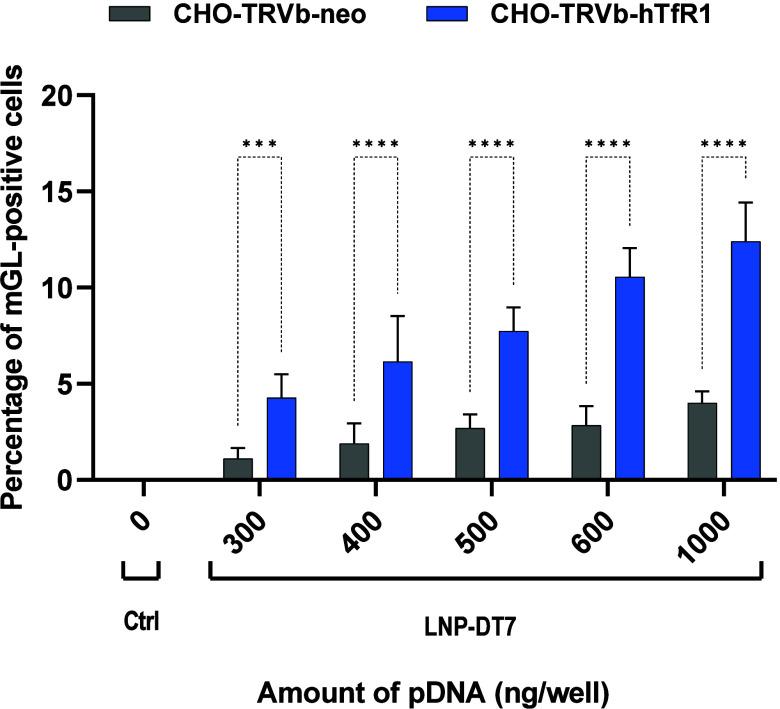
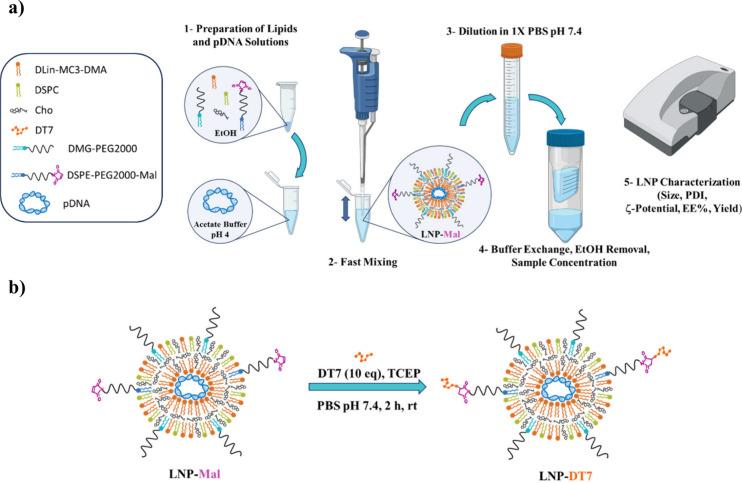
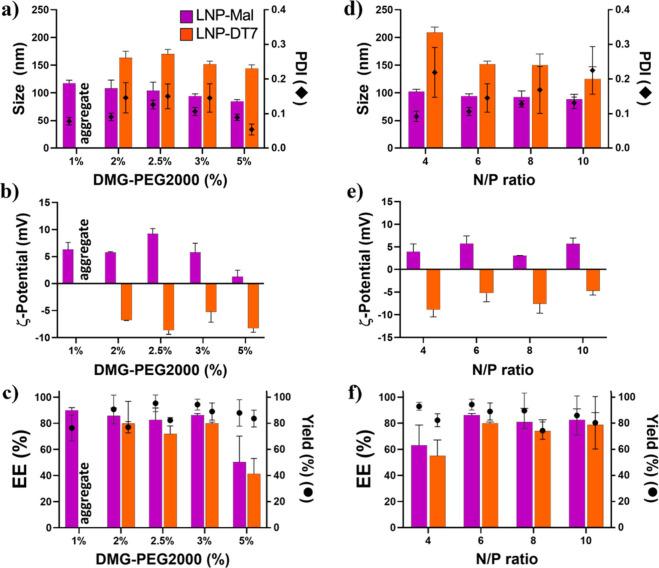
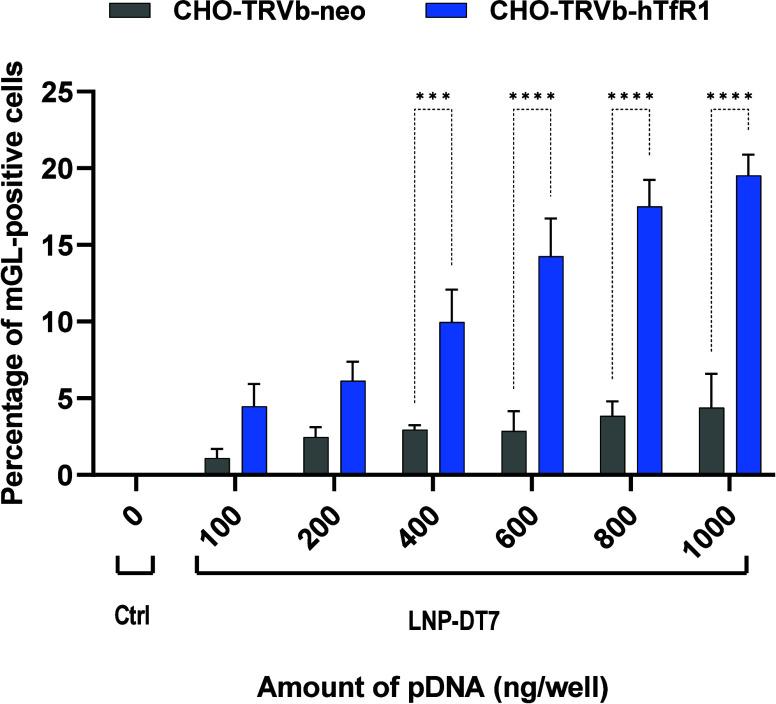
Despite considerable progress in using lipid nanoparticle (LNP) vehicles for gene delivery, achieving selective transfection of specific cell types remains a significant challenge, hindering the advancement of new gene or gene-editing therapies. Although LNPs have been equipped with ligands aimed at targeting specific cellular receptors, achieving complete selectivity continues to be elusive. The exact reasons for this limited selectivity are not fully understood, as cell targeting involves a complex interplay of various cellular factors. Assessing how much ligand/receptor binding contributes to selectivity is challenging due to these additional influencing factors. Nonetheless, such data are important for developing new nanocarriers and setting realistic expectations for selectivity. Here, we have quantified the selective, targeted transfection using two uniquely engineered cell lines that eliminate unpredictable and interfering cellular influences. We have compared the targeted transfection of Chinese ovary hamster (CHO) cells engineered to express the human transferrin receptor 1 (hTfR1), CHO-TRVb-hTfR1, with CHO cells that completely lack any transferrin receptor, CHO-TRVb-neo cells (negative control). Thus, the two cell lines differ only in the presence/absence of hTfR1. The transfection was performed with pDNA-encapsulating LNPs equipped with the DT7 peptide ligand that specifically binds to hTfR1 and enables targeted transfection. The LNP's pDNA encoded for the monomeric GreenLantern (mGL) reporter protein, whose fluorescence was used to quantify transfection. We report a novel LNP composition designed to achieve an optimal particle size and ζ-potential, efficient pDNA encapsulation, hTfR1-targeting capability, and sufficient polyethylene glycol sheltering to minimize random cell targeting. The transfection efficiency was quantified in both cell lines separately through flow cytometry based on the expression of the fluorescent gene product. Our results demonstrated an LNP dose-dependent mGL expression, with a 5-fold preference for the CHO-TRVb-hTfR1 when compared to CHO-TRVb-neo. In another experiment, when both cell lines were mixed at a 1:1 ratio, the DT7-decorated LNP achieved a 3-fold higher transfection of the CHO-TRVb-hTfR1 over the CHO-TRVb-neo cells. Based on the low-level transfection of the CHO-TRVb-neo cells in both experiments, our results suggest that 17-25% of the transfection occurred in a nonspecific manner. The observed transfection selectivity for the CHO-TRVb-hTfR1 cells was based entirely on the hTfR1/DT7 interaction. This work showed that the platform of two engineered cell lines which differ only in the hTfR1 can greatly facilitate the development of LNPs with hTfR1-targeting ligands.
尽管在使用脂质纳米颗粒(LNP)载体进行基因递送方面取得了显著进展,但实现特定细胞类型的选择性转染仍然是一项重大挑战,阻碍了新基因或基因编辑疗法的发展。尽管LNP已配备旨在靶向特定细胞受体的配体,但实现完全选择性仍然难以捉摸。由于细胞靶向涉及多种细胞因子的复杂相互作用,这种有限选择性的确切原因尚未完全了解。由于这些额外的影响因素,评估配体/受体结合对选择性的贡献程度具有挑战性。尽管如此,这些数据对于开发新的纳米载体和设定对选择性的现实期望非常重要。在这里,我们使用两种独特设计的细胞系对选择性靶向转染进行了量化,这两种细胞系消除了不可预测和干扰性的细胞影响。我们将工程改造为表达人转铁蛋白受体1(hTfR1)的中国仓鼠卵巢(CHO)细胞(CHO-TRVb-hTfR1)与完全缺乏任何转铁蛋白受体的CHO细胞(CHO-TRVb-neo细胞,阴性对照)的靶向转染进行了比较。因此,这两种细胞系仅在是否存在hTfR1方面有所不同。转染是使用封装有pDNA的LNP进行的,该LNP配备了与hTfR1特异性结合并实现靶向转染的DT7肽配体。LNP的pDNA编码单体绿色荧光蛋白(mGL)报告蛋白,其荧光用于量化转染。我们报告了一种新型LNP组合物,旨在实现最佳粒径和ζ电位、高效的pDNA封装、hTfR1靶向能力以及足够的聚乙二醇保护,以最大限度地减少随机细胞靶向。通过基于荧光基因产物表达的流式细胞术分别对两种细胞系中的转染效率进行了量化。我们的结果表明mGL表达呈LNP剂量依赖性,与CHO-TRVb-neo相比,CHO-TRVb-hTfR1的偏好性高5倍。在另一项实验中,当将两种细胞系以1:1的比例混合时,用DT7修饰的LNP对CHO-TRVb-hTfR1的转染比对CHO-TRVb-neo细胞高3倍。基于两项实验中CHO-TRVb-neo细胞的低水平转染,我们的结果表明17%-25%的转染以非特异性方式发生。观察到的对CHO-TRVb-hTfR1细胞的转染选择性完全基于hTfR1/DT7相互作用。这项工作表明,仅在hTfR1方面存在差异的两种工程细胞系平台可以极大地促进具有hTfR1靶向配体的LNP的开发。

 Zotero 插件