
脂肪酸合酶(FASN)是一种限制T细胞免疫的肿瘤细胞内在代谢检查点。
Fatty acid synthase (FASN) is a tumor-cell-intrinsic metabolic checkpoint restricting T-cell immunity.
作者信息
Cuyàs Elisabet, Pedarra Stefano, Verdura Sara, Pardo Miguel Angel, Espin Garcia Roderic, Serrano-Hervás Eila, Llop-Hernández Àngela, Teixidor Eduard, Bosch-Barrera Joaquim, López-Bonet Eugeni, Martin-Castillo Begoña, Lupu Ruth, Pujana Miguel Angel, Sardanyès Josep, Alarcón Tomás, Menendez Javier A
机构信息
Program Against Cancer Therapeutic Resistance (ProCURE), Catalan Institute of Oncology, 17007, Girona, Spain.
Metabolism and Cancer Group, Girona Biomedical Research Institute (IDIBGI), 17190, Girona, Spain.
出版信息
Cell Death Discov. 2024 Sep 30;10(1):417. doi: 10.1038/s41420-024-02184-z.
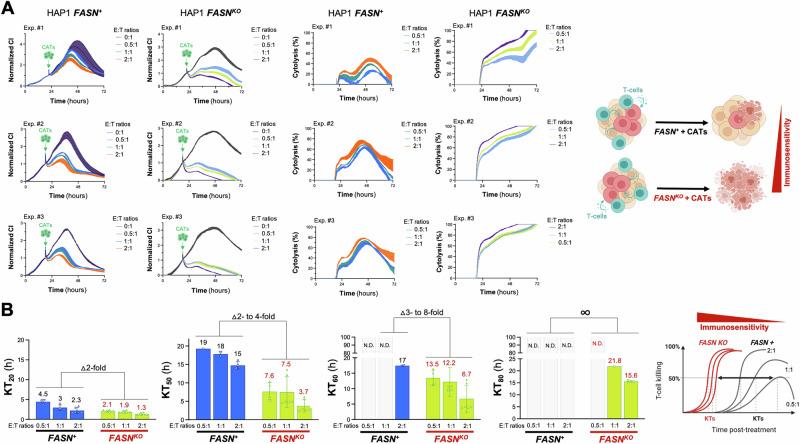
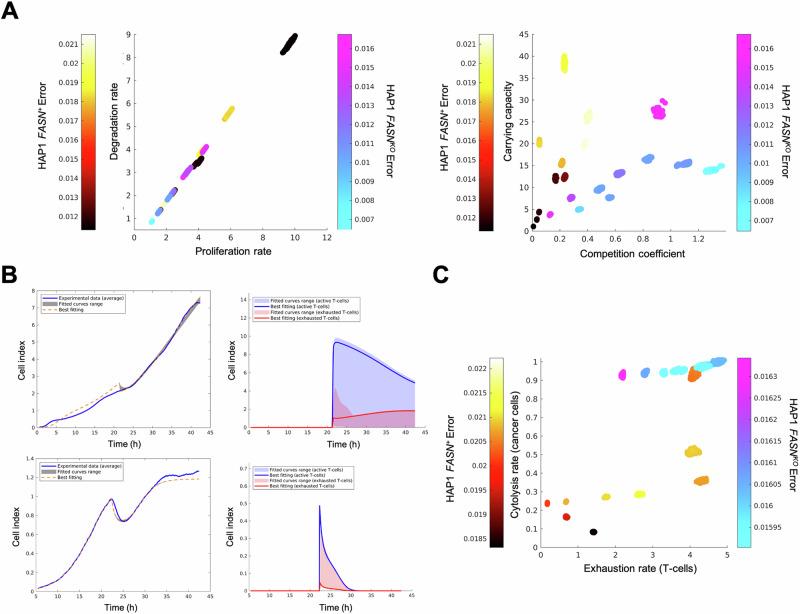
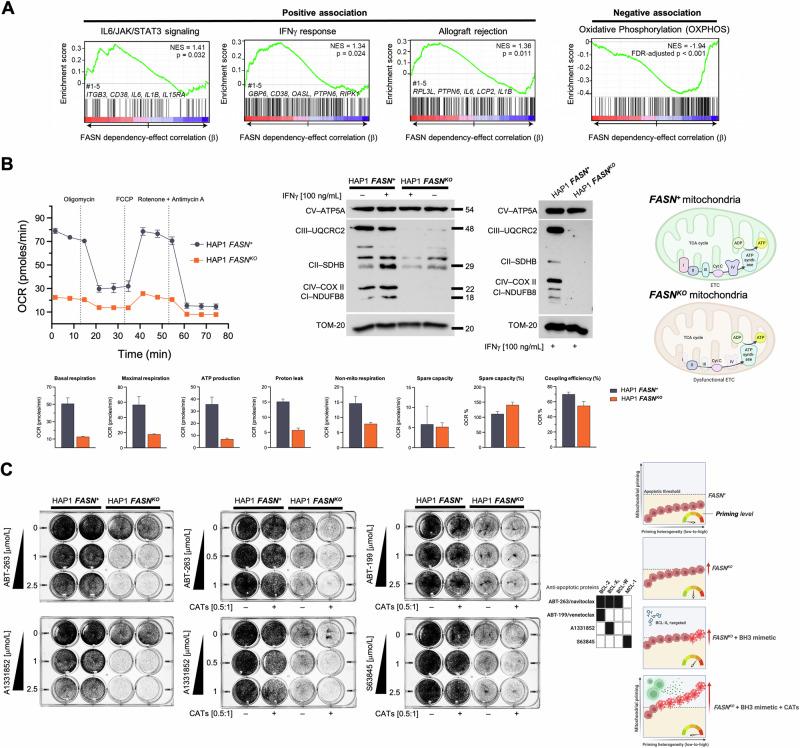
Fatty acid synthase (FASN)-catalyzed endogenous lipogenesis is a hallmark of cancer metabolism. However, whether FASN is an intrinsic mechanism of tumor cell defense against T cell immunity remains unexplored. To test this hypothesis, here we combined bioinformatic analysis of the FASN-related immune cell landscape, real-time assessment of cell-based immunotherapy efficacy in CRISPR/Cas9-based FASN gene knockout (FASN KO) cell models, and mathematical and mechanistic evaluation of FASN-driven immunoresistance. FASN expression negatively correlates with infiltrating immune cells associated with cancer suppression, cytolytic activity signatures, and HLA-I expression. Cancer cells engineered to carry a loss-of-function mutation in FASN exhibit an enhanced cytolytic response and an accelerated extinction kinetics upon interaction with cytokine-activated T cells. Depletion of FASN results in reduced carrying capacity, accompanied by the suppression of mitochondrial OXPHOS and strong downregulation of electron transport chain complexes. Targeted FASN depletion primes cancer cells for mitochondrial apoptosis as it synergizes with BCL-2/BCL-X-targeting BH3 mimetics to render cancer cells more susceptible to T-cell-mediated killing. FASN depletion prevents adaptive induction of PD-L1 in response to interferon-gamma and reduces constitutive overexpression of PD-L1 by abolishing PD-L1 post-translational palmitoylation. FASN is a novel tumor cell-intrinsic metabolic checkpoint that restricts T cell immunity and may be exploited to improve the efficacy of T cell-based immunotherapy.
脂肪酸合酶(FASN)催化的内源性脂肪生成是癌症代谢的一个标志。然而,FASN是否是肿瘤细胞抵御T细胞免疫的内在机制仍未得到探索。为了验证这一假设,我们在此结合了对FASN相关免疫细胞格局的生物信息学分析、基于CRISPR/Cas9的FASN基因敲除(FASN KO)细胞模型中基于细胞的免疫治疗疗效的实时评估,以及对FASN驱动的免疫抗性的数学和机制评估。FASN表达与与癌症抑制、细胞溶解活性特征和HLA-I表达相关的浸润免疫细胞呈负相关。经基因工程改造在FASN中携带功能丧失突变的癌细胞在与细胞因子激活的T细胞相互作用时表现出增强的细胞溶解反应和加速的消亡动力学。FASN的缺失导致承载能力降低,同时伴随着线粒体氧化磷酸化的抑制和电子传递链复合物的强烈下调。靶向FASN缺失使癌细胞易于发生线粒体凋亡,因为它与靶向BCL-2/BCL-X的BH3模拟物协同作用,使癌细胞更容易受到T细胞介导的杀伤。FASN缺失可防止癌细胞因干扰素-γ而适应性诱导PD-L1,并通过消除PD-L1的翻译后棕榈酰化来降低PD-L1的组成性过表达。FASN是一种新型的肿瘤细胞内在代谢检查点,它限制T细胞免疫,可被利用来提高基于T细胞的免疫治疗的疗效。



 Zotero 插件