
用于区分 SARS-CoV-2 刺突蛋白-ACE2 分子动力学模拟中非平凡构象变化的深度学习。
Deep learning for discriminating non-trivial conformational changes in molecular dynamics simulations of SARS-CoV-2 spike-ACE2.
机构信息
Department of Computer Science, Federal University of Minas Gerais, Belo Horizonte, Minas Gerais, Brazil.
Department of Chemistry, Federal University of Paraíba, João Pessoa, Paraíba, Brazil.
出版信息
Sci Rep. 2024 Sep 30;14(1):22639. doi: 10.1038/s41598-024-72842-w.
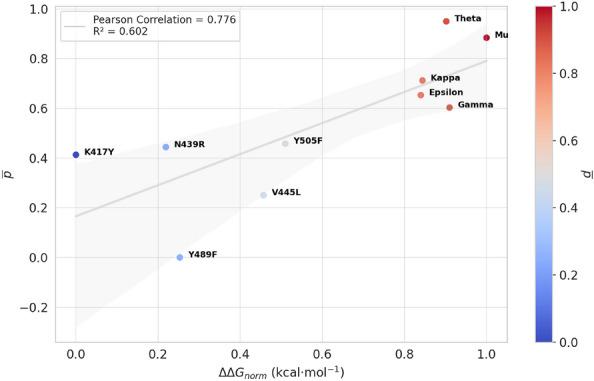
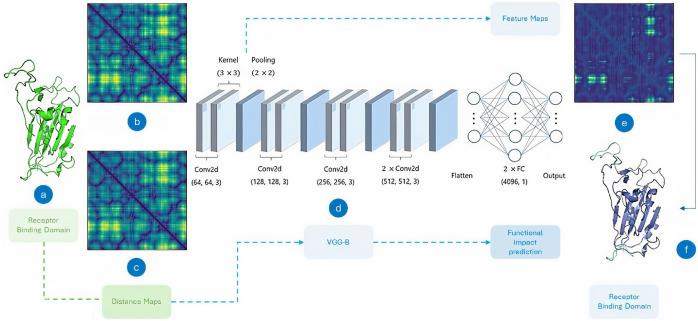
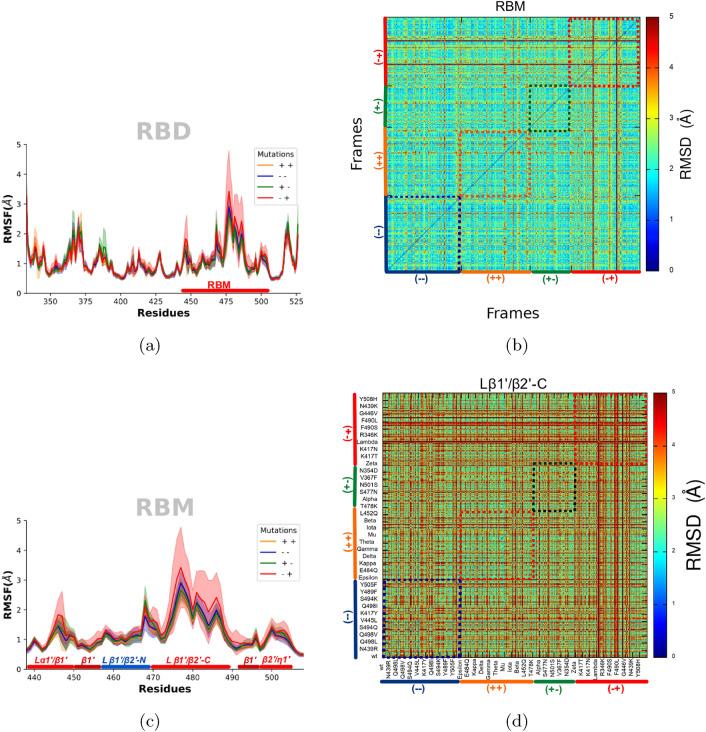
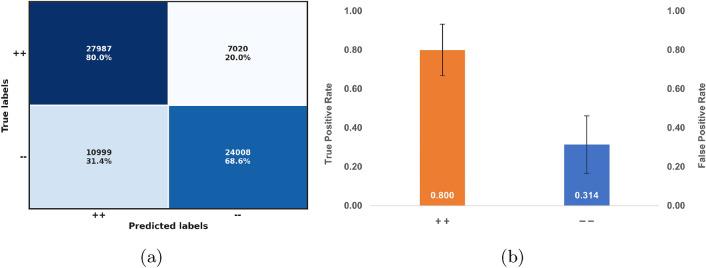
Molecular dynamics (MD) simulations produce a substantial volume of high-dimensional data, and traditional methods for analyzing these data pose significant computational demands. Advances in MD simulation analysis combined with deep learning-based approaches have led to the understanding of specific structural changes observed in MD trajectories, including those induced by mutations. In this study, we model the trajectories resulting from MD simulations of the SARS-CoV-2 spike protein-ACE2, specifically the receptor-binding domain (RBD), as interresidue distance maps, and use deep convolutional neural networks to predict the functional impact of point mutations, related to the virus's infectivity and immunogenicity. Our model was successful in predicting mutant types that increase the affinity of the S protein for human receptors and reduce its immunogenicity, both based on MD trajectories (precision = 0.718; recall = 0.800; [Formula: see text] = 0.757; MCC = 0.488; AUC = 0.800) and their centroids. In an additional analysis, we also obtained a strong positive Pearson's correlation coefficient equal to 0.776, indicating a significant relationship between the average sigmoid probability for the MD trajectories and binding free energy (BFE) changes. Furthermore, we obtained a coefficient of determination of 0.602. Our 2D-RMSD analysis also corroborated predictions for more infectious and immune-evading mutants and revealed fluctuating regions within the receptor-binding motif (RBM), especially in the [Formula: see text] loop. This region presented a significant standard deviation for mutations that enable SARS-CoV-2 to evade the immune response, with RMSD values of 5Å in the simulation. This methodology offers an efficient alternative to identify potential strains of SARS-CoV-2, which may be potentially linked to more infectious and immune-evading mutations. Using clustering and deep learning techniques, our approach leverages information from the ensemble of MD trajectories to recognize a broad spectrum of multiple conformational patterns characteristic of mutant types. This represents a strategic advantage in identifying emerging variants, bypassing the need for long MD simulations. Furthermore, the present work tends to contribute substantially to the field of computational biology and virology, particularly to accelerate the design and optimization of new therapeutic agents and vaccines, offering a proactive stance against the constantly evolving threat of COVID-19 and potential future pandemics.
分子动力学 (MD) 模拟产生了大量的高维数据,而传统的数据分析方法需要大量的计算资源。MD 模拟分析的进展与基于深度学习的方法相结合,使得我们能够理解 MD 轨迹中观察到的特定结构变化,包括突变引起的结构变化。在这项研究中,我们将 SARS-CoV-2 刺突蛋白-ACE2(特别是受体结合域 [RBD])的 MD 模拟轨迹建模为残基间距离图,并使用深度卷积神经网络来预测与病毒感染力和免疫原性相关的点突变的功能影响。我们的模型成功地预测了增加 S 蛋白与人受体亲和力并降低其免疫原性的突变类型,这两种类型的预测都是基于 MD 轨迹(精确率 = 0.718;召回率 = 0.800;[Formula: see text] = 0.757;MCC = 0.488;AUC = 0.800)及其质心。在进一步的分析中,我们还获得了一个很强的正皮尔逊相关系数,等于 0.776,这表明 MD 轨迹的平均 sigmoid 概率与结合自由能 (BFE) 变化之间存在显著的关系。此外,我们还获得了 0.602 的决定系数。我们的 2D-RMSD 分析也证实了更具感染力和免疫逃避突变体的预测,并揭示了受体结合基序(RBM)内的波动区域,特别是在 [Formula: see text] 环。该区域的突变导致 SARS-CoV-2 逃避免疫反应,模拟中 RMSD 值为 5Å,这表明该区域的标准偏差很大。这种方法为识别可能具有更强感染力和免疫逃避能力的 SARS-CoV-2 菌株提供了一种有效的替代方法。使用聚类和深度学习技术,我们的方法利用 MD 轨迹的集合信息来识别广泛的多种构象模式,这些模式是突变体类型的特征。这在识别新兴变体方面具有战略优势,避免了对长 MD 模拟的需求。此外,这项工作对计算生物学和病毒学领域做出了重要贡献,特别是有助于加速新治疗剂和疫苗的设计和优化,从而对 COVID-19 和潜在未来大流行带来的持续不断的威胁采取积极主动的立场。
 Zotero 插件