
重新审视柬埔寨十年来医疗保健财务负担不平等状况,2009-19 年:趋势、决定因素和分解。
Revisiting a decade of inequality in healthcare financial burden in Cambodia, 2009-19: trends, determinants and decomposition.
机构信息
Department of Health Care Management, University of Greifswald, Greifswald, Germany.
SOCIEUX+ EU Expertise on Social Protection, Labour and Employment, Brussels, Belgium.
出版信息
Int J Equity Health. 2024 Sep 30;23(1):196. doi: 10.1186/s12939-024-02257-6.
BACKGROUND
Out-of-pocket healthcare expenditure (OOPHE) without adequate social protection often translates to inequitable financial burden and utilization of services. Recent publications highlighted Cambodia's progress towards Universal Health Coverage (UHC) with reduced incidence of catastrophic health expenditure (CHE) and improvements in its distribution. However, departing from standard CHE measurement methods suggests a different storyline on trends and inequality in the country.
OBJECTIVE
This study revisits the distribution and impact of OOPHE and its financial burden from 2009-19, employing alternative socio-economic and economic shock metrics. It also identifies determinants of the financial burden and evaluates inequality-contributing and -mitigating factors from 2014-19, including coping mechanisms, free healthcare, and OOPHE financing sources.
METHODS
Data from the Cambodian Socio-Economic Surveys of 2009, 2014, and 2019 were utilized. An alternative measure to CHE is proposed: Excessive financial burden (EFB). A household was considered under EFB when its OOPHE surpassed 10% or 25% of total consumption, excluding healthcare costs. A polychoric wealth index was used to rank households and measure EFB inequality using the Erreygers Concentration Index. Inequality shifts from 2014-19 were decomposed using the Recentered Influence Function regression followed by the Oaxaca-Blinder method. Determinants of financial burden levels were assessed through zero-inflated ordered logit regression.
RESULTS
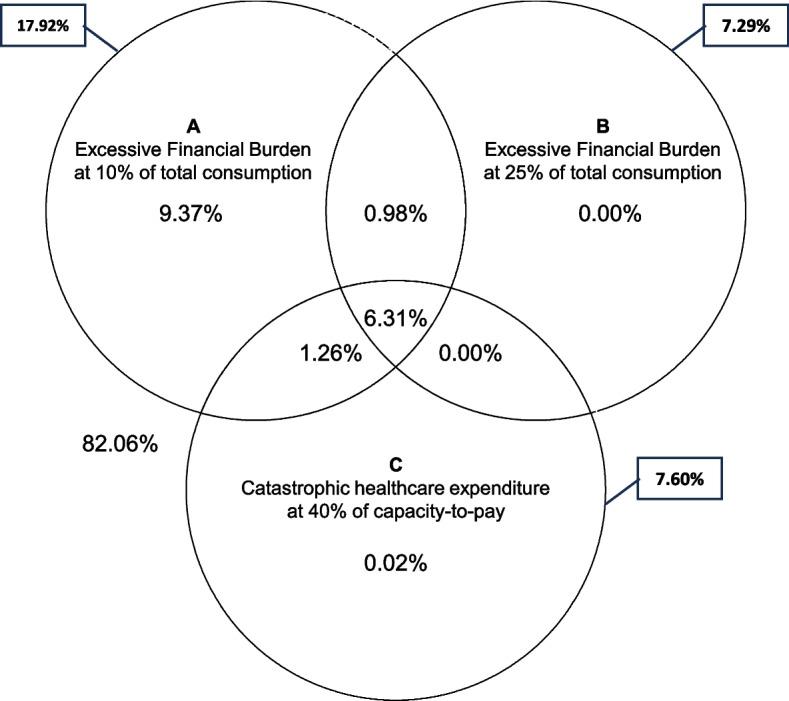
Between 2009-19, EFB incidence increased from 10.95% to 17.92% at the 10% threshold, and from 4.41% to 7.29% at the 25% threshold. EFB was systematically concentrated among the poorest households, with inequality sharply rising over time, and nearly a quarter of the poorest households facing EFB at the 10% threshold. The main determinants of financial burden were geographic location, household size, age and education of household head, social health protection coverage, disease prevalence, hospitalization, and coping strategies. Urbanization, biased disease burdens, and preventive care were key in explaining the evolution of inequality.
CONCLUSION
More efforts are needed to expand social protection, but monitoring those through standard measures such as CHE has masked inequality and the burden of the poor. The financial burden across the population has risen and become more unequal over the past decade despite expansion and improvements in social health protection schemes. Health Equity funds have, to some extent, mitigated inequality over time. However, their slow expansion and the reduced reliance on coping strategies to finance OOPHE could not outbalance inequality.
背景
缺乏充分社会保护的医疗保健自付费用(OOPHE)往往会导致不公平的财务负担和服务利用不平等。最近的出版物强调了柬埔寨在全民健康覆盖(UHC)方面取得的进展,降低了灾难性医疗支出(CHE)的发生率,并改善了其分配情况。然而,偏离 CHE 的标准衡量方法表明,该国在趋势和不平等方面存在不同的情况。
目的
本研究通过采用替代社会经济和经济冲击指标,重新审视 2009 年至 2019 年 OOPHE 的分布和影响及其财务负担。它还确定了财务负担的决定因素,并评估了 2014 年至 2019 年期间的不平等贡献和缓解因素,包括应对机制、免费医疗保健和 OOPHE 融资来源。
方法
利用 2009 年、2014 年和 2019 年柬埔寨社会经济调查的数据。提出了 CHE 的替代衡量标准:过度财务负担(EFB)。当家庭的 OOPHE 超过总消费的 10%或 25%(不包括医疗保健费用)时,就认为该家庭处于 EFB 状态。使用多质心财富指数对家庭进行排名,并使用 Erreygers 集中指数衡量 EFB 不平等。使用重新中心化影响函数回归和 Oaxaca-Blinder 方法对 2014 年至 2019 年的不平等情况进行分解。通过零膨胀有序逻辑回归评估财务负担水平的决定因素。
结果
2009 年至 2019 年间,在 10%的阈值下,EFB 的发生率从 10.95%上升到 17.92%,在 25%的阈值下,从 4.41%上升到 7.29%。EFB 系统地集中在最贫困的家庭中,不平等程度随着时间的推移急剧上升,近四分之一最贫困的家庭在 10%的阈值下面临 EFB。财务负担的主要决定因素是地理位置、家庭规模、家庭户主的年龄和教育程度、社会健康保护覆盖范围、疾病流行率、住院治疗和应对策略。城市化、偏向性疾病负担和预防保健是解释不平等演变的关键因素。
结论
尽管社会健康保护计划有所扩大和改善,但仍需要加大努力扩大社会保护,但通过 CHE 等标准措施监测这些措施掩盖了不平等和贫困人口的负担。尽管社会健康保护计划有所扩大和改善,但过去十年,人口的财务负担有所增加,且更加不平等。健康公平基金在一定程度上随着时间的推移缓解了不平等。然而,其缓慢的扩张和对利用应对策略为 OOPHE 融资的依赖程度降低,无法平衡不平等。




 Zotero 插件