
通过整合人血浆蛋白质组学,鉴定乳腺癌的新型生物标志物和潜在治疗靶点:孟德尔随机化研究和共定位分析。
Identifying new biomarkers and potential therapeutic targets for breast cancer through the integration of human plasma proteomics: a Mendelian randomization study and colocalization analysis.
机构信息
Department of Breast Surgery, Guangxi Medical University Cancer Hospital, Nanning, China.
Department of Breast and Thyroid Surgery, Affiliated Hospital of Guilin Medical University, Guilin, China.
出版信息
Front Endocrinol (Lausanne). 2024 Sep 16;15:1449668. doi: 10.3389/fendo.2024.1449668. eCollection 2024.
BACKGROUND
The proteome is a crucial reservoir of targets for cancer treatment. While some targeted therapies have been developed, there are still significant challenges in early diagnosis and treatment, highlighting the need to identify new biomarkers and therapeutic targets for breast cancer. Therefore, we conducted a comprehensive proteome-wide Mendelian randomization (MR) study to identify novel biomarkers and potential therapeutic targets for breast cancer.
METHODS
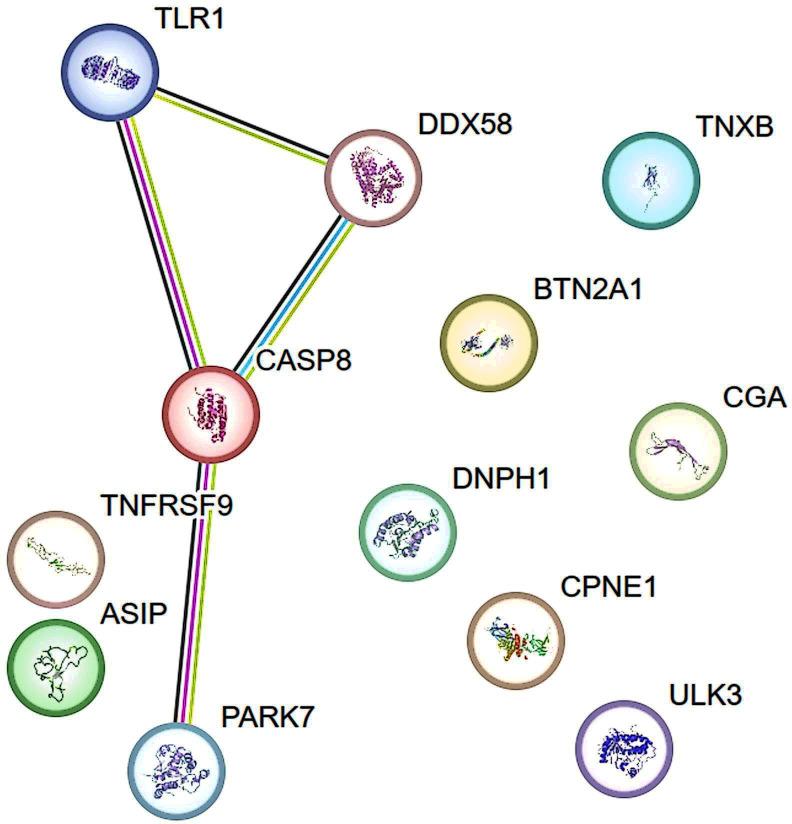
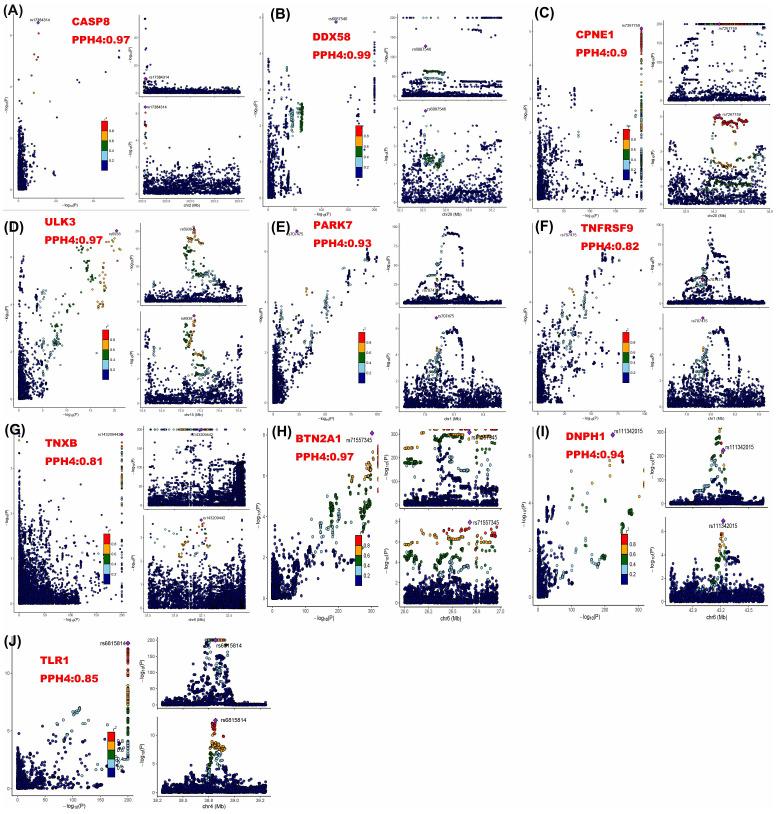
Protein quantitative trait locus (pQTL) data were extracted from two published plasma proteome-wide association studies. Genetic variants associated with breast cancer were obtained from the Breast Cancer Association Consortium, which included 133,384 cases and 113,789 controls, and the Finnish cohort study, comprising 18,786 cases and 182,927 controls. We employed summary-based MR and colocalization methods to identify potential drug targets for breast cancer, which were subsequently validated using a two-sample MR approach. Finally, a protein-protein interaction (PPI) network was constructed to detect interactions between the identified proteins and existing cancer drug targets.
RESULTS
Gene-predicted levels of ten proteins were associated with breast cancer risk. Decreased levels of CASP8, DDX58, CPNE1, ULK3, PARK7, and BTN2A1, as well as increased levels of TNFRSF9, TNXB, DNPH1, and TLR1, were linked to an elevated risk of breast cancer. Among these, CASP8 and DDX58 were supported by tier-one evidence, while CPNE1, ULK3, PARK7, and TNFRSF9 received tier-two evidence support. The remaining proteins, TNXB, BTN2A1, DNPH1, and TLR1, were supported by tier-three evidence. CASP8, DDX58, CPNE1, ULK3, PARK7, and TNFRSF9 have already been identified as targets in drug development and potential therapeutic targets for breast cancer treatment. Additionally, ULK3 showed promise as a prognostic biomarker for breast cancer.
CONCLUSIONS
The present study identified several novel potential drug targets and biomarkers for breast cancer, providing new insights into its diagnosis and treatment. The integration of PPI and druggability evaluations enhances the prioritization of these therapeutic targets, paving the way for future drug development efforts.
背景
蛋白质组是癌症治疗的重要靶点库。虽然已经开发出一些靶向疗法,但在早期诊断和治疗方面仍存在重大挑战,这突显了需要为乳腺癌确定新的生物标志物和治疗靶点的必要性。因此,我们进行了一项全面的蛋白质组范围内孟德尔随机化(MR)研究,以确定乳腺癌的新生物标志物和潜在治疗靶点。
方法
从两项已发表的血浆蛋白质组关联研究中提取蛋白质定量性状基因座(pQTL)数据。从乳腺癌协会联盟(BCAC)获得与乳腺癌相关的遗传变异,该联盟包括 133384 例病例和 113789 例对照,以及芬兰队列研究,包括 18786 例病例和 182927 例对照。我们采用基于汇总的 MR 和共定位方法来识别乳腺癌的潜在药物靶点,随后使用两样本 MR 方法进行验证。最后,构建蛋白质-蛋白质相互作用(PPI)网络,以检测鉴定出的蛋白质与现有癌症药物靶点之间的相互作用。
结果
十种蛋白质的基因预测水平与乳腺癌风险相关。CASP8、DDX58、CPNE1、ULK3、PARK7 和 BTN2A1 的水平降低,以及 TNFRSF9、TNXB、DNPH1 和 TLR1 的水平升高,与乳腺癌风险增加有关。其中,CASP8 和 DDX58 得到了一级证据的支持,而 CPNE1、ULK3、PARK7 和 TNFRSF9 则得到了二级证据的支持。其余的蛋白质,TNXB、BTN2A1、DNPH1 和 TLR1,则得到了三级证据的支持。CASP8、DDX58、CPNE1、ULK3、PARK7 和 TNFRSF9 已经被确定为药物开发的靶点,也是乳腺癌治疗的潜在治疗靶点。此外,ULK3 有望成为乳腺癌的预后生物标志物。
结论
本研究确定了几种新的潜在药物靶点和乳腺癌生物标志物,为其诊断和治疗提供了新的见解。PPI 和可药性评估的整合增强了这些治疗靶点的优先级,为未来的药物开发工作铺平了道路。


 Zotero 插件