
粘性科学:将复合凝聚层粘合剂用于生物医学应用
Sticky Science: Using Complex Coacervate Adhesives for Biomedical Applications.
作者信息
Kwant Ayla N, Es Sayed Julien S, Kamperman Marleen, Burgess Janette K, Slebos Dirk-Jan, Pouwels Simon D
机构信息
Department of Pulmonary Diseases, University Medical Center Groningen, Hanzeplein 1, Groningen, 9713GZ, The Netherlands.
Polymer Science, Zernike Institute for Advanced Materials (ZIAM), University of Groningen, Nijenborgh 3, Groningen, 9747AG, The Netherlands.
出版信息
Adv Healthc Mater. 2025 Jan;14(2):e2402340. doi: 10.1002/adhm.202402340. Epub 2024 Oct 1.
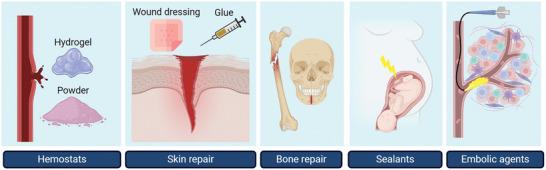
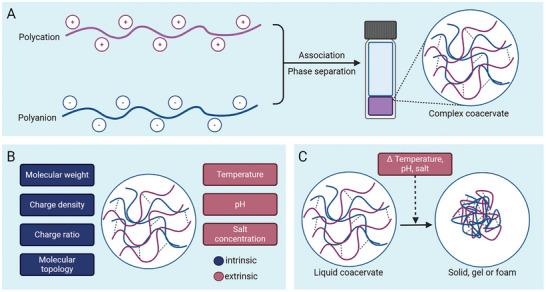
Tissue adhesives are used for various medical applications, including wound closure, bleeding control, and bone healing. Currently available options often show weak adhesion or cause adverse effects. Recently, there has been an increasing interest in complex coacervates as medical adhesives. Complex coacervates are formed by mixing oppositely charged macromolecules that associate and undergo liquid-liquid phase separation, in which the dense bottom phase is the complex coacervate. Complex coacervates are strong and often biocompatible, and show strong underwater adhesion. The properties of the resulting materials are tunable by intrinsic factors such as polymer chemistry, molecular weight, charge density, and topology of the macromolecules, as well as extrinsic factors such as temperature, pH, and salt concentration. Therefore, complex coacervates are interesting new candidates for medical adhesives. In this review, it is described how complex coacervates form and how different factors influence their behavior. Next, an overview of recent studies on complex coacervates in the context of medical adhesives is presented. The application of complex coacervates as hemostatic or embolic agents, skin or bone repair adhesives, and soft tissue sealants is discussed. Lastly, additional possibilities for utilizing these materials in the future are discussed.
组织粘合剂用于多种医学应用,包括伤口闭合、止血和骨愈合。目前可用的选择通常显示出较弱的粘附力或会引起不良反应。最近,作为医学粘合剂的复合凝聚层越来越受到关注。复合凝聚层是通过将带相反电荷的大分子混合形成的,这些大分子相互结合并经历液-液相分离,其中致密的底部相就是复合凝聚层。复合凝聚层粘性强,通常具有生物相容性,并表现出很强的水下粘附力。所得材料的性能可通过诸如聚合物化学、分子量、电荷密度和大分子拓扑结构等内在因素,以及诸如温度、pH值和盐浓度等外在因素进行调节。因此,复合凝聚层是医学粘合剂中令人感兴趣的新候选材料。在这篇综述中,将描述复合凝聚层如何形成以及不同因素如何影响其行为。接下来,将概述在医学粘合剂背景下关于复合凝聚层的近期研究。讨论了复合凝聚层作为止血或栓塞剂、皮肤或骨修复粘合剂以及软组织密封剂的应用。最后,探讨了未来利用这些材料的其他可能性。

 Zotero 插件