
解锁骨肉瘤的肿瘤免疫微环境:对免疫景观和机制的深入了解。
Unlocking the tumor-immune microenvironment in osteosarcoma: insights into the immune landscape and mechanisms.
机构信息
Center of Multidisciplinary Technology for Advanced Medicine (CMUTEAM), Faculty of Medicine, Chiang Mai University, Chiang Mai, Thailand.
Office of Research Administration, Chiang Mai University, Chiang Mai, Thailand.
出版信息
Front Immunol. 2024 Sep 18;15:1394284. doi: 10.3389/fimmu.2024.1394284. eCollection 2024.
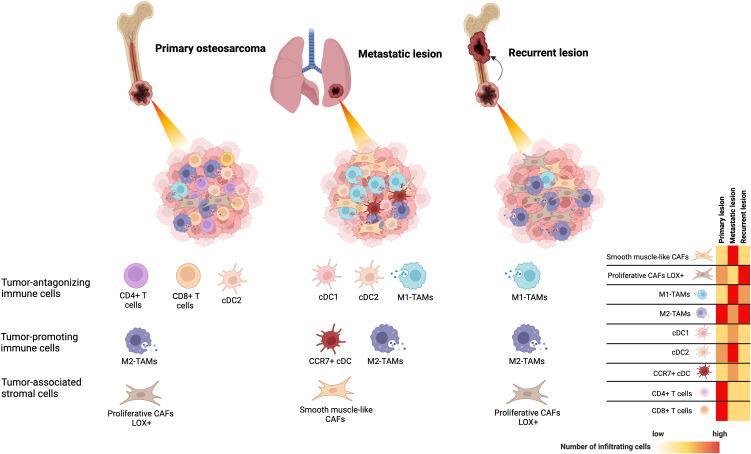
Osteosarcoma has a unique tumor microenvironment (TME), which is characterized as a complex microenvironment comprising of bone cells, immune cells, stromal cells, and heterogeneous vascular structures. These elements are intricately embedded in a mineralized extracellular matrix, setting it apart from other primary TMEs. In a state of normal physiological function, these cell types collaborate in a coordinated manner to maintain the homeostasis of the bone and hematopoietic systems. However, in the pathological condition, i.e., neoplastic malignancies, the tumor-immune microenvironment (TIME) has been shown to promote cancer cells proliferation, migration, apoptosis and drug resistance, as well as immune escape. The intricate and dynamic system of the TIME in osteosarcoma involves crucial roles played by various infiltrating cells, the complement system, and exosomes. This complexity is closely associated with tumor cells evading immune surveillance, experiencing uncontrolled proliferation, and facilitating metastasis. In this review, we elucidate the intricate interplay between diverse cell populations in the osteosarcoma TIME, each contributing uniquely to tumor progression. From chondroblastic and osteoblastic osteosarcoma cells to osteoclasts, stromal cells, and various myeloid and lymphoid cell subsets, the comprehensive single-cell analysis provides a detailed roadmap of the complex osteosarcoma ecosystem. Furthermore, we summarize the mutations, epigenetic mechanisms, and extracellular vesicles that dictate the immunologic landscape and modulate the TIME of osteosarcoma. The perspectives of the clinical implementation of immunotherapy and therapeutic approaches for targeting immune cells are also intensively discussed.
骨肉瘤具有独特的肿瘤微环境(TME),其特征是一种复杂的微环境,包含骨细胞、免疫细胞、基质细胞和异质血管结构。这些元素错综复杂地嵌入矿化细胞外基质中,使其有别于其他原发性 TME。在正常生理功能状态下,这些细胞类型协同工作,以维持骨骼和造血系统的稳态。然而,在病理条件下,即恶性肿瘤中,肿瘤免疫微环境(TIME)已被证明可促进癌细胞增殖、迁移、凋亡和耐药性,并促进免疫逃逸。骨肉瘤 TIME 中复杂而动态的系统涉及各种浸润细胞、补体系统和外泌体的关键作用。这种复杂性与肿瘤细胞逃避免疫监视、经历不受控制的增殖以及促进转移密切相关。在这篇综述中,我们阐明了骨肉瘤 TIME 中不同细胞群体之间的复杂相互作用,每个群体都对肿瘤进展有独特的贡献。从成软骨细胞和成骨细胞骨肉瘤细胞到破骨细胞、基质细胞以及各种髓系和淋巴样细胞亚群,全面的单细胞分析提供了复杂骨肉瘤生态系统的详细路线图。此外,我们总结了决定免疫景观并调节骨肉瘤 TIME 的突变、表观遗传机制和细胞外囊泡。还深入讨论了免疫疗法的临床实施和靶向免疫细胞的治疗方法的观点。


 Zotero 插件