
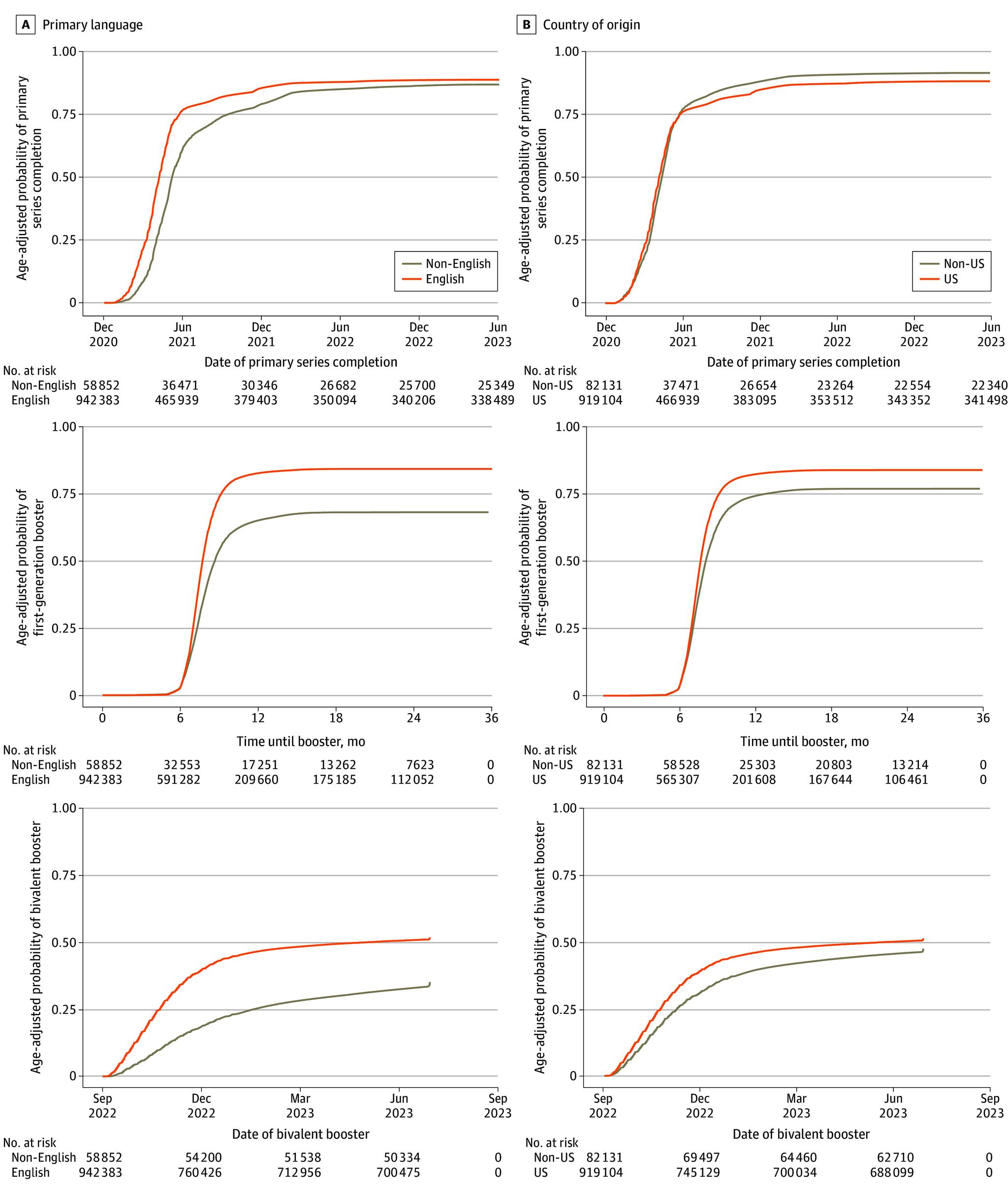
接种 COVID-19 疫苗的时间按语言和原籍国划分。
Time to COVID-19 Vaccination by Language and Country of Origin.
机构信息
HealthPartners Institute for Medical Education and Research, Bloomington, Minnesota.
出版信息
JAMA Netw Open. 2024 Oct 1;7(10):e2437388. doi: 10.1001/jamanetworkopen.2024.37388.
IMPORTANCE
Disparities in COVID-19 vaccination rates by race and ethnicity are well documented. Less is known about primary language and COVID-19 vaccine uptake.
OBJECTIVE
To describe the time to COVID-19 primary series vaccination and booster doses by primary language and country of origin.
DESIGN, SETTING, AND PARTICIPANTS: This retrospective cohort study included patients aged 6 months or older with at least 1 health encounter from July 1, 2019, to June 30, 2023, at a single health care system serving patients across Minnesota and western Wisconsin.
EXPOSURE
Primary language and country of origin documented in the electronic health record.
MAIN OUTCOMES AND MEASURES
Three COVID-19 vaccine coverage outcomes were evaluated: (1) primary series (1 Ad26.COV.S vaccine or 2 mRNA COVID-19 vaccines), (2) first-generation booster (primary series Ad26.COV.S vaccine plus 1 Ad26.COV.S or mRNA COVID-19 vaccine at least 2 months after the second dose or primary series mRNA vaccine plus 1 mRNA vaccine at least 5 months after the second dose), and (3) bivalent booster. Vaccine coverage was described by patient characteristics. Associations of primary language, race and ethnicity, and other patient characteristics with COVID-19 vaccine uptake were evaluated using time-to-event analysis in multivariable Cox proportional hazards regression models, and adjusted hazard ratios (AHRs) with 95% CIs were reported.
RESULTS
There were 1 001 235 patients included (53.7% female). Most patients reported English as a primary language (94.1%) and were born in the US (91.8%). Primary series coverage was 63.7%; first-generation booster coverage, 64.4%; and bivalent booster coverage, 39.5%. Coverage for all outcomes was lower among those with a non-English primary language compared with English as the primary language (56.9% vs 64.1% for primary series; 47.5% vs 65.3% for first-generation booster; 26.2% vs 40.3% for bivalent booster). Those with a non-English primary language had lower COVID-19 vaccine uptake for the primary series (AHR, 0.85; 95% CI, 0.84-0.86), first-generation booster (AHR, 0.74; 95% CI, 0.73-0.75), and bivalent booster (AHR, 0.65; 95% CI, 0.64-0.67) compared with patients with English as their primary language. Non-US-born patients had higher primary series uptake compared with US-born patients (AHR, 1.19; 95% CI, 1.18-1.20) but similar first-generation booster (AHR, 1.01; 95% CI, 0.99-1.02) and bivalent booster (AHR, 1.00; 95% CI, 0.98-1.02) uptake.
CONCLUSIONS AND RELEVANCE
In this retrospective cohort study, patients with a non-English primary language had both lower coverage and delays in receiving COVID-19 vaccines compared with those with English as their primary language. Reporting on language may identify health disparities that can be addressed with language-specific interventions.
重要性
种族和民族的 COVID-19 疫苗接种率差异有充分的记录。关于主要语言和 COVID-19 疫苗接种率的了解较少。
目的
描述按主要语言和原籍国划分的 COVID-19 初级系列疫苗接种和加强剂量的时间。
设计、地点和参与者:这项回顾性队列研究纳入了 2019 年 7 月 1 日至 2023 年 6 月 30 日期间在一家为明尼苏达州和威斯康星州西部的患者提供服务的单一医疗保健系统中至少有 1 次健康就诊的 6 个月或以上的患者。
暴露情况
电子健康记录中记录的主要语言和原籍国。
主要结果和措施
评估了三种 COVID-19 疫苗接种情况:(1)初级系列(1 剂 Ad26.COV.S 疫苗或 2 剂 mRNA COVID-19 疫苗);(2)第一代加强剂(初级系列 Ad26.COV.S 疫苗加 1 剂 Ad26.COV.S 或 mRNA COVID-19 疫苗,至少在第二剂后 2 个月或初级系列 mRNA 疫苗加 1 剂 mRNA 疫苗,至少在第二剂后 5 个月);(3)双价加强剂。根据患者特征描述疫苗接种情况。使用多变量 Cox 比例风险回归模型中的时间到事件分析评估主要语言、种族和民族以及其他患者特征与 COVID-19 疫苗接种率的关系,并报告调整后的危险比(AHR)及其 95%置信区间。
结果
共纳入 1001235 例患者(53.7%为女性)。大多数患者报告英语为主要语言(94.1%),出生于美国(91.8%)。初级系列接种率为 63.7%;第一代加强剂接种率为 64.4%;双价加强剂接种率为 39.5%。与英语为主要语言的患者相比,主要语言为非英语的患者的所有结果的疫苗接种率均较低(初级系列为 56.9%比 64.1%;第一代加强剂为 47.5%比 65.3%;双价加强剂为 26.2%比 40.3%)。与英语为主要语言的患者相比,主要语言为非英语的患者的 COVID-19 疫苗接种率较低(AHR,0.85;95%CI,0.84-0.86),第一代加强剂(AHR,0.74;95%CI,0.73-0.75)和双价加强剂(AHR,0.65;95%CI,0.64-0.67)。非美国出生的患者的初级系列接种率高于美国出生的患者(AHR,1.19;95%CI,1.18-1.20),但第一代加强剂(AHR,1.01;95%CI,0.99-1.02)和双价加强剂(AHR,1.00;95%CI,0.98-1.02)的接种率相似。
结论和相关性
在这项回顾性队列研究中,与英语为主要语言的患者相比,主要语言为非英语的患者的 COVID-19 疫苗接种率较低,且接种时间也较晚。报告语言状况可能有助于发现语言方面的差异,从而可以通过具体语言的干预措施来解决这些差异。

 Zotero 插件