
研究热休克蛋白90(HSP90)在癌细胞表型可塑性中的作用。
Investigating the role of HSP90 in cancer cell phenotypic plasticity.
作者信息
Sollars Vincent, Chapman Alexandria, Liang Nicole R, Myers Seth
机构信息
Department of Biomedical Sciences at Joan C. Edwards School of Medicine at Marshall University, USA.
出版信息
J Breast Cancer Res. 2024;4(1):5-10. doi: 10.46439/breastcancer.4.021.
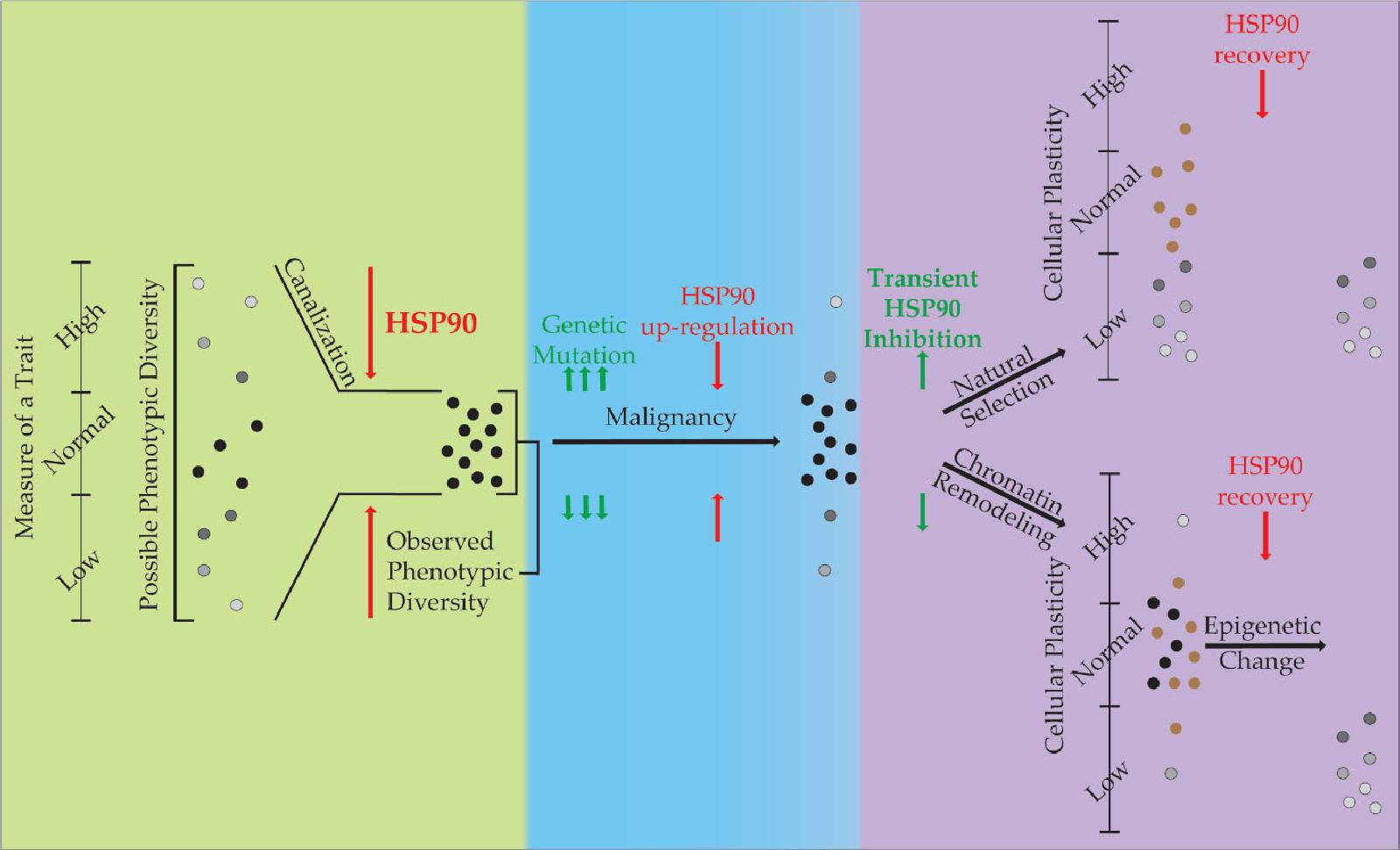
The emerging importance of epigenetic gene regulation in cancer progression necessitates not only our understanding of which genes are potential targets but also what mechanisms are employed in targeting those genes. Understanding the mechanisms that promote the evolution of the normal genome and epigenome is central to understanding how cancer cells adapt to chemotherapy. Our previous investigations have shown that heat shock protein 90 (HSP90) has a critical role in epigenetic gene regulation through histone acetylation and phenotypic plasticity. We recently extended these results in an A549 lung cancer model to test the role of HSP90 in the plasticity of cells regarding multi-drug resistance and epithelial-to-mesenchymal transition phenotypes. HSP90 is over-expressed in multiple cancers with poor prognosis. We propose that inhibition of HSP90 results in lower phenotypic plasticity of cancer cells making them more susceptible to chemotherapeutic intervention. Here we review the context of our results in the broader field of evolution of these phenotypes.
表观遗传基因调控在癌症进展中日益重要,这不仅需要我们了解哪些基因是潜在靶点,还需要了解靶向这些基因所采用的机制。了解促进正常基因组和表观基因组进化的机制是理解癌细胞如何适应化疗的核心。我们之前的研究表明,热休克蛋白90(HSP90)通过组蛋白乙酰化和表型可塑性在表观遗传基因调控中起关键作用。我们最近在A549肺癌模型中扩展了这些结果,以测试HSP90在细胞对多药耐药性和上皮-间质转化表型的可塑性中的作用。HSP90在多种预后不良的癌症中过度表达。我们提出,抑制HSP90会导致癌细胞的表型可塑性降低,使其更容易受到化疗干预。在此,我们在这些表型进化的更广泛领域中审视我们结果的背景。
 Zotero 插件