
鳞翅目模式昆虫家蚕对微生物病原体的体液免疫反应。
The humoral immune response of the lepidopteran model insect, silkworm L., to microbial pathogens.
作者信息
Muhammad Abrar, Sun Chao, Shao Yongqi
机构信息
Max Planck Partner Group, Institute of Sericulture and Apiculture, College of Animal Sciences, Zhejiang University, Hangzhou, China.
Analysis Center of Agrobiology and Environmental Sciences, Zhejiang University, Hangzhou, China.
出版信息
Curr Res Insect Sci. 2024 Sep 18;6:100097. doi: 10.1016/j.cris.2024.100097. eCollection 2024.
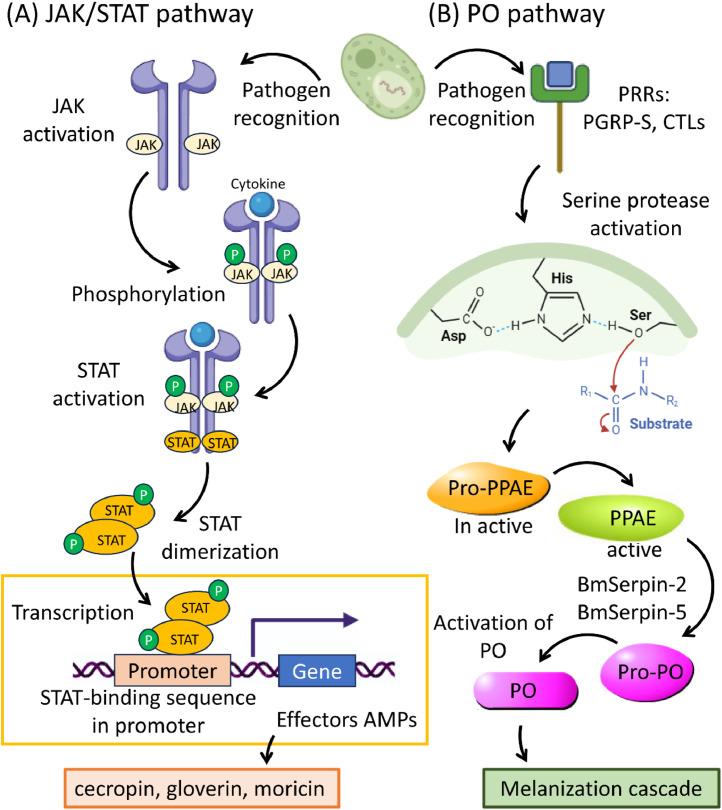
Insects are valuable models for studying innate immunity and its role in combating infections. The silkworm L., a well-studied insect model, is susceptible to a range of pathogens, including bacteria, fungi, viruses, and microsporidia. Their susceptibility makes it a suitable model for investigating host-pathogen interactions and immune responses against infections and diseases. This review focuses on the humoral immune response and the production of antimicrobial peptides (AMPs), the phenoloxidase (PO) system, and other soluble factors that constitute the primary defense of silkworms against microbial pathogens. The innate immune system of silkworms relies on pattern recognition receptors (PRRs) to recognize pathogen-associated molecular patterns (PAMPs), which then activate various immune pathways including Imd, Toll, JAK/STAT, and RNA interference (RNAi). Their activation triggers the secretion of AMPs, enzymatic defenses (lysozyme and PO), and the generation of reactive oxygen species (ROS). Collectively, these pathways work together to neutralize and eliminate pathogens, thereby contributing to the defense mechanism of silkworms. Understanding the innate immunity of silkworms can uncover conserved molecular pathways and key immune components shared between insects and vertebrates. Additionally, it can provide valuable insights for improving sericulture practices, developing strategies to control diseases affecting silk production, and providing a theoretical foundation for developing pest control measures.
昆虫是研究先天免疫及其在对抗感染中作用的宝贵模型。家蚕是一种经过充分研究的昆虫模型,易受多种病原体感染,包括细菌、真菌、病毒和微孢子虫。它们的易感性使其成为研究宿主 - 病原体相互作用以及针对感染和疾病的免疫反应的合适模型。本综述重点关注体液免疫反应、抗菌肽(AMPs)的产生、酚氧化酶(PO)系统以及构成家蚕对抗微生物病原体主要防御的其他可溶性因子。家蚕的先天免疫系统依靠模式识别受体(PRRs)识别病原体相关分子模式(PAMPs),进而激活包括Imd、Toll、JAK/STAT和RNA干扰(RNAi)在内的各种免疫途径。它们的激活触发抗菌肽的分泌、酶促防御(溶菌酶和PO)以及活性氧(ROS)的产生。这些途径共同作用以中和并消除病原体,从而构成家蚕的防御机制。了解家蚕的先天免疫可以揭示昆虫和脊椎动物之间共有的保守分子途径和关键免疫成分。此外,它可以为改进养蚕实践、制定控制影响丝绸生产的疾病的策略以及为制定害虫控制措施提供理论基础提供有价值的见解。


 Zotero 插件