
通过实验设计方法优化的芥子酸负载纳米颗粒:细胞毒性、抗凋亡、抗增殖和抗氧化活性
Sinapic-Acid-Loaded Nanoparticles Optimized via Experimental Design Methods: Cytotoxic, Antiapoptotoic, Antiproliferative, and Antioxidant Activity.
作者信息
Poyraz Fatma Şayan, Akbaş Gülşah, Duranoğlu Dilek, Acar Serap, Mansuroğlu Banu, Ersöz Melike
机构信息
Department of Molecular Biology and Genetics, Faculty of Art and Sciences, Yildiz Technical University, Istanbul 34349, Turkey.
Department of Chemical Engineering, Faculty of Chemical and Metallurgical Engineering, Yildiz Technical University, Istanbul 34210, Turkey.
出版信息
ACS Omega. 2024 Sep 17;9(39):40329-40345. doi: 10.1021/acsomega.4c00216. eCollection 2024 Oct 1.
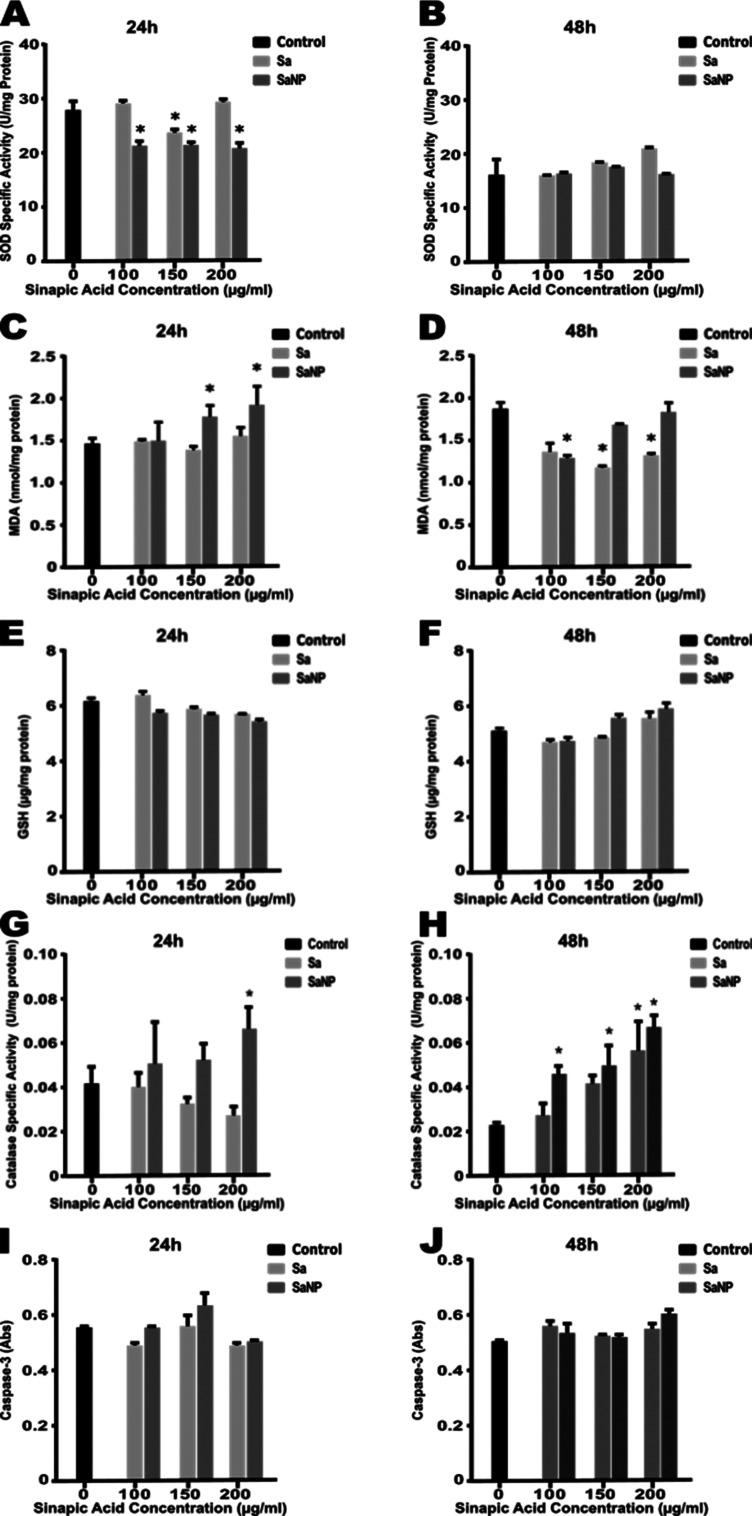
Nanoparticles are frequently investigated as carrier systems that increase the biological activities of hydrophobic molecules, especially by providing them with water solubility. Sinapic acid (Sa), commonly found in plants, is a phenolic compound with a wide spectrum of biological activities and extensive pharmacological properties. The aim of this study was the synthesis/characterization of optimized sinapic-acid-loaded poly(lactic--glycolic acid) (PLGA) nanoparticles (SaNPs) to improve the solubility of sinapic acid (Sa) that limit its use in the biological system and investigate the biological activities of these nanoparticles in the breast cancer cell line. For this purpose, sinapic-acid-loaded PLGA nanoparticles were obtained and optimized by experimental design methods. Then, cytotoxic (MTT method), antiapoptotic (terminal deoxynucleotidyl transferase dUTP nick end labeling (TUNEL) assay), antiproliferative (immunocytochemically by PCNA assay), and antioxidant activities (superoxide dismutase (SOD) and catalase activities, glutathione, malondialdehyde (MDA), and caspase-3 levels) of optimized nanoparticles were examined comperatively with free drug on MCF-7 cells. The IC values of the SaNPs (170.6 ± 3.6 nm size) in MCF-7 cells were determined at 180, 168, and 145 μg/mL for 24, 48, and 72 h, respectively, and at these doses, the nanoparticles did not show any toxic effect on the MCF10A cell line. Treatment of Sa and SaNPs at doses of 24 and 48 h showed a statistically significant reduction in the PCNA level in MCF-7 cells, with an increase in the number of cells leading to apoptosis. In MCF-7 cells treated with SaNP at concentrations of 150 and 200 μg/mL for 24 h, MDA levels were significantly increased, SOD activities were significantly decreased, and reduced glutathione (GSH) and catalase levels were increased compared with control groups. The findings of this study indicate that polyphenolic compounds can contribute to the design of drugs for treatment by forming nanoparticle formulations. The developed nanoparticle formulation is thought to be a useful model for other hydrophobic biological active substances.
纳米颗粒经常被作为载体系统进行研究,该系统可增强疏水分子的生物活性,特别是通过赋予它们水溶性来实现。芥子酸(Sa)常见于植物中,是一种具有广泛生物活性和多种药理特性的酚类化合物。本研究的目的是合成/表征优化的负载芥子酸的聚乳酸-乙醇酸共聚物(PLGA)纳米颗粒(SaNPs),以提高限制其在生物系统中应用的芥子酸(Sa)的溶解度,并研究这些纳米颗粒在乳腺癌细胞系中的生物活性。为此,通过实验设计方法获得并优化了负载芥子酸的PLGA纳米颗粒。然后,将优化后的纳米颗粒与游离药物对MCF-7细胞的细胞毒性(MTT法)、抗凋亡(末端脱氧核苷酸转移酶dUTP缺口末端标记法(TUNEL))、抗增殖(通过PCNA免疫细胞化学检测)和抗氧化活性(超氧化物歧化酶(SOD)和过氧化氢酶活性、谷胱甘肽、丙二醛(MDA)和半胱天冬酶-3水平)进行了比较研究。在MCF-7细胞中,SaNPs(尺寸为170.6±3.6nm)的IC值在24、48和72小时分别测定为180、168和145μg/mL,在这些剂量下,纳米颗粒对MCF10A细胞系未显示任何毒性作用。在24和48小时剂量下处理Sa和SaNPs显示MCF-7细胞中PCNA水平有统计学意义的降低,同时导致凋亡的细胞数量增加。在150和200μg/mL浓度下处理24小时的SaNP的MCF-7细胞中,与对照组相比,MDA水平显著升高,SOD活性显著降低,还原型谷胱甘肽(GSH)和过氧化氢酶水平升高。本研究结果表明,多酚类化合物可通过形成纳米颗粒制剂有助于治疗药物的设计。所开发的纳米颗粒制剂被认为是其他疏水性生物活性物质的有用模型。


 Zotero 插件