
嵌合抗原受体 T 细胞疗法治疗晚期血液恶性肿瘤后的心血管事件:一项荟萃分析。
Cardiovascular Events After Chimeric Antigen Receptor T-Cell Therapy for Advanced Hematologic Malignant Neoplasms: A Meta-Analysis.
机构信息
Department of Cardiology, Angiology and Respiratory Medicine, University Hospital Heidelberg, Heidelberg, Germany.
German Centre for Cardiovascular Research (DZHK), partner site, Mannheim/Heidelberg, Germany.
出版信息
JAMA Netw Open. 2024 Oct 1;7(10):e2437222. doi: 10.1001/jamanetworkopen.2024.37222.
IMPORTANCE
The frequency and clinical phenotypes of cardiotoxic events in chimeric antigen receptor (CAR) T-cell recipients remain poorly understood given that landmark approval trials typically exclude patients with high-risk cardiovascular profiles and data from nontrial settings are scarce.
OBJECTIVE
To summarize the prevalence of adverse cardiovascular events among adults receiving CAR T-cell therapies for advanced hematologic malignant neoplasms.
DATA SOURCES
MEDLINE, Embase, Cochrane Library, and Google Scholar were systematically searched from database inception until February 26, 2024.
STUDY SELECTION
Observational studies were included if they comprised adult CAR T-cell recipients with advanced hematologic malignant neoplasms and if they systematically evaluated cardiovascular complications.
DATA EXTRACTION AND SYNTHESIS
Extraction of prespecified parameters related to the patient population, study design, and clinical events was performed at the study level by 2 independent reviewers in accordance with the Meta-Analysis of Observational Studies in Epidemiology (MOOSE) reporting guideline. Meta-analysis of single proportions was conducted using random-effect models with Freeman-Tukey double arcsine transformations to calculate pooled prevalence estimates. Sensitivity analysis was performed using generalized linear mixed models with logit transformations.
MAIN OUTCOMES AND MEASURES
Ventricular and supraventricular arrhythmias, heart failure events, reduction in left ventricular ejection fraction, myocardial infarction, and cardiovascular and all-cause mortality.
RESULTS
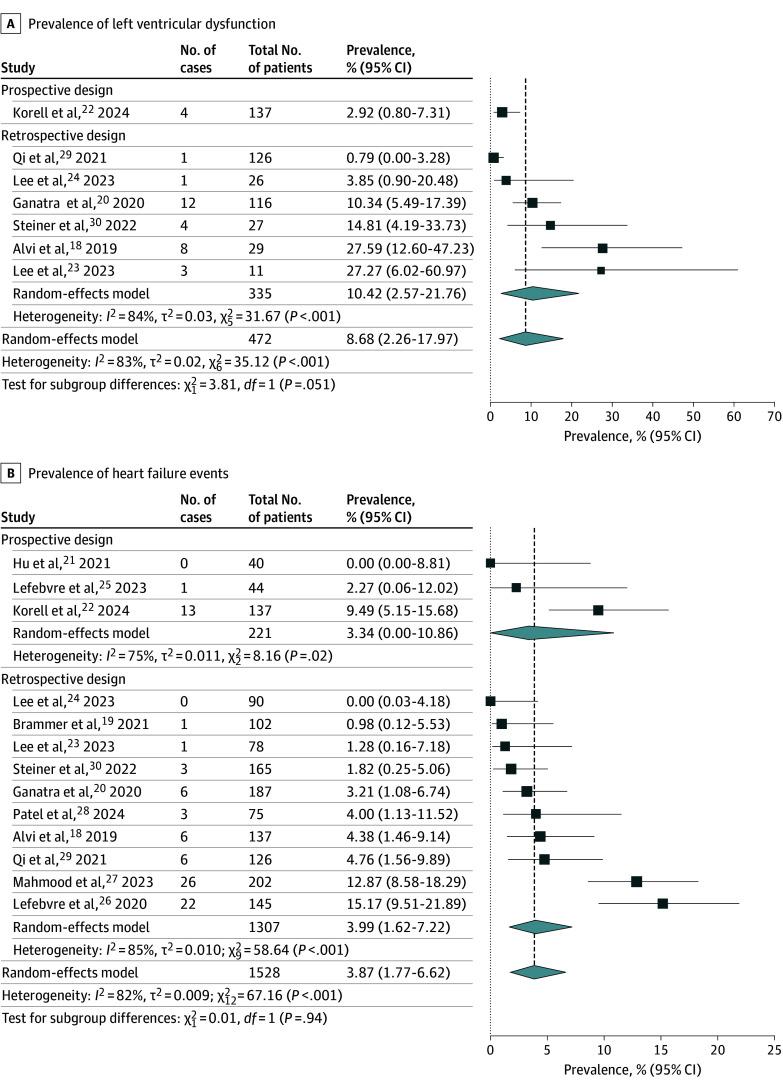
Thirteen studies comprising 1528 CAR T-cell recipients (median [IQR] age, 61 [58.7-63.0] years; 1016 males [66%]; 80% patients with lymphoma) were included. The median (IQR) duration of follow-up was 487 (294-530) days. On random-effects meta-analysis, we observed a pooled prevalence of 0.66% (95% CI, 0.00%-2.28%) for ventricular arrhythmia, 7.79% (95% CI, 4.87%-11.27%) for supraventricular arrhythmia, 8.68% (95% CI, 2.26%-17.97%) for left ventricular dysfunction, 3.87% (95% CI, 1.77%-6.62%) for heart failure events, 0.62% (95% CI, 0.02%-1.74%) for myocardial infarction, and 0.63% (95% CI, 0.13%-1.38%) for cardiovascular death. The pooled prevalence of all-cause mortality was 30.01% (95% CI, 19.49%-41.68%). Sensitivity analyses generated similar findings.
CONCLUSIONS AND RELEVANCE
This meta-analysis found a low prevalence of ventricular arrhythmia, myocardial infarction, and cardiovascular death among CAR T-cell recipients over a short-term to midterm follow-up. Left ventricular dysfunction and supraventricular arrhythmia were the most commonly reported cardiovascular complications, suggesting that cardiovascular surveillance strategies should focus on decreases in ejection fraction and supraventricular arrhythmia.
重要性
鉴于标志性的批准试验通常排除具有高心血管风险特征的患者,并且来自非试验环境的数据稀缺,因此,嵌合抗原受体(CAR)T 细胞受体患者中心血管毒性事件的频率和临床表型仍了解甚少。
目的
总结接受嵌合抗原受体 T 细胞疗法治疗晚期血液恶性肿瘤的成人发生不良心血管事件的患病率。
数据来源
系统检索了 MEDLINE、Embase、Cochrane 图书馆和 Google Scholar 数据库,检索时间从数据库建立到 2024 年 2 月 26 日。
研究选择
如果观察性研究包括患有晚期血液恶性肿瘤的成年 CAR T 细胞受体患者,并且系统评估了心血管并发症,则将其纳入研究。
数据提取和综合
按照 MOOSE 报告指南,由 2 名独立评审员在研究水平上提取与患者人群、研究设计和临床事件相关的预设参数。使用随机效应模型和 Freeman-Tukey 双反正弦变换对单个比例进行荟萃分析,以计算汇总患病率估计值。使用对数变换的广义线性混合模型进行敏感性分析。
主要结局和测量
室性和室上性心律失常、心力衰竭事件、左心室射血分数降低、心肌梗死以及心血管和全因死亡率。
结果
纳入了 13 项研究,共纳入 1528 名接受 CAR T 细胞治疗的患者(中位数[IQR]年龄,61[58.7-63.0]岁;1016 名男性[66%];80%的患者患有淋巴瘤)。中位(IQR)随访时间为 487(294-530)天。在随机效应荟萃分析中,我们观察到室性心律失常的汇总患病率为 0.66%(95%CI,0.00%-2.28%),室上性心律失常为 7.79%(95%CI,4.87%-11.27%),左心室功能障碍为 8.68%(95%CI,2.26%-17.97%),心力衰竭事件为 3.87%(95%CI,1.77%-6.62%),心肌梗死为 0.62%(95%CI,0.02%-1.74%),心血管死亡为 0.63%(95%CI,0.13%-1.38%)。全因死亡率的汇总患病率为 30.01%(95%CI,19.49%-41.68%)。敏感性分析得出了类似的发现。
结论和相关性
这项荟萃分析发现,在短期至中期随访期间,CAR T 细胞受体患者的室性心律失常、心肌梗死和心血管死亡率较低。左心室功能障碍和室上性心律失常是最常报告的心血管并发症,这表明心血管监测策略应侧重于射血分数降低和室上性心律失常。



 Zotero 插件