
使用图神经网络进行苦味肽预测。
Bitter peptide prediction using graph neural networks.
作者信息
Srivastava Prashant, Steuer Alexandra, Ferri Francesco, Nicoli Alessandro, Schultz Kristian, Bej Saptarshi, Di Pizio Antonella, Wolkenhauer Olaf
机构信息
Institute of Computer Science, University of Rostock, 18051, Rostock, Germany.
Section III In Silico Biology & Machine Learning, Leibniz Institute for Food Systems Biology at the Technical University of Munich, 85354, Freising, Germany.
出版信息
J Cheminform. 2024 Oct 7;16(1):111. doi: 10.1186/s13321-024-00909-x.
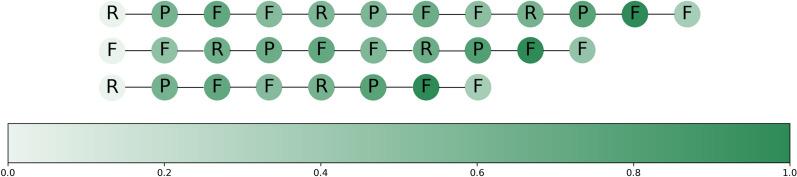
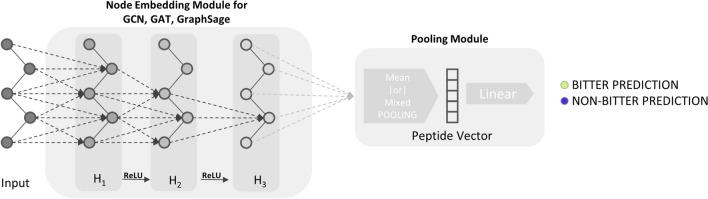
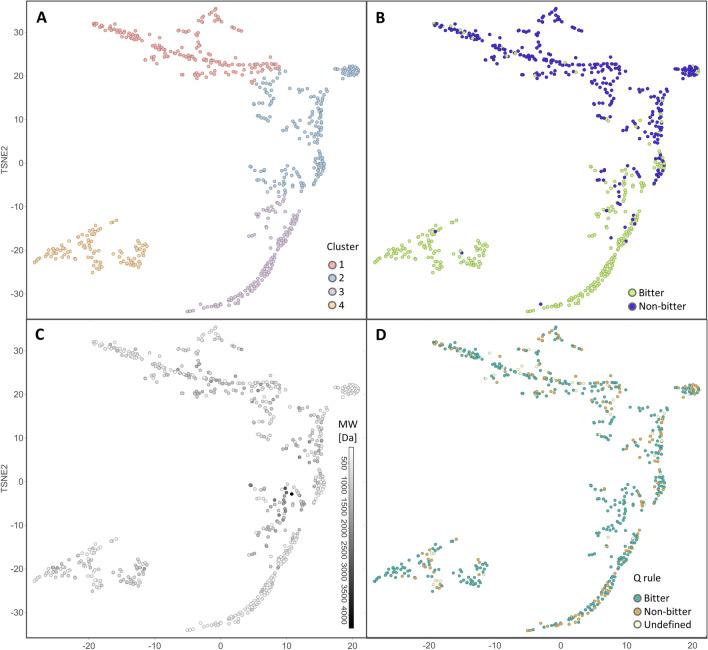
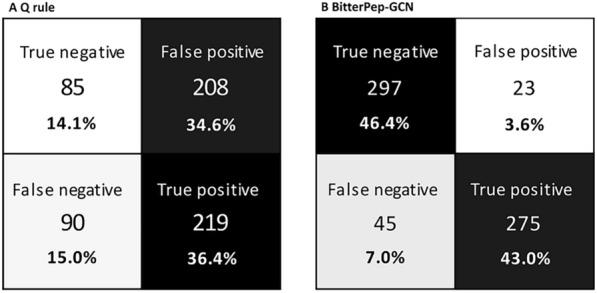
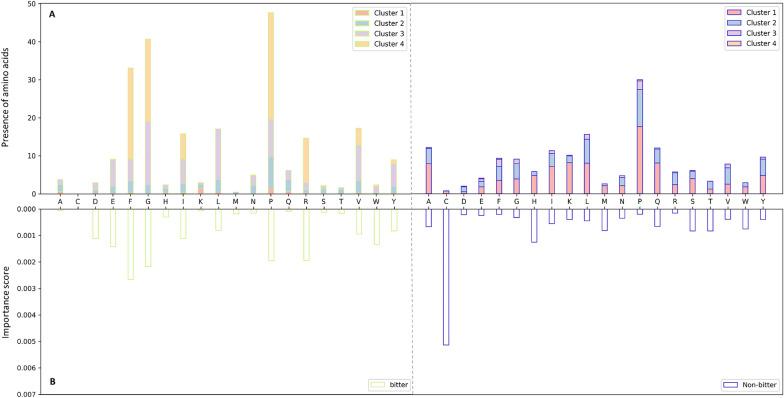
Bitter taste is an unpleasant taste modality that affects food consumption. Bitter peptides are generated during enzymatic processes that produce functional, bioactive protein hydrolysates or during the aging process of fermented products such as cheese, soybean protein, and wine. Understanding the underlying peptide sequences responsible for bitter taste can pave the way for more efficient identification of these peptides. This paper presents BitterPep-GCN, a feature-agnostic graph convolution network for bitter peptide prediction. The graph-based model learns the embedding of amino acids in the bitter peptide sequences and uses mixed pooling for bitter classification. BitterPep-GCN was benchmarked using BTP640, a publicly available bitter peptide dataset. The latent peptide embeddings generated by the trained model were used to analyze the activity of sequence motifs responsible for the bitter taste of the peptides. Particularly, we calculated the activity for individual amino acids and dipeptide, tripeptide, and tetrapeptide sequence motifs present in the peptides. Our analyses pinpoint specific amino acids, such as F, G, P, and R, as well as sequence motifs, notably tripeptide and tetrapeptide motifs containing FF, as key bitter signatures in peptides. This work not only provides a new predictor of bitter taste for a more efficient identification of bitter peptides in various food products but also gives a hint into the molecular basis of bitterness.Scientific ContributionOur work provides the first application of Graph Neural Networks for the prediction of peptide bitter taste. The best-developed model, BitterPep-GCN, learns the embedding of amino acids in the bitter peptide sequences and uses mixed pooling for bitter classification. The embeddings were used to analyze the sequence motifs responsible for the bitter taste.
苦味是一种影响食物摄入的不良味觉模态。苦味肽在产生功能性生物活性蛋白水解物的酶促过程中,或在奶酪、大豆蛋白和葡萄酒等发酵产品的陈化过程中产生。了解导致苦味的潜在肽序列可为更高效地识别这些肽铺平道路。本文提出了BitterPep-GCN,一种用于苦味肽预测的与特征无关的图卷积网络。基于图的模型学习苦味肽序列中氨基酸的嵌入,并使用混合池化进行苦味分类。使用公开可用的苦味肽数据集BTP640对BitterPep-GCN进行基准测试。训练模型生成的潜在肽嵌入用于分析负责肽苦味的序列基序的活性。特别是,我们计算了肽中存在的单个氨基酸以及二肽、三肽和四肽序列基序的活性。我们的分析确定了特定的氨基酸,如F、G、P和R,以及序列基序,特别是含有FF的三肽和四肽基序,作为肽中的关键苦味特征。这项工作不仅为更高效地识别各种食品中的苦味肽提供了一种新的苦味预测器,还为苦味的分子基础提供了线索。
科学贡献
我们的工作首次将图神经网络应用于肽苦味的预测。最先进的模型BitterPep-GCN学习苦味肽序列中氨基酸的嵌入,并使用混合池化进行苦味分类。这些嵌入用于分析负责苦味的序列基序。

 Zotero 插件