
Nav1.8 和 Nav1.7 通道的相互作用导致神经性疼痛中的神经元过度兴奋。
Interplay of Nav1.8 and Nav1.7 channels drives neuronal hyperexcitability in neuropathic pain.
机构信息
Department of Neurology and Center for Neuroscience and Regeneration Research, Yale University School of Medicine, New Haven, CT, USA.
Rehabilitation Research Center, Veterans Affairs Connecticut Healthcare System , West Haven, CT, USA.
出版信息
J Gen Physiol. 2024 Nov 4;156(11). doi: 10.1085/jgp.202413596. Epub 2024 Oct 8.
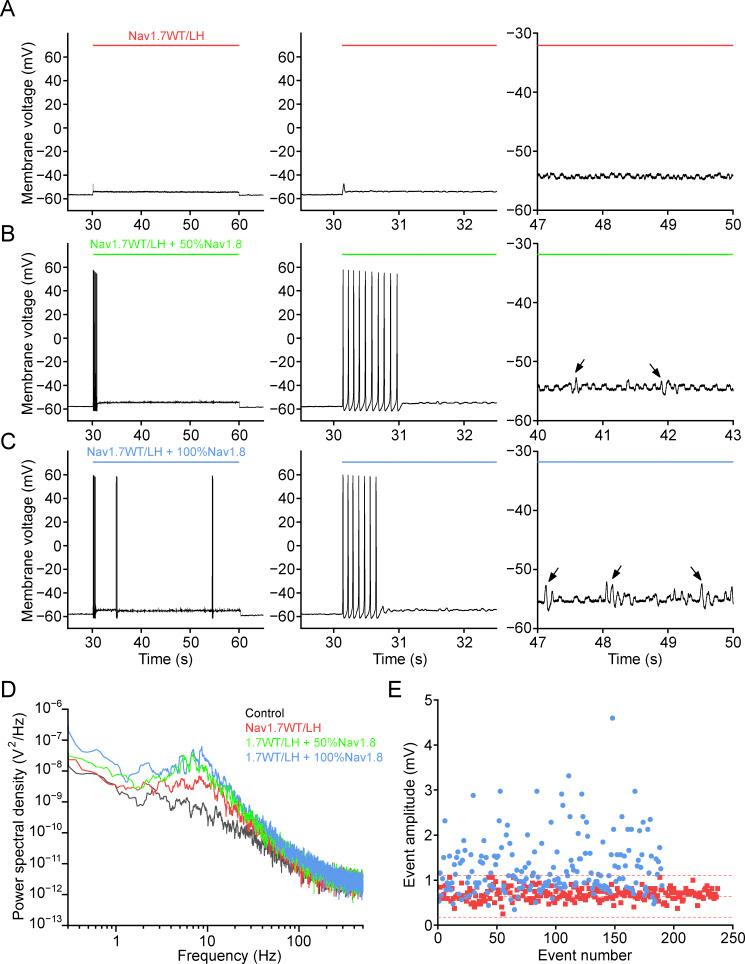
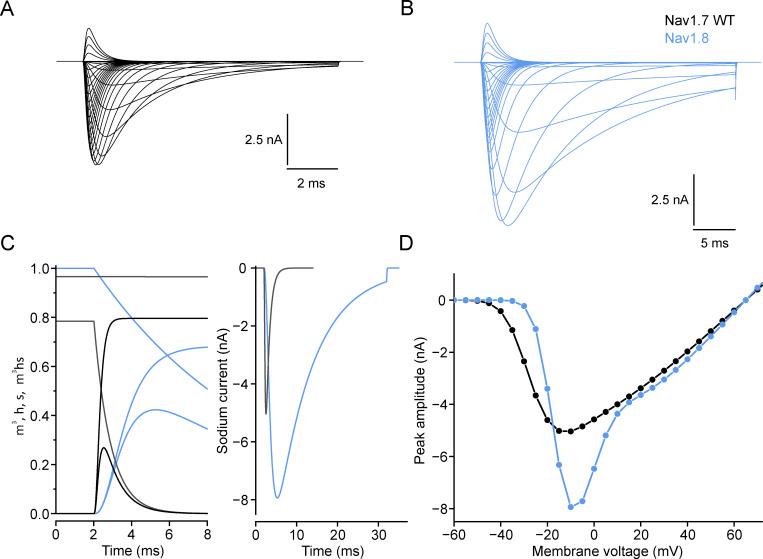
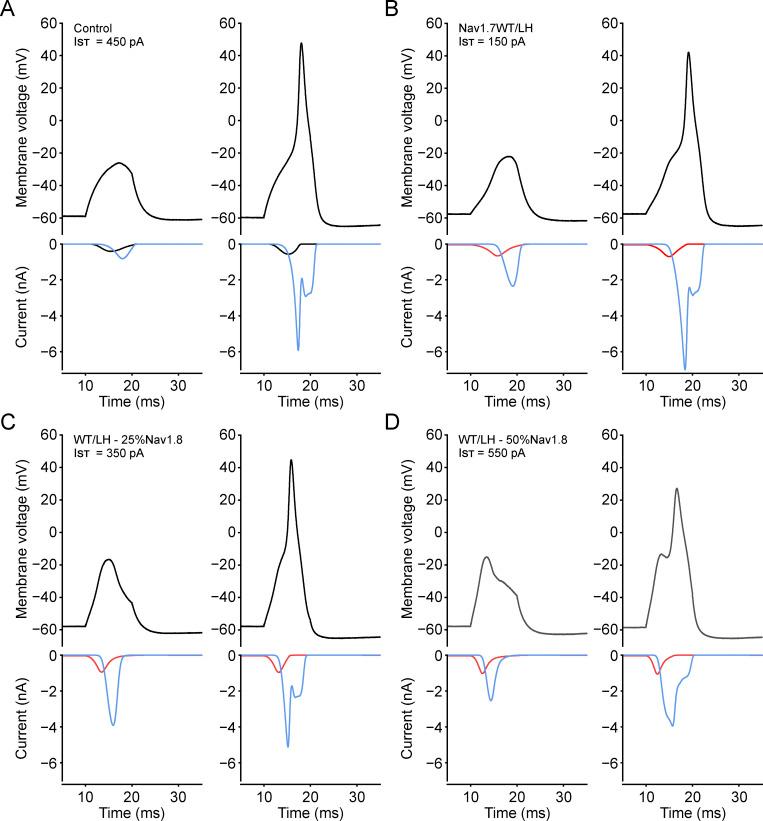
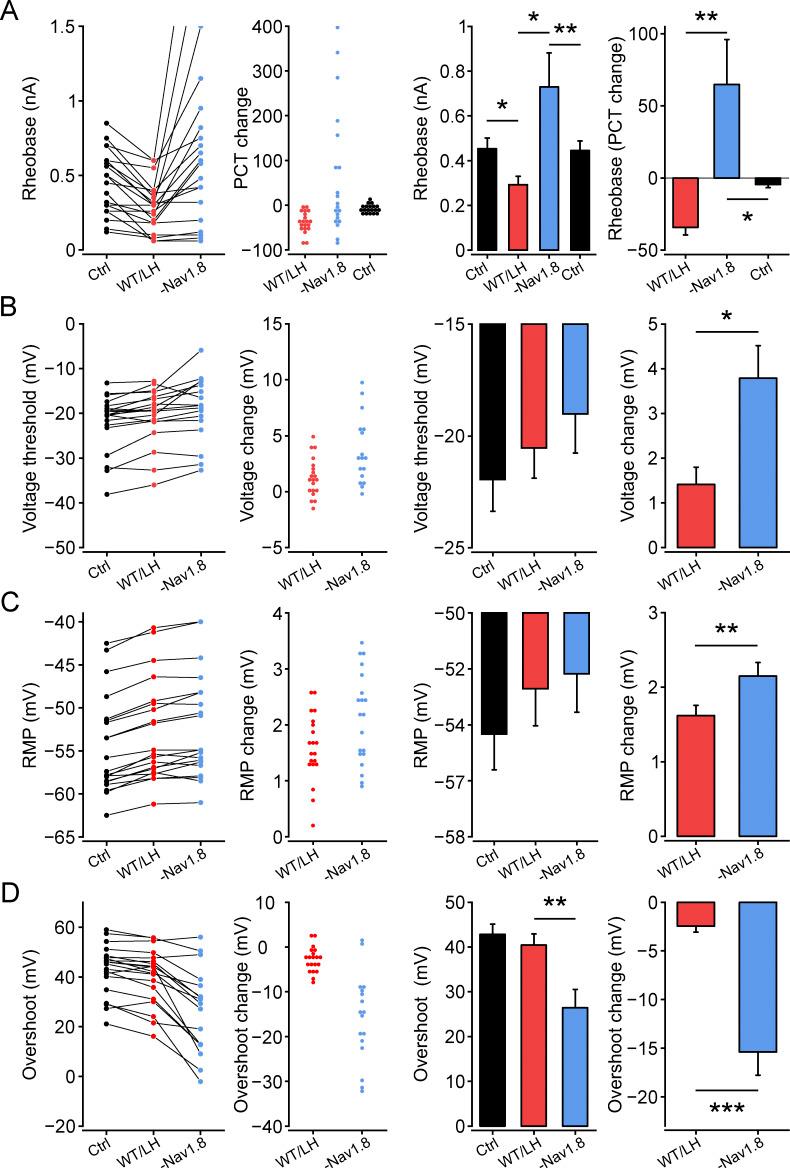
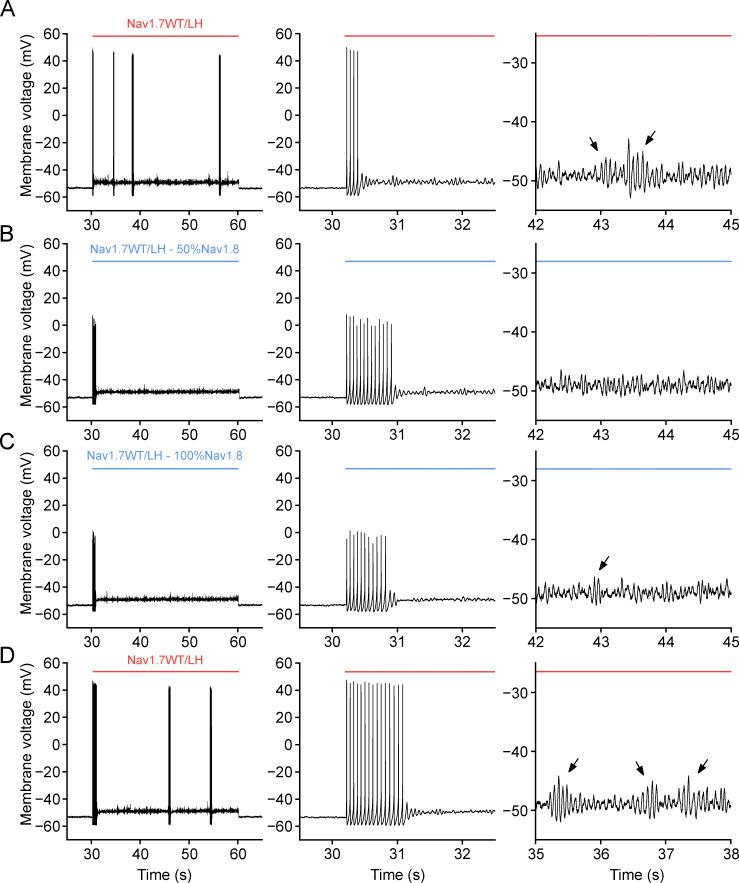
While voltage-gated sodium channels Nav1.7 and Nav1.8 both contribute to electrogenesis in dorsal root ganglion (DRG) neurons, details of their interactions have remained unexplored. Here, we studied the functional contribution of Nav1.8 in DRG neurons using a dynamic clamp to express Nav1.7L848H, a gain-of-function Nav1.7 mutation that causes inherited erythromelalgia (IEM), a human genetic model of neuropathic pain, and demonstrate a profound functional interaction of Nav1.8 with Nav1.7 close to the threshold for AP generation. At the voltage threshold of -21.9 mV, we observed that Nav1.8 channel open-probability exceeded Nav1.7WT channel open-probability ninefold. Using a kinetic model of Nav1.8, we showed that a reduction of Nav1.8 current by even 25-50% increases rheobase and reduces firing probability in small DRG neurons expressing Nav1.7L848H. Nav1.8 subtraction also reduces the amplitudes of subthreshold membrane potential oscillations in these cells. Our results show that within DRG neurons that express peripheral sodium channel Nav1.7, the Nav1.8 channel amplifies excitability at a broad range of membrane voltages with a predominant effect close to the AP voltage threshold, while Nav1.7 plays a major role at voltages closer to resting membrane potential. Our data show that dynamic-clamp reduction of Nav1.8 conductance by 25-50% can reverse hyperexcitability of DRG neurons expressing a gain-of-function Nav1.7 mutation that causes pain in humans and suggests, more generally, that full inhibition of Nav1.8 may not be required for relief of pain due to DRG neuron hyperexcitability.
电压门控钠离子通道 Nav1.7 和 Nav1.8 均有助于背根神经节 (DRG) 神经元的电发生,但它们之间的相互作用细节仍未得到探索。在这里,我们使用动态钳位来表达 Nav1.7L848H,这是一种导致遗传性红斑性肢痛症 (IEM) 的功能获得性 Nav1.7 突变,这是一种人类神经性疼痛的遗传模型,研究了 Nav1.8 在 DRG 神经元中的功能贡献,并证明了 Nav1.8 与 Nav1.7 之间的功能相互作用非常接近产生动作电位的阈值。在 -21.9 mV 的电压阈值下,我们观察到 Nav1.8 通道的开启概率是 Nav1.7WT 通道的开启概率的九倍。使用 Nav1.8 的动力学模型,我们表明,即使 Nav1.8 电流减少 25-50%,也会增加阈值并降低表达 Nav1.7L848H 的小型 DRG 神经元的放电概率。Nav1.8 减法还会降低这些细胞中阈下膜电位振荡的幅度。我们的结果表明,在表达周围钠离子通道 Nav1.7 的 DRG 神经元中,Nav1.8 通道在广泛的膜电压范围内增强兴奋性,主要作用接近动作电位电压阈值,而 Nav1.7 在更接近静息膜电位的电压下发挥主要作用。我们的数据表明,通过动态钳位将 Nav1.8 电导降低 25-50%可以逆转表达导致人类疼痛的功能获得性 Nav1.7 突变的 DRG 神经元的过度兴奋,并表明,更一般地说,由于 DRG 神经元过度兴奋引起的疼痛,完全抑制 Nav1.8 可能不是必需的。





 Zotero 插件