
探索人体中微塑料检测的替代方法:问卷调查。
Exploring alternatives for detecting microplastics in the human body: questionnaire survey.
机构信息
Department of Epidemiology and Health Statistics, School of Public Health, Ningxia Medical University, Yinchuan, 750004, Ningxia Hui Autonomous Region, China.
Medical Experiment Center, General Hospital of Ningxia Medical University, Yinchuan, 750004, Ningxia Hui Autonomous Region, China.
出版信息
Sci Rep. 2024 Oct 8;14(1):23458. doi: 10.1038/s41598-024-73982-9.
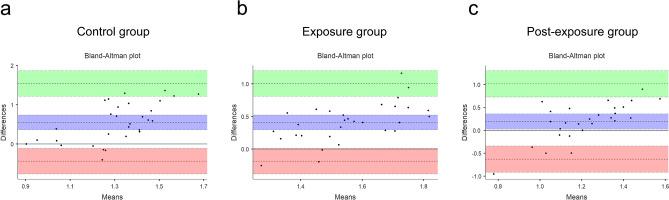
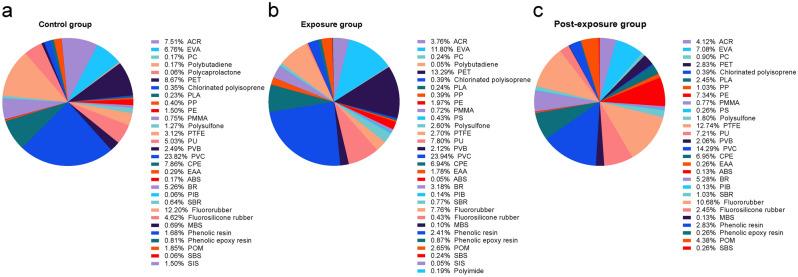
Microplastics (MPs) can enter the body via plastic products. Given modern plastic exposure, we seek to assess MP exposure in large populations through epidemiological tools. In this quasi-experimental study, every participant filled out a questionnaire, and those who satisfied any of the following requirements were not allowed to continue in the study: Diabetes, ulcerative colitis, Crohn's disease, infectious diseases. Participants in the exposure and control groups were provided three hot meals in disposable plastic tableware (DPT) (n = 30) or non-DPT (n = 30), respectively. After a month of observation, individuals in the exposure group discontinued the three meals provided in DPT (n = 27) for 1 month as the post-exposure group. Each Participant in the three groups received a questionnaire survey and fecal sample collection. We compared the differences in MP levels between different groups and used the Bland-Altman analysis method to evaluate the consistency of the results obtained by different measurement methods. Statistically significant differences in the total quantity (P (0.80 matching degree) = 0.020; P (0.65 matching degree) < 0.001) and types (Polyethylene Terephthalate (EVA) (P = 0.039), Polyethylene Terephthalate (PET) (P = 0.022), Polyvinyl Butyral (PVB) (P = 0.013), Chlorinated Polyethylene (CPE) (P = 0.039), phenolic epoxy resin (P = 0.012)) of MPs were observed between the exposure and post-exposure groups. The Bland-Altman analysis results indicate that the two methods exhibit good consistency in the three groups (control group: mean difference = 0.54, agreement limits (95% CI) = - 0.44 ~ 1.54; exposure group: mean difference = 0.41, agreement limits (95% CI) = - 0.19 ~ 1.01; post-exposure group: mean difference = 0.19, agreement limits (95% CI) = - 0.63 ~ 1.02). The method based on questionnaire surveys can substitute the method of fecal sample detection to evaluate the exposure of MP particles.
微塑料(MPs)可通过塑料制品进入人体。鉴于现代塑料的广泛使用,我们希望通过流行病学工具来评估大量人群的 MP 暴露情况。在这项准实验研究中,每位参与者都填写了一份问卷,对于任何以下情况的参与者,我们不允许其继续参加研究:糖尿病、溃疡性结肠炎、克罗恩病、传染病。暴露组和对照组的参与者分别使用一次性塑料餐具(DPT)(n=30)或非 DPT(n=30)提供三份热餐。经过一个月的观察,暴露组的 27 人停止使用 DPT 提供的三顿饭,作为暴露后组。三组中的每个参与者都接受了问卷调查和粪便样本采集。我们比较了不同组之间 MP 水平的差异,并使用 Bland-Altman 分析方法评估了不同测量方法获得的结果的一致性。总数量(P(0.80 匹配度)=0.020;P(0.65 匹配度)<0.001)和类型(聚对苯二甲酸乙二醇酯(EVA)(P=0.039)、聚对苯二甲酸乙二醇酯(PET)(P=0.022)、聚丁基缩醛(PVB)(P=0.013)、氯化聚乙烯(CPE)(P=0.039)、酚醛环氧树脂(P=0.012))在暴露组和暴露后组之间存在统计学差异。Bland-Altman 分析结果表明,两种方法在三组中具有良好的一致性(对照组:平均差异=0.54,一致性限(95%CI)=-0.441.54;暴露组:平均差异=0.41,一致性限(95%CI)=-0.191.01;暴露后组:平均差异=0.19,一致性限(95%CI)=-0.63~1.02)。基于问卷调查的方法可以替代粪便样本检测方法来评估 MP 颗粒的暴露情况。
 Zotero 插件