
用PSMA/BN配体功能化的放射性标记氧化铁纳米颗粒用于前列腺癌的双靶点治疗。
Radiolabeled iron oxide nanoparticles functionalized with PSMA/BN ligands for dual-targeting of prostate cancer.
作者信息
Bajwa Danae Efremia, Salvanou Evangelia-Alexandra, Theodosiou Maria, Koutsikou Theodora S, Efthimiadou Eleni K, Bouziotis Penelope, Liolios Christos
机构信息
Radiochemical Studies Laboratory, Energy & Safety, Institute of Nuclear & Radiological Sciences & Technology (INRASTES), National Centre for Scientific Research (NCSR) "Demokritos", Athens, Greece.
Laboratory of Inorganic Chemistry, Department of Chemistry, National and Kapodistrian University of Athens, Athens, Greece.
出版信息
Front Nucl Med. 2023 Sep 20;3:1184309. doi: 10.3389/fnume.2023.1184309. eCollection 2023.
INTRODUCTION
Prostate cancer (PCa) is the second most frequent cancer diagnosis in men and the fifth leading cause of death worldwide. Prostate Specific Membrane Antigen (PSMA) and Gastrin Releasing Peptide (GRP) receptors are overexpressed in PCa. In this study, we have developed iron oxide nanoparticles (IONs) functionalized with the Prostate Specific Membrane Antigen (PSMA) and Gastrin Releasing Peptide (GRP) ligands for dual targeting of Prostate cancer.
METHODS
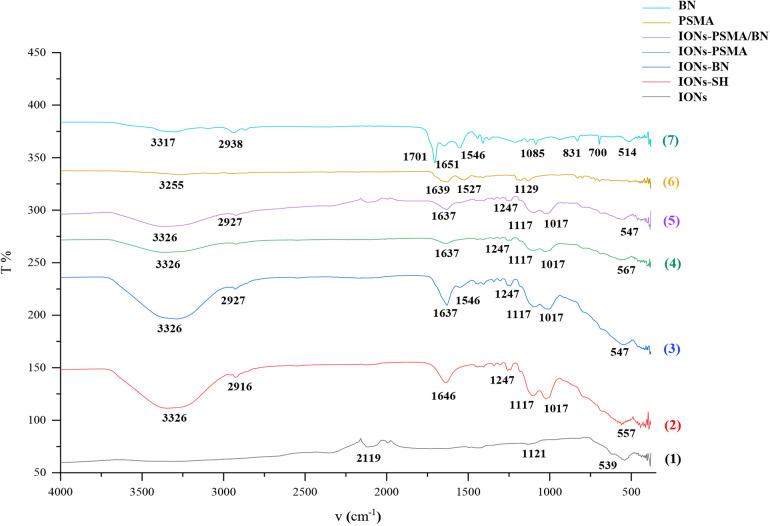
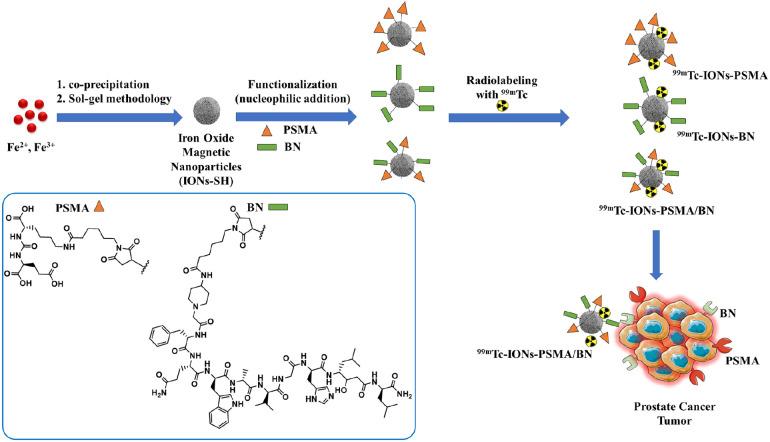
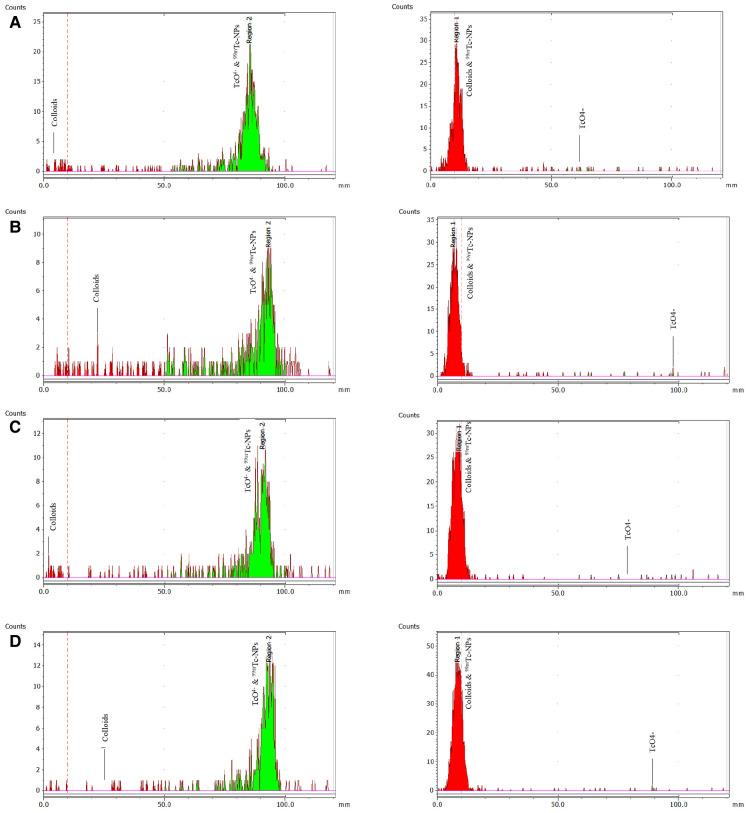
IONs were developed with a thin silica layer on their surface with MPTES (carrying -SH groups, IONs-SH), and they were coupled either with a pharmacophore targeting PSMA (IONs-PSMA) or with bombesin peptide (IONs-BN), targeting GRP receptors, or with both (IONs-PSMA/BN). The functionalized IONs were characterized for their size, zeta potential, and efficiency of functionalization using dynamic light scattering (DLS) and Fourier-Transform Infrared Spectroscopy (FT-IR). All the aforementioned types of IONs were radiolabeled directly with Technetium-99m (Tc) and evaluated for their radiolabeling efficiency, stability, and binding ability on two different PCa cell lines (PC3 and LNCaP).
RESULTS AND DISCUSSION
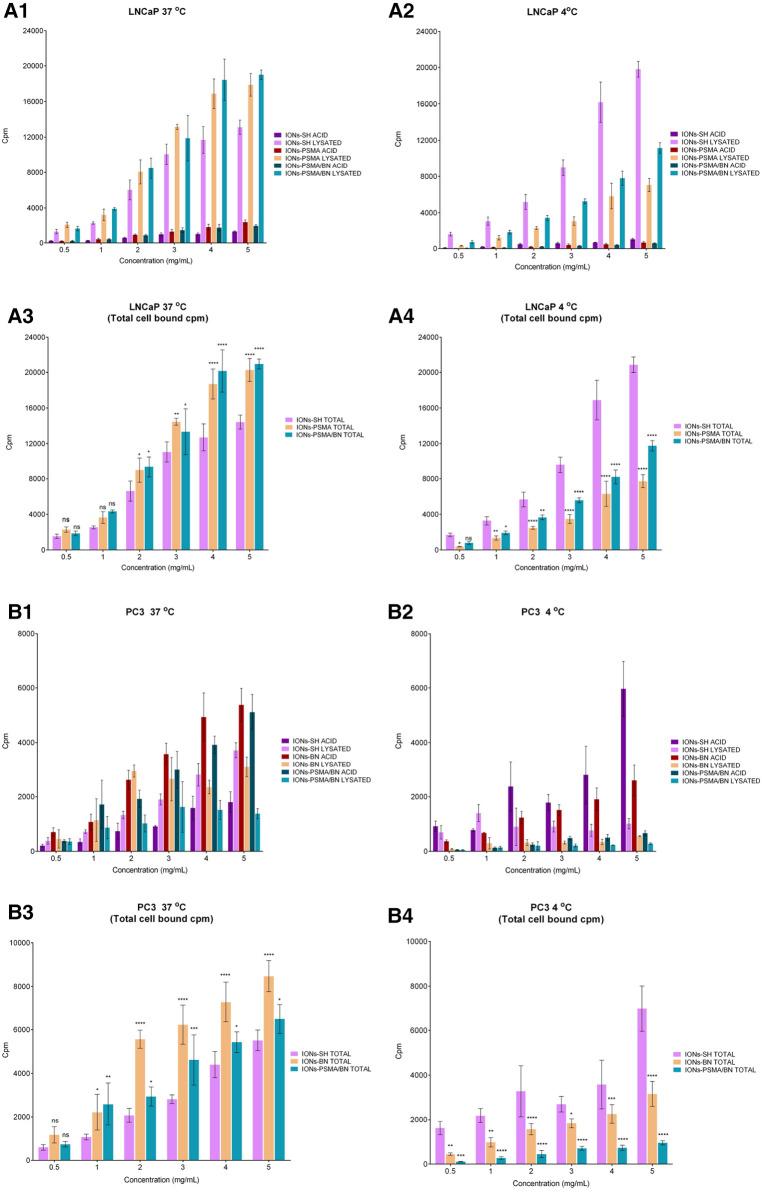
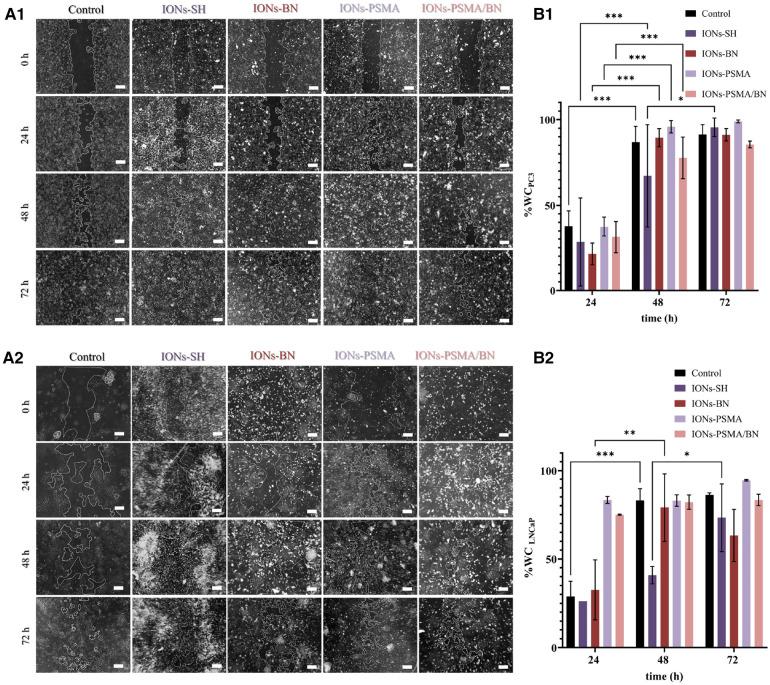
The MTT assay demonstrated low toxicity of the IONs against PC3 and LNCaP cells, while the performed wound-healing assay further proved that these nanostructures did not affect cellular growth mechanisms. The observed hemolysis ratio after co-incubation with red blood cells was extremely low. Furthermore, the Tc-radiolabeled IONs showed good stability in human serum, DTPA, and histidine, and high specific binding rates in cancer cells, supporting their future utilization as potential diagnostic tools for PCa with Single Photon Emission Computed Tomography (SPECT) imaging.
引言
前列腺癌(PCa)是男性中第二常见的癌症诊断类型,也是全球第五大死因。前列腺特异性膜抗原(PSMA)和胃泌素释放肽(GRP)受体在前列腺癌中过表达。在本研究中,我们开发了用前列腺特异性膜抗原(PSMA)和胃泌素释放肽(GRP)配体功能化的氧化铁纳米颗粒(IONs),用于前列腺癌的双重靶向。
方法
在IONs表面用3-巯丙基三乙氧基硅烷(MPTES,带有-SH基团,IONs-SH)形成一层薄的二氧化硅层,然后将其与靶向PSMA的药效基团(IONs-PSMA)或与靶向GRP受体的蛙皮素肽(IONs-BN)或两者(IONs-PSMA/BN)偶联。使用动态光散射(DLS)和傅里叶变换红外光谱(FT-IR)对功能化的IONs进行尺寸、zeta电位和功能化效率表征。所有上述类型的IONs都直接用锝-99m(Tc)进行放射性标记,并评估其放射性标记效率、稳定性以及在两种不同前列腺癌细胞系(PC3和LNCaP)上的结合能力。
结果与讨论
MTT试验表明IONs对PC3和LNCaP细胞的毒性较低,而进行的伤口愈合试验进一步证明这些纳米结构不影响细胞生长机制。与红细胞共孵育后观察到的溶血率极低。此外,用Tc放射性标记的IONs在人血清、二乙三胺五乙酸(DTPA)和组氨酸中显示出良好的稳定性,并且在癌细胞中具有高特异性结合率,支持它们未来作为前列腺癌单光子发射计算机断层扫描(SPECT)成像潜在诊断工具的应用。




 Zotero 插件