
弥漫性大 B 细胞淋巴瘤患者的生存预测:利用自动化机器学习的多模态 PET/CT 深度特征放射组学模型。
Survival prediction in diffuse large B-cell lymphoma patients: multimodal PET/CT deep features radiomic model utilizing automated machine learning.
机构信息
The Key Laboratory of Broadband Wireless Communication and Sensor Network Technology (Ministry of Education), Nanjing University of Posts and Telecommunications, Nanjing, China.
出版信息
J Cancer Res Clin Oncol. 2024 Oct 9;150(10):452. doi: 10.1007/s00432-024-05905-0.
PURPOSE
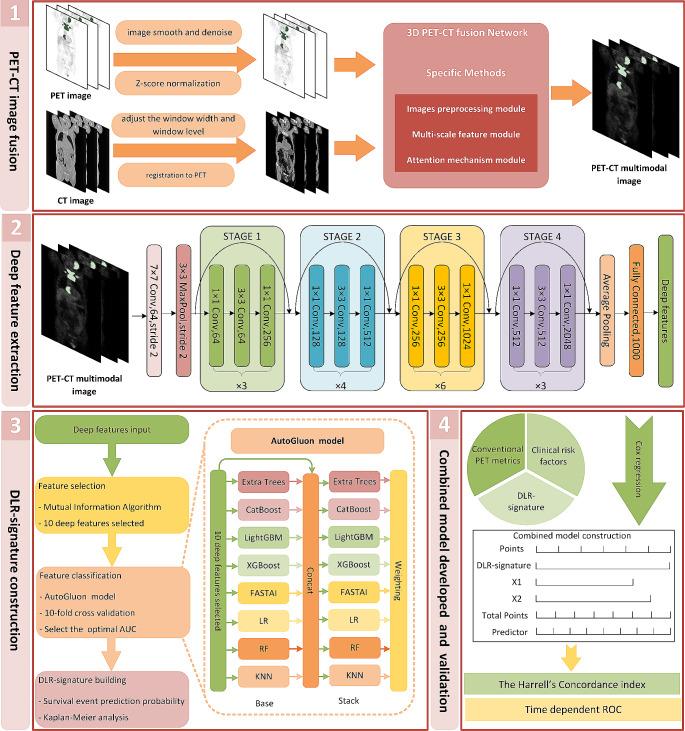
We sought to develop an effective combined model for predicting the survival of patients with diffuse large B-cell lymphoma (DLBCL) based on the multimodal PET-CT deep features radiomics signature (DFR-signature).
METHODS
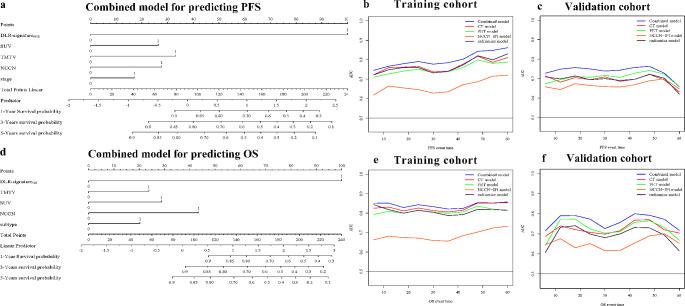
369 DLBCL patients from two medical centers were included in this study. Their PET and CT images were fused to construct the multimodal PET-CT images using a deep learning fusion network. Then the deep features were extracted from those fused PET-CT images, and the DFR-signature was constructed through an Automated machine learning (AutoML) model. Combined with clinical indexes from the Cox regression analysis, we constructed a combined model to predict the progression-free survival (PFS) and the overall survival (OS) of patients. In addition, the combined model was evaluated in the concordance index (C-index) and the time-dependent area under the ROC curve (tdAUC).
RESULTS
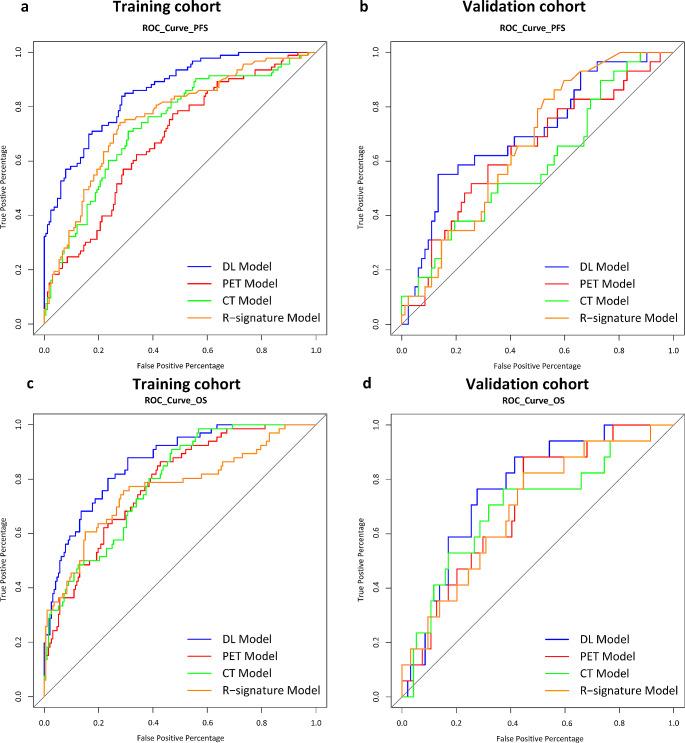
A total of 1000 deep features were extracted to build a DFR-signature. Besides the DFR-signature, the combined model integrating metabolic and clinical factors performed best in terms of PFS and OS. For PFS, the C-indices are 0.784 and 0.739 in the training cohort and internal validation cohort, respectively. For OS, the C-indices are 0.831 and 0.782 in the training cohort and internal validation cohort.
CONCLUSIONS
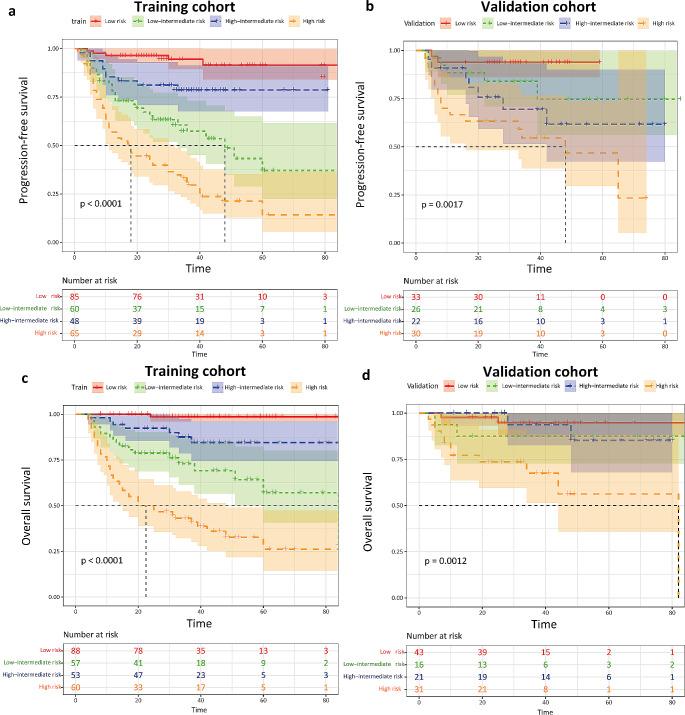
DFR-signature constructed from multimodal images improved the classification accuracy of prognosis for DLBCL patients. Moreover, the constructed DFR-signature combined with NCCN-IPI exhibited excellent potential for risk stratification of DLBCL patients.
目的
我们旨在开发一种基于多模态 PET-CT 深度学习特征放射组学特征(DFR-特征)的弥漫性大 B 细胞淋巴瘤(DLBCL)患者生存的有效联合模型。
方法
本研究纳入了来自两个医学中心的 369 例 DLBCL 患者。使用深度学习融合网络对其 PET 和 CT 图像进行融合,构建多模态 PET-CT 图像。然后从这些融合的 PET-CT 图像中提取深度学习特征,并通过自动化机器学习(AutoML)模型构建 DFR-特征。结合 Cox 回归分析中的临床指标,构建联合模型预测患者的无进展生存(PFS)和总生存(OS)。此外,通过一致性指数(C-index)和时间依赖的 ROC 曲线下面积(tdAUC)评估联合模型。
结果
共提取了 1000 个深度学习特征构建 DFR-特征。除了 DFR-特征外,整合代谢和临床因素的联合模型在 PFS 和 OS 方面表现最佳。在 PFS 方面,训练队列和内部验证队列的 C 指数分别为 0.784 和 0.739。在 OS 方面,训练队列和内部验证队列的 C 指数分别为 0.831 和 0.782。
结论
多模态图像构建的 DFR-特征提高了对 DLBCL 患者预后的分类准确性。此外,构建的 DFR-特征联合 NCCN-IPI 对 DLBCL 患者的风险分层具有出色的潜力。

 Zotero 插件