
用于预测急性胰腺炎相关性急性肾损伤重症患者死亡率的机器学习模型
Machine learning models for mortality prediction in critically ill patients with acute pancreatitis-associated acute kidney injury.
作者信息
Liu Yamin, Zhu Xu, Xue Jing, Maimaitituerxun Rehanguli, Chen Wenhang, Dai Wenjie
机构信息
Department of Epidemiology and Health Statistics, Xiangya School of Public Health, Central South University, Changsha, Hunan, China.
Department of Epidemiology and Health Statistics, College of Integrated Traditional Chinese and Western Medicine, Hunan University of Chinese Medicine, Changsha, Hunan, China.
出版信息
Clin Kidney J. 2024 Sep 11;17(10):sfae284. doi: 10.1093/ckj/sfae284. eCollection 2024 Oct.
BACKGROUND
The occurrence of acute kidney injury (AKI) was associated with an increased mortality rate among acute pancreatitis (AP) patients, indicating the importance of accurately predicting the mortality rate of critically ill patients with acute pancreatitis-associated acute kidney injury (AP-AKI) at an early stage. This study aimed to develop and validate machine learning-based predictive models for in-hospital mortality rate in critically ill patients with AP-AKI by comparing their performance with the traditional logistic regression (LR) model.
METHODS
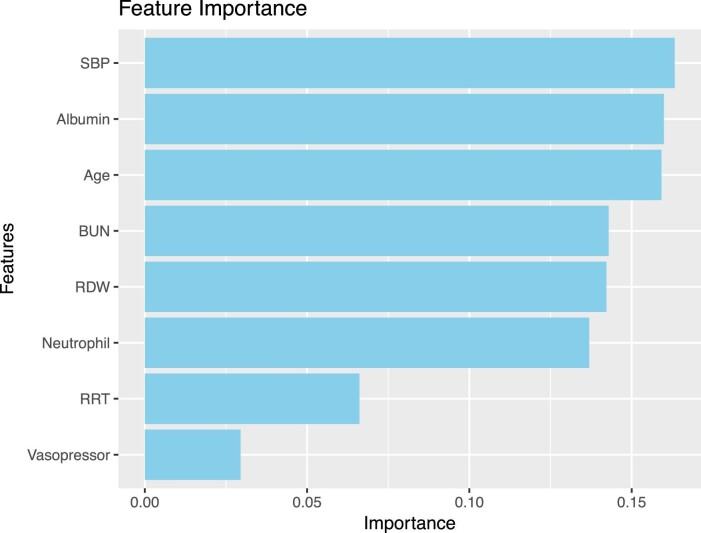
This study used data from three clinical databases. The predictors were identified by the Recursive Feature Elimination algorithm. The LR and two machine learning models-random forest (RF) and eXtreme Gradient Boosting (XGBoost)-were developed using 10-fold cross-validation to predict in-hospital mortality rate in AP-AKI patients.
RESULTS
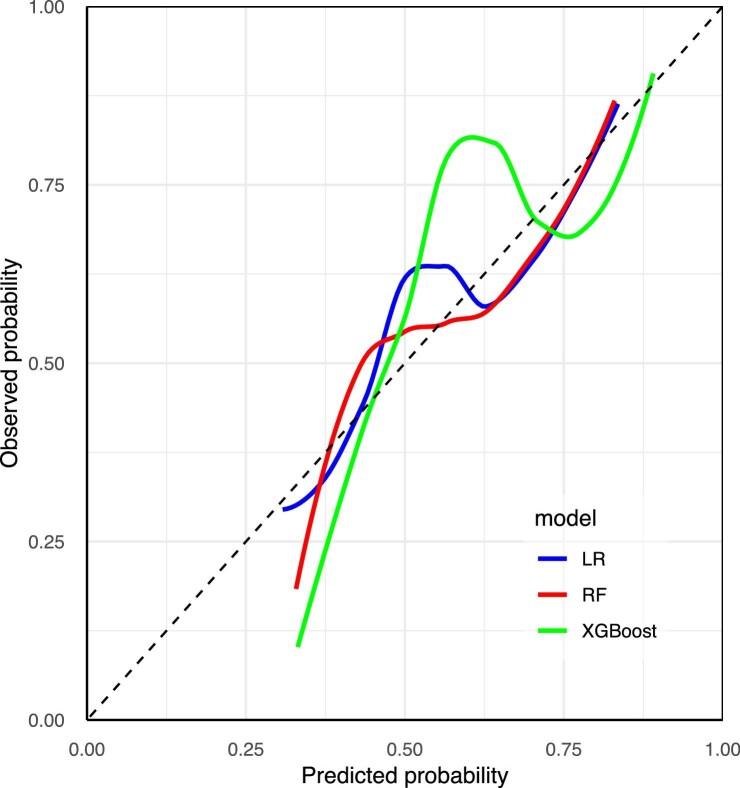
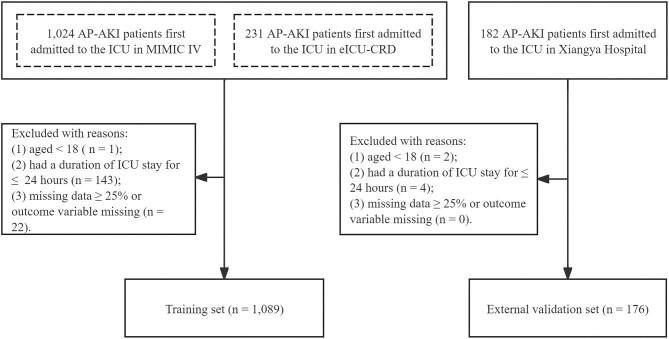
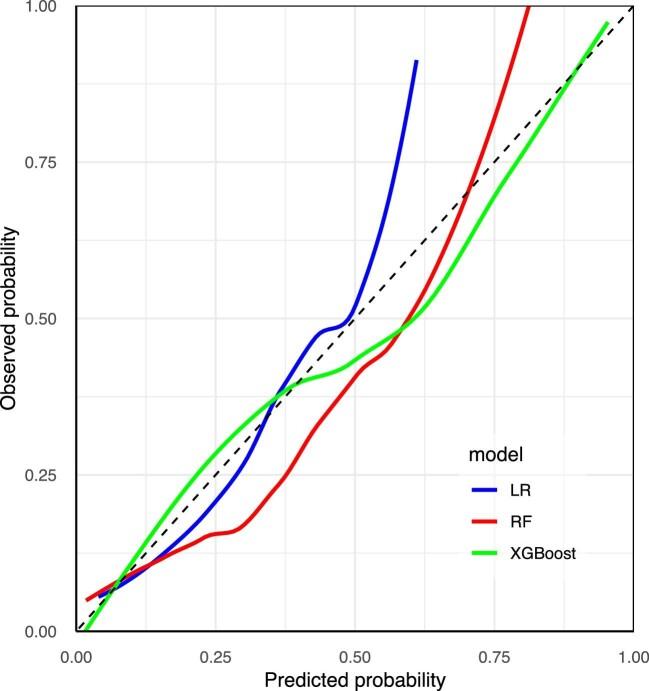
A total of 1089 patients from the Medical Information Mart for Intensive Care-IV (MIMIC-IV) and eICU Collaborative Research Database (eICU-CRD) were included in the training set and 176 patients from Xiangya Hospital were included in the external validation set. The in-hospital mortality rates of the training and external validation sets were 13.77% and 54.55%, respectively. Compared with the area under the curve (AUC) values of the LR model and the RF model, the AUC value of the XGBoost model {0.941 [95% confidence interval (CI) 0.931-0.952]} was significantly higher (both < .001) and the XGBoost model had the smallest Brier score of 0.039 in the training set. In the external validation set, the performance of the XGBoost model was acceptable, with an AUC value of 0.724 (95% CI 0.648-0.800). However, it did not differ significantly from the LR and RF models.
CONCLUSIONS
The XGBoost model was superior to the LR and RF models in terms of both the discrimination and calibration in the training set. Whether the findings can be generalized needs to be further validated.
背景
急性肾损伤(AKI)的发生与急性胰腺炎(AP)患者死亡率增加相关,这表明早期准确预测急性胰腺炎相关性急性肾损伤(AP-AKI)重症患者死亡率的重要性。本研究旨在通过将基于机器学习的预测模型与传统逻辑回归(LR)模型的性能进行比较,开发并验证用于AP-AKI重症患者院内死亡率的预测模型。
方法
本研究使用了来自三个临床数据库的数据。通过递归特征消除算法确定预测因子。使用10折交叉验证开发了LR以及两种机器学习模型——随机森林(RF)和极端梯度提升(XGBoost),以预测AP-AKI患者的院内死亡率。
结果
重症监护医学信息数据库-IV(MIMIC-IV)和电子重症监护病房协作研究数据库(eICU-CRD)中的1089例患者被纳入训练集,湘雅医院的176例患者被纳入外部验证集。训练集和外部验证集的院内死亡率分别为13.77%和54.55%。与LR模型和RF模型的曲线下面积(AUC)值相比,XGBoost模型的AUC值{0.941[95%置信区间(CI)0.931-0.952]}显著更高(均P<0.001),且XGBoost模型在训练集中的布里尔得分最小,为0.039。在外部验证集中,XGBoost模型的性能尚可,AUC值为0.724(95%CI 0.648-0.800)。然而,它与LR和RF模型相比无显著差异。
结论
在训练集中,XGBoost模型在区分度和校准方面均优于LR和RF模型。这些发现能否推广尚需进一步验证。


 Zotero 插件