
童年和成年社会经济地位对晚年健康长寿的影响:来自中国长寿纵向研究的证据。
Childhood and adult socioeconomic status influence on late-life healthy longevity: evidence from the Chinese longitudinal healthy longevity survey.
机构信息
School of Public Finance and Taxation, Capital University of Economics and Business, Beijing, China.
出版信息
Front Public Health. 2024 Sep 30;12:1352937. doi: 10.3389/fpubh.2024.1352937. eCollection 2024.
BACKGROUND
Older people in low- and middle-income countries are more susceptible to the impact of childhood experiences. This study comprehensively examines how childhood socioeconomic status (SES) and adult SES collectively influence late-life healthy longevity from a life course perspective, providing insights for shaping health-related policies.
METHODS
This study analyzed data from the Chinese Longitudinal Healthy Longevity Survey (1998-2018) with 37,264 individuals aged 65 and above. Using R software, we applied continuous-time multi-state models incorporating the Rockwood frailty index with 38 indicators to assess participants' health. Childhood SES or life course SES trajectories were core explanatory variables, while age and gender were controlled. Multinomial regression estimated annual transition probabilities between different states, and the multi-state life table method calculated total and frailty-specific life expectancy (LE).
RESULTS
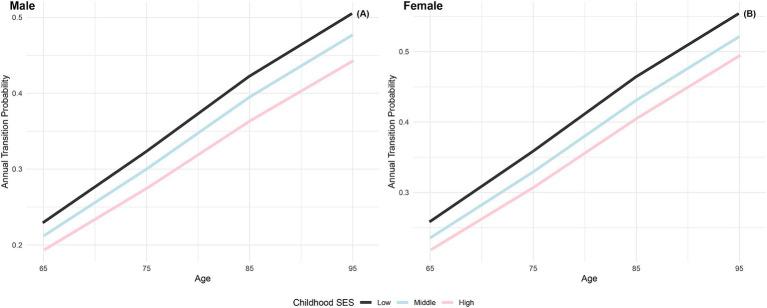
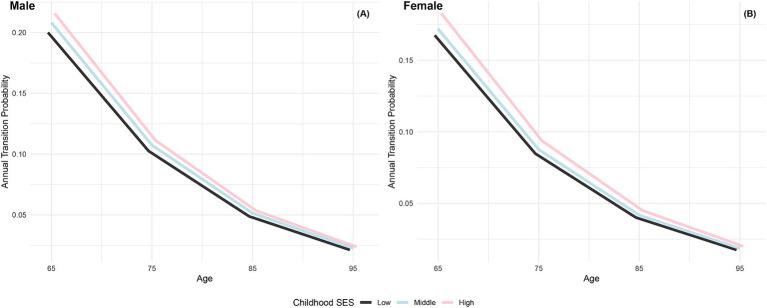
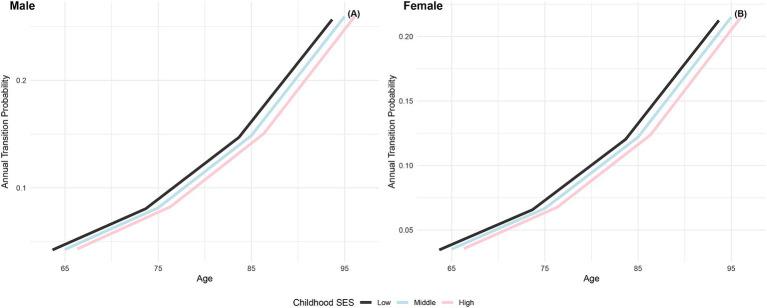
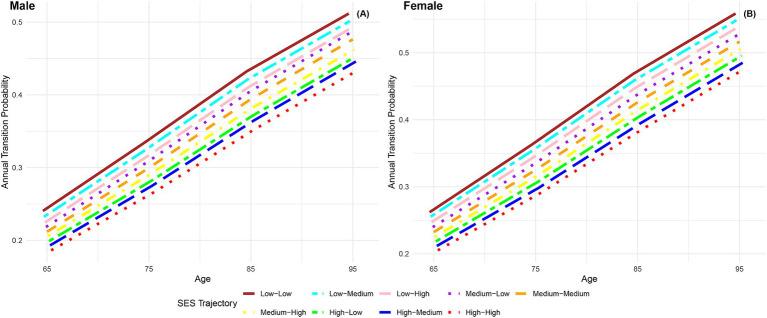
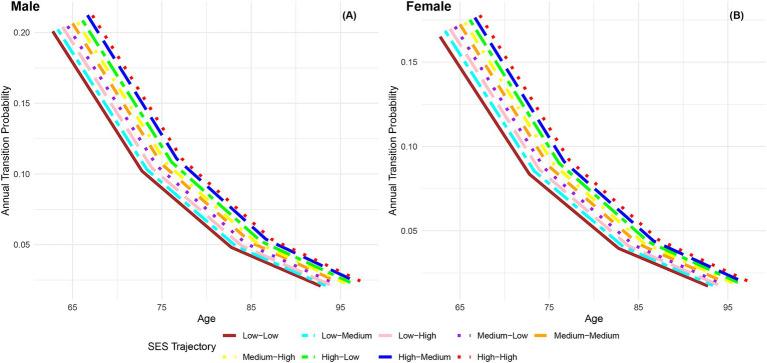
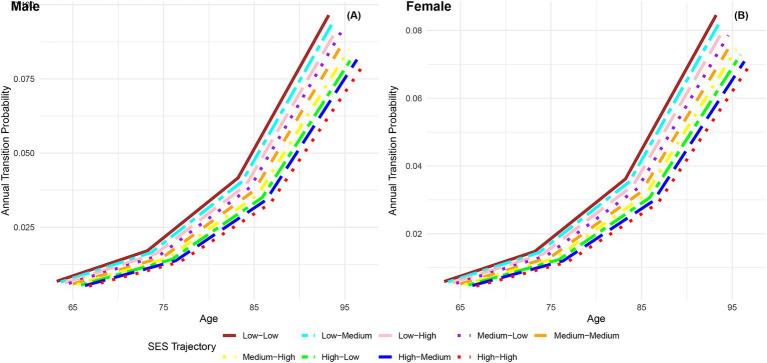
(1) Social mobility among older people in China showed an upward trend from childhood to adulthood. (2) Transition probabilities for robust-frailty, robust-dead, and frailty-dead increased with age, while frailty-robust decreased. Transition probabilities and LE varied across different childhood SES (low, medium, high) or life-course SES trajectory categories (low-low, low-medium, low-high, medium-low, medium-medium, medium-high, high-low, high-medium, high-high), with probabilities of robust-frailty, robust-dead, and frailty-dead decreasing sequentially across different categories, and frailty-robust increasing sequentially across different categories. Total LE, robust LE, and robust LE proportion increased sequentially across different categories, while frailty LE decreased sequentially across different categories. (3) Women had higher total LE and frailty incidence, but lower recovery rate, mortality risk, robust LE, and robust LE proportion compared to men.
CONCLUSION
Favorable childhood SES and lifelong accumulation of SES advantages protect against frailty morbidity, improve recovery rate, reduce mortality risk, and increase total LE, robust LE, and robust LE proportion. High childhood SES has a stronger protective effect than high adult SES, indicating the lasting impact of childhood conditions on healthy longevity. Systematic interventions in education, food supply, and medical accessibility for children from impoverished families are crucial.
背景
中低收入国家的老年人更容易受到童年经历的影响。本研究从生命历程的角度全面考察了童年社会经济地位(SES)和成年 SES 如何共同影响晚年健康长寿,为制定健康相关政策提供了依据。
方法
本研究分析了中国长寿与健康长寿调查(1998-2018 年)的数据,共有 37264 名 65 岁及以上的个体。使用 R 软件,我们应用连续时间多状态模型,结合 Rockwood 脆弱指数和 38 个指标,评估参与者的健康状况。童年 SES 或生命历程 SES 轨迹是核心解释变量,同时控制年龄和性别。多项回归估计了不同状态之间的年转移概率,多状态寿命表法计算了总寿命和脆弱性特异性寿命(LE)。
结果
(1)中国老年人的社会流动呈现从童年到成年的上升趋势。(2)健壮-脆弱、健壮-死亡和脆弱-死亡的转移概率随年龄增加而增加,而脆弱-健壮则随年龄增加而减少。转移概率和 LE 因不同的童年 SES(低、中、高)或生命历程 SES 轨迹类别(低-低、低-中、低-高、中-低、中-中、中-高、高-低、高-中、高-高)而异,健壮-脆弱、健壮-死亡和脆弱-死亡的转移概率依次递减,而脆弱-健壮的转移概率依次递增。总 LE、健壮 LE 和健壮 LE 比例依次递增,而脆弱 LE 依次递减。(3)女性的总 LE 和脆弱性发病率较高,但恢复率、死亡率风险、健壮 LE 和健壮 LE 比例较低。
结论
有利的童年 SES 和终身 SES 优势的积累可以预防脆弱性发病,提高恢复率,降低死亡率风险,增加总 LE、健壮 LE 和健壮 LE 比例。高童年 SES 的保护作用强于高成年 SES,表明童年条件对健康长寿的持久影响。对贫困家庭儿童进行系统性的教育、食品供应和医疗可及性干预至关重要。


 Zotero 插件