
2 型糖尿病的炎症轨迹:早期和晚期治疗的新机会。
Inflammatory Trajectory of Type 2 Diabetes: Novel Opportunities for Early and Late Treatment.
机构信息
IRCCS MultiMedica, Via Fantoli 16/15, 20138 Milan, Italy.
Cardiac Rehabilitation Unit of Bari Institute, Istituti Clinici Scientifici Maugeri IRCCS, 70124 Bari, Italy.
出版信息
Cells. 2024 Oct 8;13(19):1662. doi: 10.3390/cells13191662.
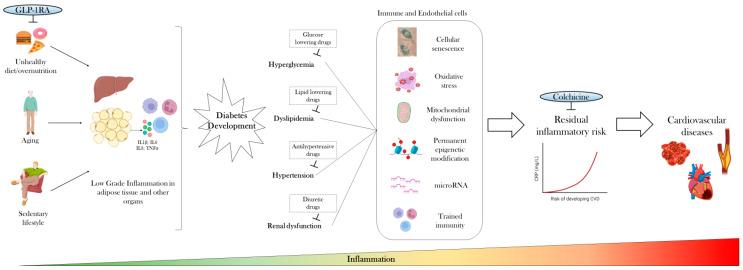
Low-grade inflammation (LGI) represents a key driver of type 2 diabetes (T2D) and its associated cardiovascular diseases (CVDs). Indeed, inflammatory markers such as hs-CRP and IL-6 predict the development of T2D and its complications, suggesting that LGI already increases before T2D diagnosis and remains elevated even after treatment. Overnutrition, unhealthy diets, physical inactivity, obesity, and aging are all recognized triggers of LGI, promoting insulin resistance and sustaining the pathogenesis of T2D. Once developed, and even before frank appearance, people with T2D undergo a pathological metabolic remodeling, with an alteration of multiple CVD risk factors, i.e., glycemia, lipids, blood pressure, and renal function. In turn, such variables foster a range of inflammatory pathways and mechanisms, e.g., immune cell stimulation, the accrual of senescent cells, long-lasting epigenetic changes, and trained immunity, which are held to chronically fuel LGI at the systemic and tissue levels. Targeting of CVD risk factors partially ameliorates LGI. However, some long-lasting inflammatory pathways are unaffected by common therapies, and LGI burden is still increased in many T2D patients, a phenomenon possibly underlying the residual inflammatory risk (i.e., having hs-CRP > 2 mg/dL despite optimal LDL cholesterol control). On the other hand, selected disease-modifying drugs, e.g., GLP-1RA, seem to also act on the pathogenesis of T2D, curbing the inflammatory trajectory of the disease and possibly preventing it if introduced early. In addition, selected trials demonstrated the potential of canonical anti-inflammatory therapies in reducing the rate of CVDs in patients with this condition or at high risk for it, many of whom had T2D. Since colchicine, an inhibitor of immune cell activation, is now approved for the prevention of CVDs, it might be worth exploring a possible therapeutic paradigm to identify subjects with T2D and an increased LGI burden to treat them with this drug. Upcoming studies will reveal whether disease-modifying drugs reverse early T2D by suppressing sources of LGI and whether colchicine has a broad benefit in people with this condition.
低度炎症(LGI)是 2 型糖尿病(T2D)及其相关心血管疾病(CVDs)的主要驱动因素。事实上,hs-CRP 和 IL-6 等炎症标志物可预测 T2D 的发生及其并发症,表明 LGI 在 T2D 诊断之前就已经增加,并在治疗后仍保持升高。营养过剩、不健康的饮食、缺乏身体活动、肥胖和衰老都是 LGI 的公认诱因,促进胰岛素抵抗并维持 T2D 的发病机制。一旦发生,甚至在出现明显症状之前,患有 T2D 的人就会经历病理性代谢重塑,多种 CVD 风险因素发生改变,即血糖、血脂、血压和肾功能。反过来,这些变量又会促进一系列炎症途径和机制,例如免疫细胞刺激、衰老细胞的积累、持久的表观遗传变化和训练免疫,这些机制被认为会在系统和组织水平上慢性引发 LGI。针对 CVD 风险因素的治疗可部分改善 LGI。然而,一些持久的炎症途径不受常见治疗的影响,许多 T2D 患者的 LGI 负担仍然增加,这种现象可能是残余炎症风险的基础(即尽管 LDL 胆固醇得到最佳控制,hs-CRP 仍>2mg/dL)。另一方面,一些有针对性的疾病修饰药物,例如 GLP-1RA,似乎也作用于 T2D 的发病机制,抑制疾病的炎症轨迹,并在早期引入时可能预防疾病。此外,一些临床试验表明,经典抗炎疗法在降低此类患者或高危患者 CVD 发生率方面具有潜在作用,其中许多患者患有 T2D。由于秋水仙碱是一种免疫细胞激活抑制剂,现已被批准用于预防 CVD,因此探索一种可能的治疗方法来识别 T2D 患者和具有 LGI 负担增加的患者,并使用该药对他们进行治疗可能是值得的。未来的研究将揭示疾病修饰药物是否通过抑制 LGI 的来源来逆转早期 T2D,以及秋水仙碱是否对患有这种疾病的人有广泛的益处。

 Zotero 插件