
使用家犬粪便样本进行全线粒体DNA测序
Whole Mitochondrial DNA Sequencing Using Fecal Samples from Domestic Dogs.
作者信息
Sugasawa Takehito, Nguyen Kieu D M, Otani Norihiro, Maehara Kiyoshi, Kamiya Fuka, Hirokawa Atsushi, Takemasa Tohru, Watanabe Koichi, Nishi Takeki, Sato Ken, Shimmura Suzuka, Takahashi Yoichiro, Kanki Yasuharu
机构信息
Laboratory of Clinical Examination and Sports Medicine, Department of Clinical Medicine, Institute of Medicine, University of Tsukuba, 1-1-1 Tennodai, Tsukuba 305-8577, Japan.
Department of Sports Medicine Analysis, Open Facility Network Office, Organization for Open Facility Initiatives, University of Tsukuba, 1-1-1 Tennodai, Tsukuba 305-8577, Japan.
出版信息
Animals (Basel). 2024 Oct 5;14(19):2872. doi: 10.3390/ani14192872.
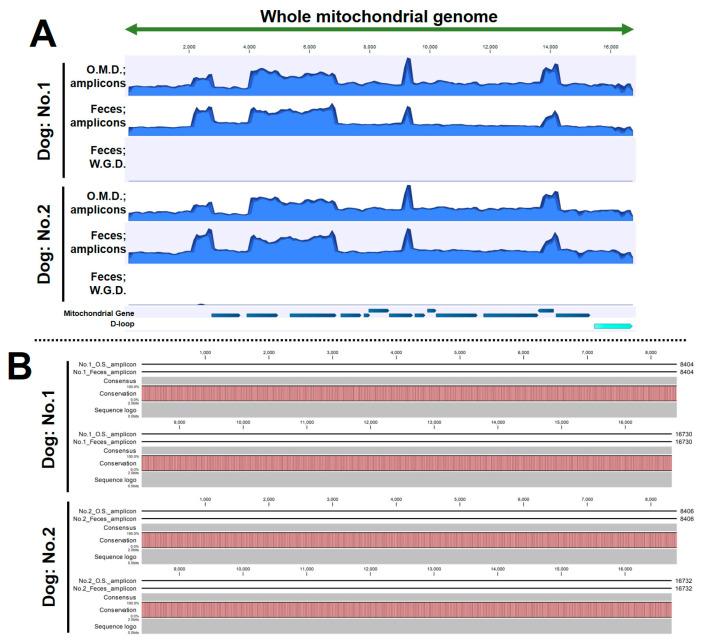
Medical care for domestic dogs is now respected worldwide as being at a similar level to that of humans. We previously established a test method to determine whole mitochondrial DNA (mtDNA) using oral mucosal DNA that may be useful for medical care and welfare. However, the sample types tested in dogs are not limited to those obtained from the oral mucosa. Therefore, in the present study, we attempted to establish a test method to determine whole mtDNA sequences using feces, which represents the least invasive specimen. Two Japanese domestic dogs were used in the present study. DNA was extracted from approximately 100 mg of fresh feces from each dog, and PCRs were performed using four primer pairs that can amplify whole mtDNA. Following PCR, amplicons were pooled to create a DNA library using an experimental robot with an original program. Data were then acquired via NGS and data analysis was performed. The results showed that the whole mtDNA sequence of the two dogs was determined with high accuracy. Our results suggest that feces can be adapted for mitochondrial disease and individual identification testing and could serve as a useful testing method for the future medical care and welfare of domestic dogs.
如今,家犬的医疗护理在全球范围内被视为与人类医疗护理处于相似水平。我们之前建立了一种利用口腔黏膜DNA来测定整个线粒体DNA(mtDNA)的检测方法,这可能对医疗护理和福利有益。然而,在犬类中进行检测的样本类型并不局限于从口腔黏膜获取的样本。因此,在本研究中,我们试图建立一种利用粪便来测定整个mtDNA序列的检测方法,粪便代表了侵入性最小的样本。本研究使用了两只日本家犬。从每只犬约100毫克的新鲜粪便中提取DNA,并使用四对能够扩增整个mtDNA的引物对进行聚合酶链式反应(PCR)。PCR之后,使用带有原始程序的实验机器人将扩增产物汇集起来构建DNA文库。然后通过下一代测序(NGS)获取数据并进行数据分析。结果表明,两只犬的整个mtDNA序列都被高精度地测定出来。我们的结果表明,粪便可用于线粒体疾病检测和个体识别检测,并可作为未来家犬医疗护理和福利的一种有用检测方法。


 Zotero 插件