
吸引力法则:趋化因子作为膀胱癌进展和免疫治疗反应的关键介质
The Laws of Attraction: Chemokines as Critical Mediators in Cancer Progression and Immunotherapy Response in Bladder Cancer.
作者信息
Hassouneh Zaineb, Kim Michelle E, Bowman Natalia, Rao Manjeet, Zhang Nu, Huang Gang, Svatek Robert S, Mukherjee Neelam
机构信息
Department of Urology, University of Texas Health Science Center at San Antonio (UTHSCSA), San Antonio, TX 78229, USA.
Department of Microbiology, Immunology, and Molecular Genetics, University of Texas Health Science Center at San Antonio (UTHSCSA), San Antonio, TX 78229, USA.
出版信息
Cancers (Basel). 2024 Sep 27;16(19):3303. doi: 10.3390/cancers16193303.
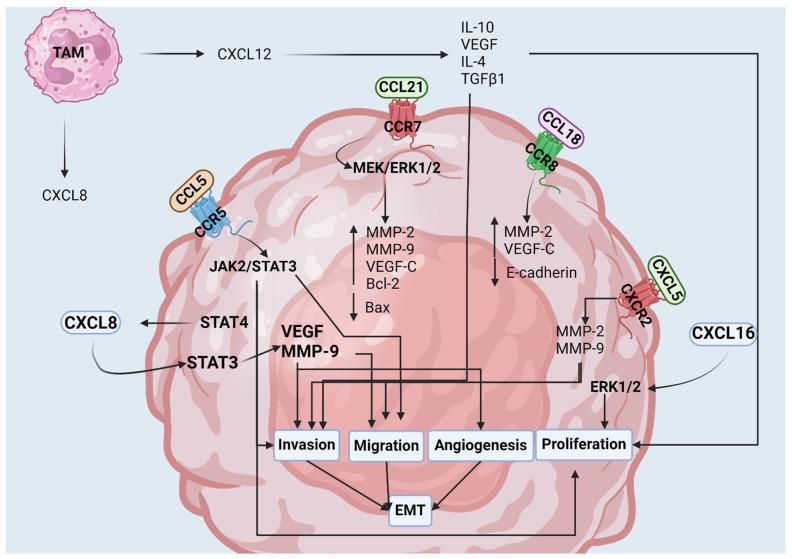
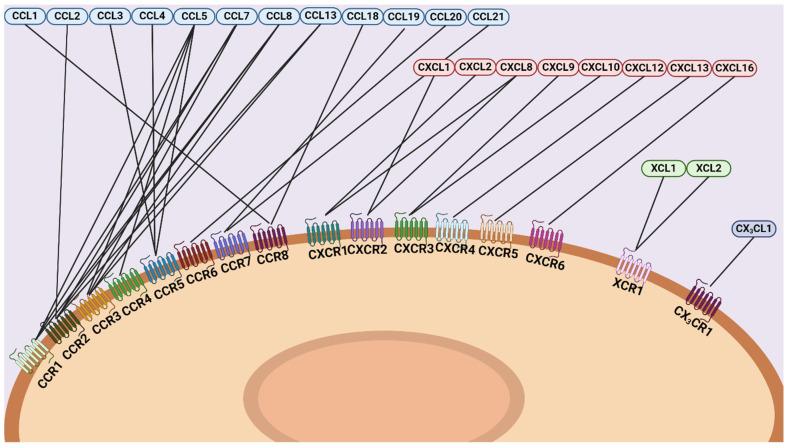
Bladder cancer (BCa) is a prevalent urogenital malignancy, characterized by a myriad of genetic and environmental risk factors that drive its progression. Approximately 75% of bladder tumors are non-muscle-invasive at diagnosis. For such cases, bladder preservation is often feasible with intravesical chemotherapy or immunotherapy. However, the high recurrence rates associated with these tumors necessitate multiple cystoscopic examinations and biopsies, leading to significant financial burden and morbidity. Despite bladder tumors exhibiting one of the highest cancer mutational loads, which typically correlates with improved responses to immunotherapy, challenges persist. The tumor microenvironment serves as a nexus for interactions between tumor cells and the immune system, wherein chemokines and chemokine receptors orchestrate the recruitment of immune cells. This review addresses existing gaps in our understanding of chemokine dynamics in BCa by elucidating the specific roles of key chemokines in shaping the immune landscape of the tumor microenvironment (TME). We explore how dysregulation of chemokine signaling pathways contributes to the recruitment of immunosuppressive cell populations, such as Tregs and monocytes, leading to an unfavorable immune response. Additionally, we highlight the potential of these chemokines as predictive biomarkers for tumor progression and treatment outcomes, emphasizing their role in informing personalized immunotherapeutic strategies. By integrating insights into chemokine networks and their implications for immune cell dynamics, this review seeks to provide a comprehensive understanding of the interplay between chemokines and the immune microenvironment in BCa. Furthermore, we discuss the potential of targeting these chemokine pathways as innovative immunotherapeutic strategies, paving the way for enhanced treatment responses and improved patient outcomes.
膀胱癌(BCa)是一种常见的泌尿生殖系统恶性肿瘤,其特征是由众多遗传和环境风险因素驱动其进展。在诊断时,约75%的膀胱肿瘤为非肌层浸润性。对于此类病例,膀胱内化疗或免疫治疗通常可实现膀胱保留。然而,这些肿瘤的高复发率需要多次膀胱镜检查和活检,导致巨大的经济负担和发病率。尽管膀胱肿瘤表现出最高的癌症突变负荷之一,这通常与免疫治疗反应的改善相关,但挑战依然存在。肿瘤微环境是肿瘤细胞与免疫系统相互作用的枢纽,其中趋化因子和趋化因子受体协调免疫细胞的募集。本综述通过阐明关键趋化因子在塑造肿瘤微环境(TME)免疫格局中的特定作用,填补了我们对BCa中趋化因子动态理解的现有空白。我们探讨趋化因子信号通路的失调如何导致免疫抑制细胞群体(如调节性T细胞和单核细胞)的募集,从而导致不利的免疫反应。此外,我们强调这些趋化因子作为肿瘤进展和治疗结果预测生物标志物的潜力,强调它们在指导个性化免疫治疗策略中的作用。通过整合对趋化因子网络及其对免疫细胞动态影响的见解,本综述旨在全面理解BCa中趋化因子与免疫微环境之间的相互作用。此外,我们讨论了靶向这些趋化因子途径作为创新免疫治疗策略的潜力,为增强治疗反应和改善患者预后铺平道路。

 Zotero 插件