
多组学植入前基因检测:基于RNA测序对整倍体囊胚的着床潜力进行重新评估。
Multi-omics PGT: re-evaluation of euploid blastocysts for implantation potential based on RNA sequencing.
作者信息
Jin Jiamin, Ma Jieliang, Wang Xiufen, Hong Fang, Zhang YinLi, Zhou Feng, Wan Cheng, Zou Yangyun, Yang Ji, Lu Sijia, Tong Xiaomei
机构信息
Assisted Reproduction Unit, Department of Obstetrics and Gynecology, Sir Run Run Shaw Hospital, Zhejiang University School of Medicine, Hangzhou, China.
Zhejiang Provincial Clinical Research Center for Obstetrics and Gynecology, Hangzhou, China.
出版信息
Hum Reprod. 2024 Dec 1;39(12):2861-2872. doi: 10.1093/humrep/deae237.
STUDY QUESTION
In addition to chromosomal euploidy, can the transcriptome of blastocysts be used as a novel predictor of embryo implantation potential?
SUMMARY ANSWER
This retrospective analysis showed that based on differentially expressed genes (DEGs) between euploid blastocysts which resulted and did not result in a clinical pregnancy, machine learning models could help improve implantation rates by blastocyst optimization.
WHAT IS KNOWN ALREADY
Embryo implantation is a multifaceted process, with implantation loss and pregnancy failure related not only to blastocyst euploidy but also to the intricate dialog between blastocyst and endometrium. Although in vitro studies have revealed the characteristics of trophectoderm (TE) differentiation in implanted blastocysts and the function of TE placentation at the implantation site, the precise molecular mechanisms of embryo implantation and their clinical application remain to be fully elucidated.
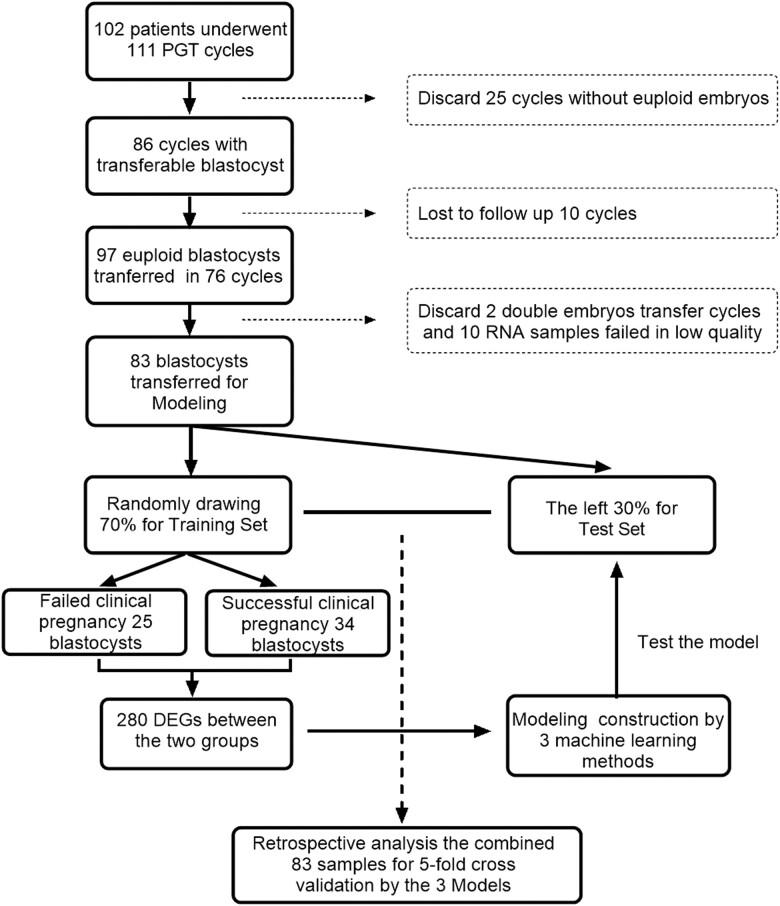
STUDY DESIGN, SIZE, DURATION: This study involved 102 patients who underwent 111 cycles for preimplantation genetic testing for aneuploidies (PGT-A) between March 2022 and July 2023.
PARTICIPANTS/MATERIALS, SETTING, METHODS: The study included 412 blastocysts biopsied at Day 5 [D5] or Day 6 [D6] for patients who underwent PGT-A. The biopsy lysates were split and subjected to DNA and RNA sequencing (DNA- and RNA-seq). One part was used for PGT-A to detect DNA copy number variations, whereas the other part was assessed simultaneously by RNA-seq to determine the transcriptome characteristics. To validate the reliability and accuracy of RNA-seq obtained from this strategy, we initially analyzed the transcriptome of blastocysts with chromosomal aneuploidies. Subsequently, we compared the transcriptomic features of blastocysts with different rates of formation (D5 vs D6) and investigated the network of interactions between key blastulation genes and the receptive endometrium. Then to evaluate the implantation potential of euploid blastocysts, we identified DEGs between euploid blastocysts that resulted in clinical pregnancy (defined as the presence of a gestational sac detected by ultrasound after 5 weeks) and those that did not. These DEGs were then employed to construct a predictive model for optimizing blastocyst selection.
MAIN RESULTS AND THE ROLE OF CHANCE
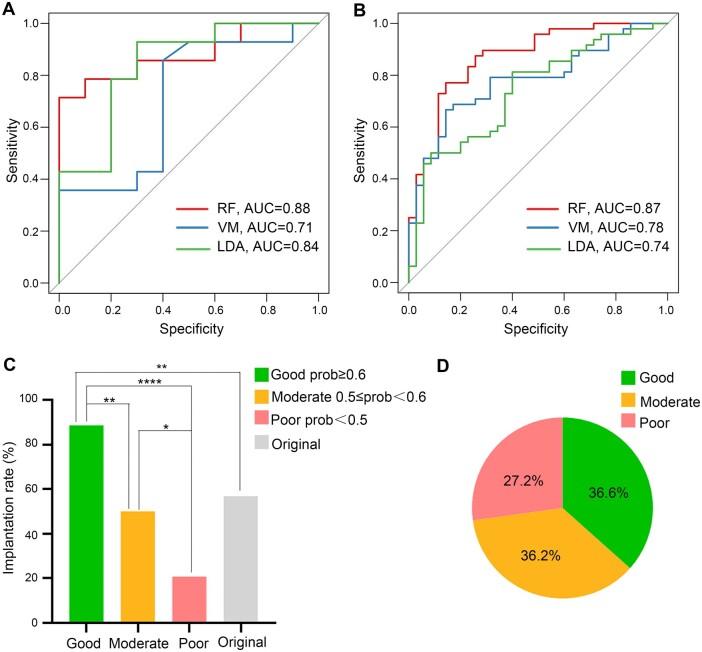
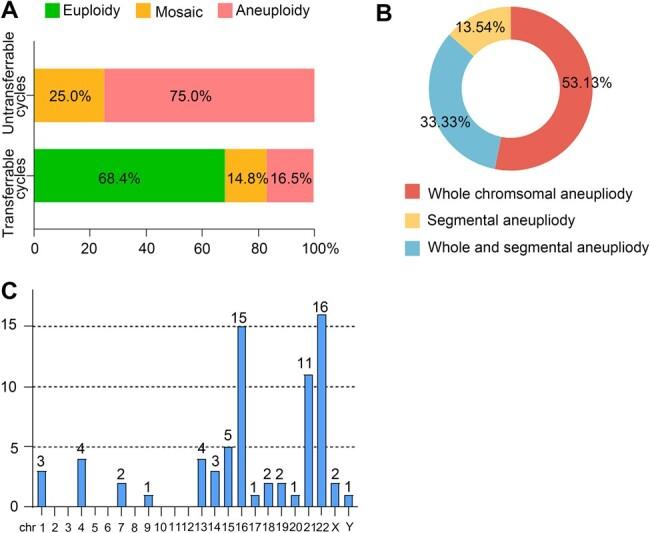
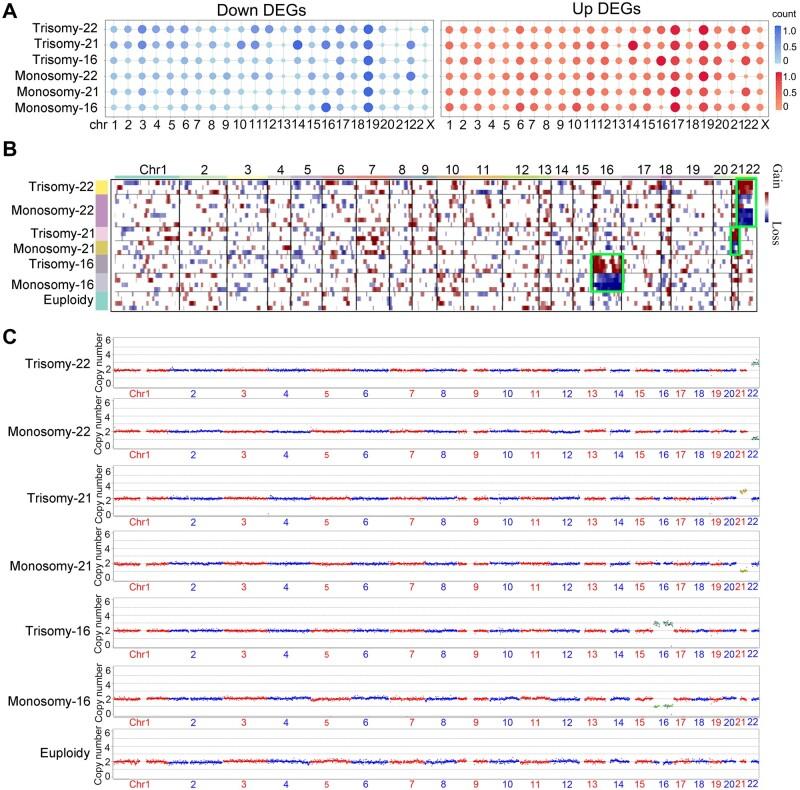
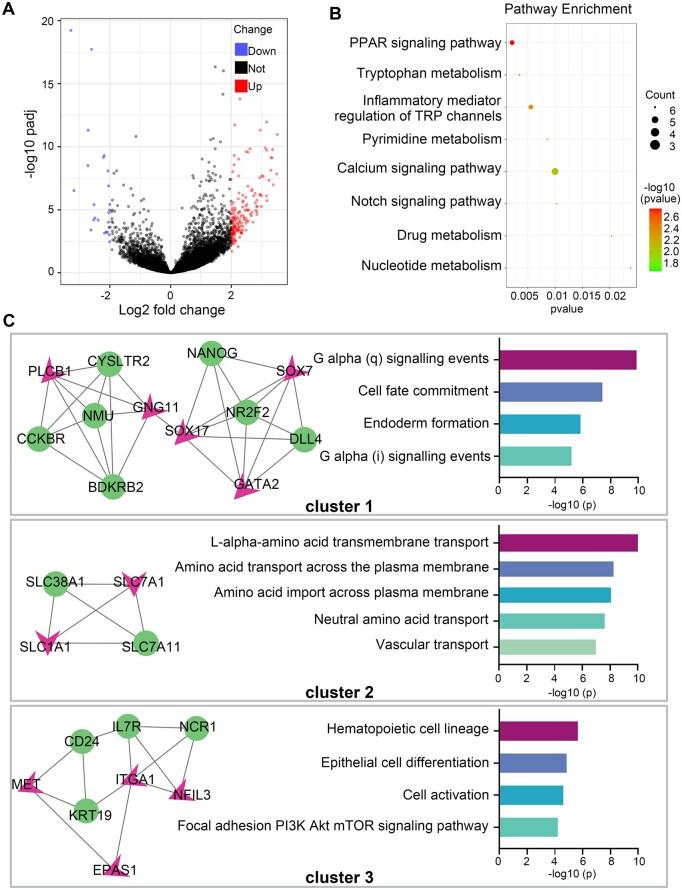
The successful detection rate of PGT-A was remarkably high at 99.8%. The RNA data may infer aneuploidy for both trisomy and monosomy. Between the euploid blastocysts that formed on D5 and D6, 187 DEGs were predominantly involved in cell differentiation for embryonic placenta development, the PPAR signaling pathway, and the Notch signaling pathway. These D5/D6 DEGs also exhibited a functional dialog with the receptive phase endometrium-specific genes through protein-protein interaction networks, indicating that the embryo undergoes further differentiation for post-implantation development. Furthermore, a modeling strategy using 280 DEGs between blastocysts leading to successful clinical pregnancies or failing to produce clinical pregnancies was implemented to refine the euploid embryo optimization, achieving areas under the curves of 0.88, 0.71, and 0.84 for the random forest (RF), support vector machine, and linear discriminant analysis models, respectively. Finally, a retrospective analysis of 83 transferred euploid blastocysts using the RF model identified three types of euploid embryos with a decreasing trend in implantation potential. Notably, the implantation rate of the good group was significantly higher than that of the moderate group (88.6% vs 50.0% P = 0.001) and that of the moderate group was higher than that of the poor group (50.0% vs 20.8%, P = 0.035).
LIMITATIONS, REASONS FOR CAUTION: The sample size was insufficient; thus, a prospective study is needed to verify the clinical effectiveness of the above model. Because we did not analyze blastocysts that led only to biochemical pregnancies but failed clinical pregnancies separately, our classification system still must be modified to screen these embryos.
WIDER IMPLICATIONS OF THE FINDINGS
Transcriptomic analysis of blastocysts offers a novel approach for predicting embryo implantation potential, which can be utilized to optimize clinical embryo selection. The ranking system may be effective in reducing the times and costs involved in achieving a clinical pregnancy.
STUDY FUNDING/COMPETING INTEREST(S): This study was funded by the "Pioneer" and "Leading Goose" R&D Program of Zhejiang (No. 2023C03034), the National Natural Science Foundation of China (82101709), and the National Key Research and Development Program for Young Scientists of China (No. 2022YFC2702300). The authors state no competing interests.
TRIAL REGISTRATION NUMBER
N/A.
研究问题
除了染色体整倍性外,囊胚的转录组能否作为预测胚胎着床潜力的新指标?
总结答案
这项回顾性分析表明,基于正常整倍体囊胚中导致临床妊娠和未导致临床妊娠的差异表达基因(DEG),机器学习模型可通过优化囊胚提高着床率。
已知信息
胚胎着床是一个多方面的过程,着床失败和妊娠失败不仅与囊胚的整倍性有关,还与囊胚和子宫内膜之间复杂的相互作用有关。尽管体外研究揭示了着床囊胚中滋养外胚层(TE)分化的特征以及TE在着床部位的胎盘形成功能,但胚胎着床的确切分子机制及其临床应用仍有待充分阐明。
研究设计、规模、持续时间:本研究纳入了2022年3月至2023年7月期间接受111个周期非整倍体植入前基因检测(PGT-A)的102例患者。
研究对象/材料、地点、方法:该研究纳入了412个在第5天(D5)或第6天(D6)进行活检的囊胚,这些患者接受了PGT-A。活检裂解物被分开用于DNA和RNA测序(DNA-和RNA-seq)。一部分用于PGT-A以检测DNA拷贝数变异,而另一部分同时通过RNA-seq进行评估以确定转录组特征。为了验证从该策略获得的RNA-seq的可靠性和准确性,我们首先分析了染色体非整倍体囊胚的转录组。随后,我们比较了不同形成率(D5与D6)囊胚的转录组特征,并研究了关键囊胚形成基因与接受性子宫内膜之间的相互作用网络。然后,为了评估整倍体囊胚的着床潜力,我们确定了导致临床妊娠(定义为5周后超声检测到妊娠囊)的整倍体囊胚与未导致临床妊娠的整倍体囊胚之间的DEG。然后利用这些DEG构建一个预测模型以优化囊胚选择。
主要结果及机遇的作用
PGT-A的成功检测率非常高,为99.8%。RNA数据可以推断三体和单体的非整倍性。在D5和D6形成的整倍体囊胚之间,187个DEG主要参与胚胎胎盘发育的细胞分化、PPAR信号通路和Notch信号通路。这些D5/D6 DEG还通过蛋白质-蛋白质相互作用网络与接受期子宫内膜特异性基因表现出功能相互作用,表明胚胎在着床后发育中经历进一步分化。此外,采用一种建模策略,利用导致成功临床妊娠或未产生临床妊娠的囊胚之间的280个DEG来优化整倍体胚胎选择,随机森林(RF)、支持向量机和线性判别分析模型的曲线下面积分别达到0.88、0.71和0.84。最后,使用RF模型对83个移植的整倍体囊胚进行回顾性分析,确定了三种着床潜力呈下降趋势的整倍体胚胎类型。值得注意的是,良好组的着床率显著高于中等组(88.6%对50.0%,P = 0.001),中等组高于不良组(50.0%对20.8%,P = 0.035)。
局限性、谨慎理由:样本量不足;因此,需要进行前瞻性研究以验证上述模型的临床有效性。由于我们没有单独分析仅导致生化妊娠但临床妊娠失败的囊胚,我们的分类系统仍需修改以筛选这些胚胎。
研究结果的更广泛意义
囊胚的转录组分析为预测胚胎着床潜力提供了一种新方法,可用于优化临床胚胎选择。该排名系统可能有效地减少实现临床妊娠所需的时间和成本。
研究资金/竞争利益:本研究由浙江省“尖兵”“领雁”研发计划(No. 2023C03034)、国家自然科学基金(82101709)和国家重点研发计划青年科学家项目(No. 2022YFC2702300)资助。作者声明无竞争利益。
试验注册号
无。

 Zotero 插件