
营养在预防和治疗骨骼肌衰老及肌肉减少症中的作用:单一营养素、全食物及整体饮食方法
Nutrition in the prevention and treatment of skeletal muscle ageing and sarcopenia: a single nutrient, a whole food and a whole diet approach.
作者信息
Granic Antoneta, Sayer Avan A, Cooper Rachel, Robinson Sian M
机构信息
AGE Research Group, Translational and Clinical Research Institute, Faculty of Medical Sciences, Newcastle University, Newcastle upon Tyne, UK.
NIHR Newcastle Biomedical Research Centre, Newcastle upon Tyne Hospitals NHS Foundation Trust, Cumbria, Northumberland, Tyne and Wear NHS Foundation Trust and Newcastle University, Newcastle upon Tyne, UK.
出版信息
Proc Nutr Soc. 2024 Oct 17:1-16. doi: 10.1017/S0029665124007432.
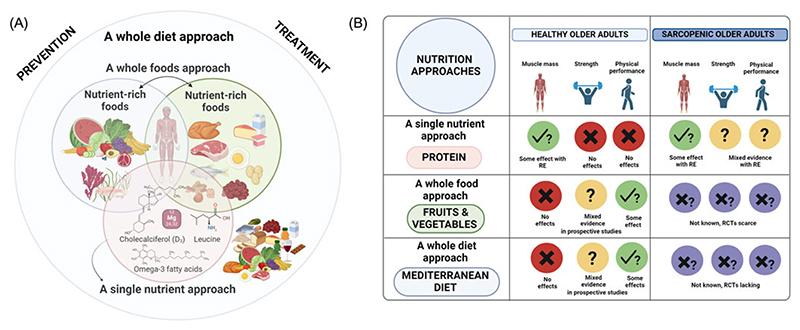
Loss of skeletal muscle strength and mass (sarcopenia) is common in older adults and associated with an increased risk of disability, frailty and premature death. Finding cost-effective prevention and treatment strategies for sarcopenia for the growing ageing population is therefore of great public health interest. Although nutrition is considered an important factor in the aetiology of sarcopenia, its potential for sarcopenia prevention and/or treatment is still being evaluated. Nutrition research for sarcopenia utilises three main approaches to understand muscle-nutrition relationships, evaluating: single nutrients, whole foods and whole diet effects - both alone or combined with exercise. Applying these approaches, we summarise recent evidence from qualitative and quantitative syntheses of findings from observational and intervention studies of healthy older adults, and those with sarcopenia. We consider protein supplements, whole foods (fruits and vegetables) and the Mediterranean diet as exemplars. There is some evidence of beneficial effects of protein supplementation ≥ 0·8 g/kg body weight/d on muscle mass when combined with exercise training in intervention studies of healthy and sarcopenic older adults. In contrast, evidence for effects on muscle function (strength and physical performance) is inconclusive. There is reasonably consistent epidemiological evidence suggesting benefits of higher fruits and vegetables consumption for better physical performance. Similarly, higher adherence to the Mediterranean diet is associated with beneficial effects on muscle function in observational studies. However, intervention studies are lacking. This review discusses how current evidence may inform the development of preventive and intervention strategies for optimal muscle ageing and nutritional public policy aimed at combatting sarcopenia.
骨骼肌力量和质量的丧失(肌肉减少症)在老年人中很常见,并且与残疾、身体虚弱和过早死亡风险增加相关。因此,为不断增长的老年人口寻找具有成本效益的肌肉减少症预防和治疗策略具有重大的公共卫生意义。尽管营养被认为是肌肉减少症病因中的一个重要因素,但其在预防和/或治疗肌肉减少症方面的潜力仍在评估中。针对肌肉减少症的营养研究采用三种主要方法来理解肌肉与营养的关系,即评估:单一营养素、全食物和整体饮食的影响——单独评估或与运动相结合评估。应用这些方法,我们总结了来自对健康老年人和患有肌肉减少症的老年人进行的观察性和干预性研究的定性和定量综合研究结果的最新证据。我们将蛋白质补充剂、全食物(水果和蔬菜)以及地中海饮食作为示例。在对健康和患有肌肉减少症的老年人进行的干预性研究中,有一些证据表明,当与运动训练相结合时,每日补充≥0·8 g/kg体重的蛋白质对肌肉质量有有益影响。相比之下,关于对肌肉功能(力量和身体表现)影响的证据尚无定论。有相当一致的流行病学证据表明,较高的水果和蔬菜摄入量有益于更好的身体表现。同样,在观察性研究中,更高程度地坚持地中海饮食与对肌肉功能的有益影响相关。然而,缺乏干预性研究。本综述讨论了当前证据如何为制定最佳肌肉衰老的预防和干预策略以及旨在对抗肌肉减少症的营养公共政策提供信息。
 Zotero 插件