
乐伐替尼联合异环磷酰胺和依托泊苷治疗复发骨肉瘤儿童和青年:一项2期随机临床试验
Lenvatinib Plus Ifosfamide and Etoposide in Children and Young Adults With Relapsed Osteosarcoma: A Phase 2 Randomized Clinical Trial.
作者信息
Gaspar Nathalie, Hung Giun-Yi, Strauss Sandra J, Campbell-Hewson Quentin, Dela Cruz Filemon S, Glade Bender Julia L, Koh Kyung-Nam, Whittle Sarah B, Chan Godfrey Chi-Fung, Gerber Nicolas U, Palmu Sauli, Morgenstern Daniel A, Longhi Alessandra, Baecklund Fredrik, Lee Jun Ah, Locatelli Franco, Márquez Vega Catalina, Janeway Katherine A, McCowage Geoffrey, McCabe Martin G, Bidadi Behzad, Huang Jie, McKenzie Jodi, Okpara Chinyere E, Bautista Francisco
机构信息
Department of Oncology for Child and Adolescent, Gustave Roussy Cancer Campus, Villejuif, France.
Department of Pediatrics, Taipei Veterans General Hospital, Taipei, Taiwan.
出版信息
JAMA Oncol. 2024 Dec 1;10(12):1645-1653. doi: 10.1001/jamaoncol.2024.4381.
IMPORTANCE
The combination of ifosfamide and etoposide (IE) is commonly used to treat relapsed or refractory osteosarcoma; however, second-line treatment recommendations vary across guidelines.
OBJECTIVE
To evaluate whether the addition of lenvatinib to IE (LEN-IE) improves outcomes in children and young adults with relapsed or refractory osteosarcoma.
DESIGN, SETTING, AND PARTICIPANTS: The OLIE phase II, open-label, randomized clinical trial was conducted globally across Europe, Asia and the Pacific, and North America. From March 22, 2020, through November 11, 2021, the trial enrolled patients aged 2 to 25 years with high-grade osteosarcoma, measurable or evaluable disease per Response Evaluation Criteria in Solid Tumors, version 1.1 (RECIST 1.1), and 1 to 2 prior lines of systemic treatment. The data analyses were performed between March 22, 2020 (first patient in) and June 22, 2022 (data cutoff for the primary analysis), and September 29, 2023 (end of study final database lock).
INTERVENTIONS
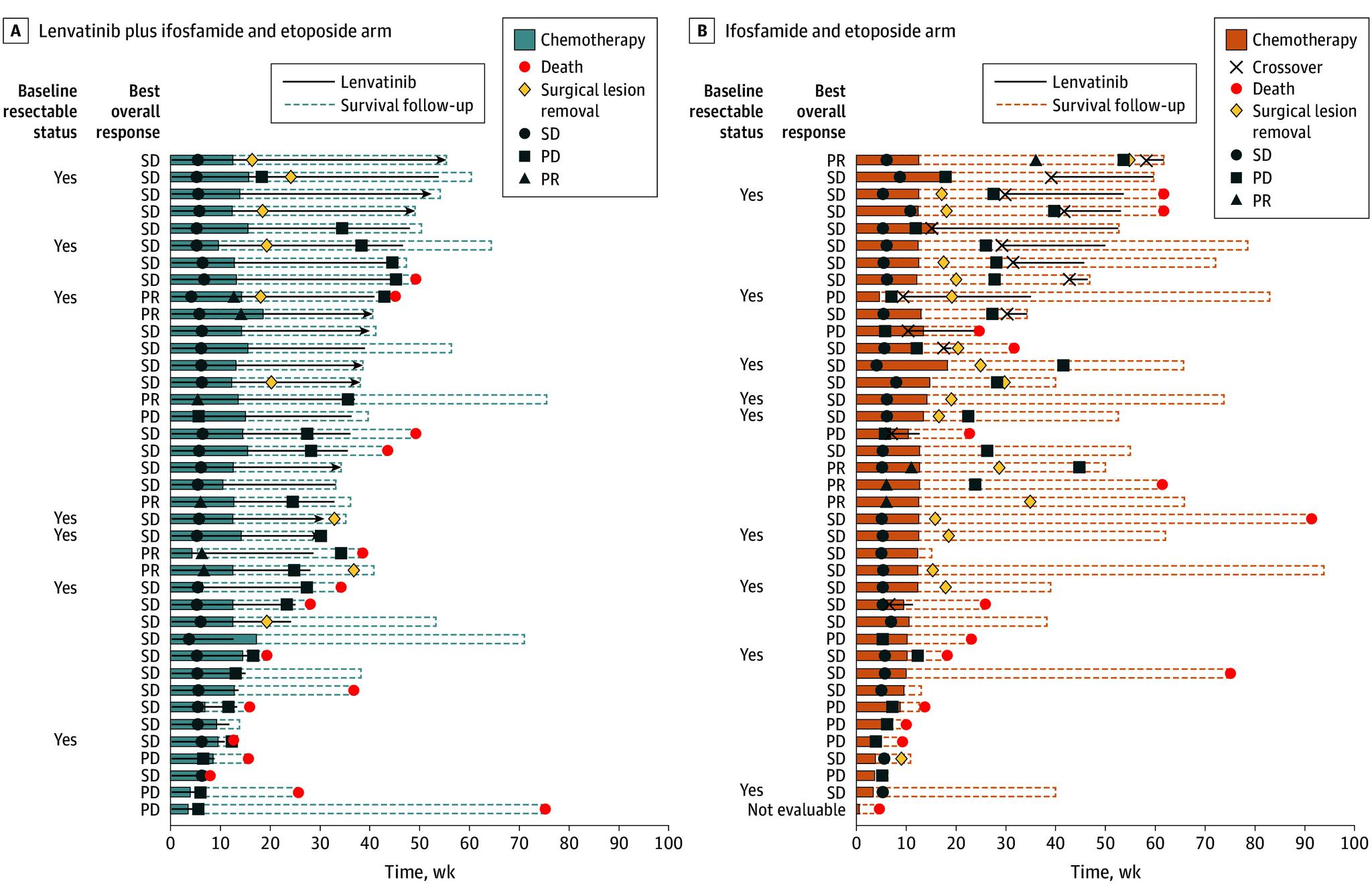
The OLIE trial assessed the efficacy and safety of lenvatinib (14 mg/m2 taken orally once daily) combined with up to 5 cycles of ifosfamide (3000 mg/m2 intravenously) and etoposide (100 mg/m2 intravenously) on days 1 to 3 of each cycle vs IE alone at the same doses. Patients randomized to IE could cross over to receive lenvatinib upon disease progression by independent imaging review.
MAIN OUTCOMES AND MEASURES
The primary end point was progression-free survival (PFS) per RECIST 1.1 by independent imaging review. The Kaplan-Meier method was used to estimate the PFS distribution, with a prespecified 1-sided significance threshold of .025 by stratified log-rank test. Secondary end points included PFS rate at 4 months and overall survival. Adverse events were summarized using descriptive statistics.
RESULTS
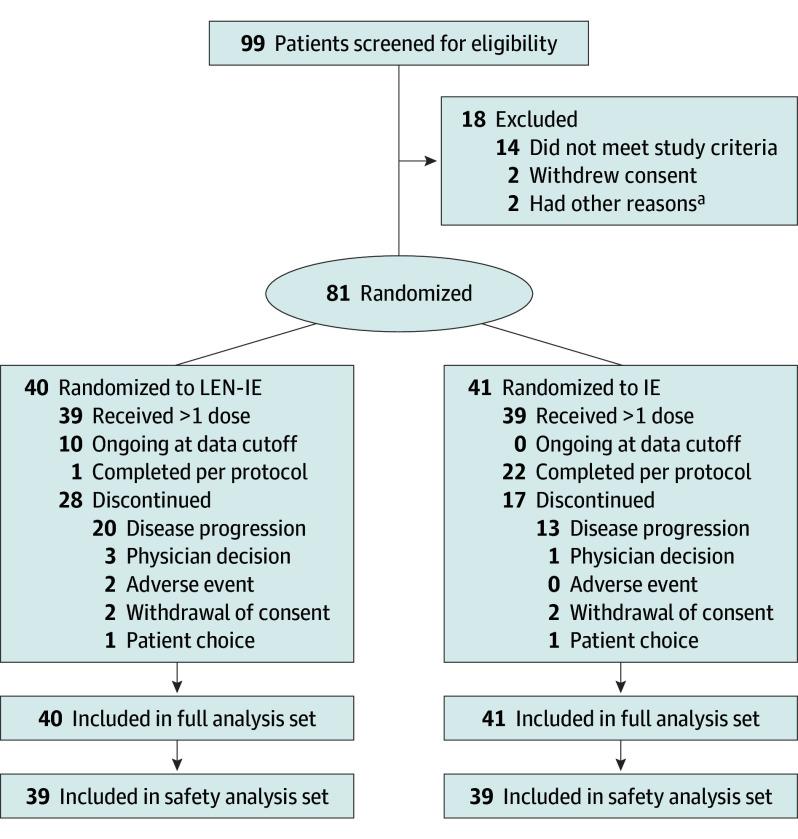
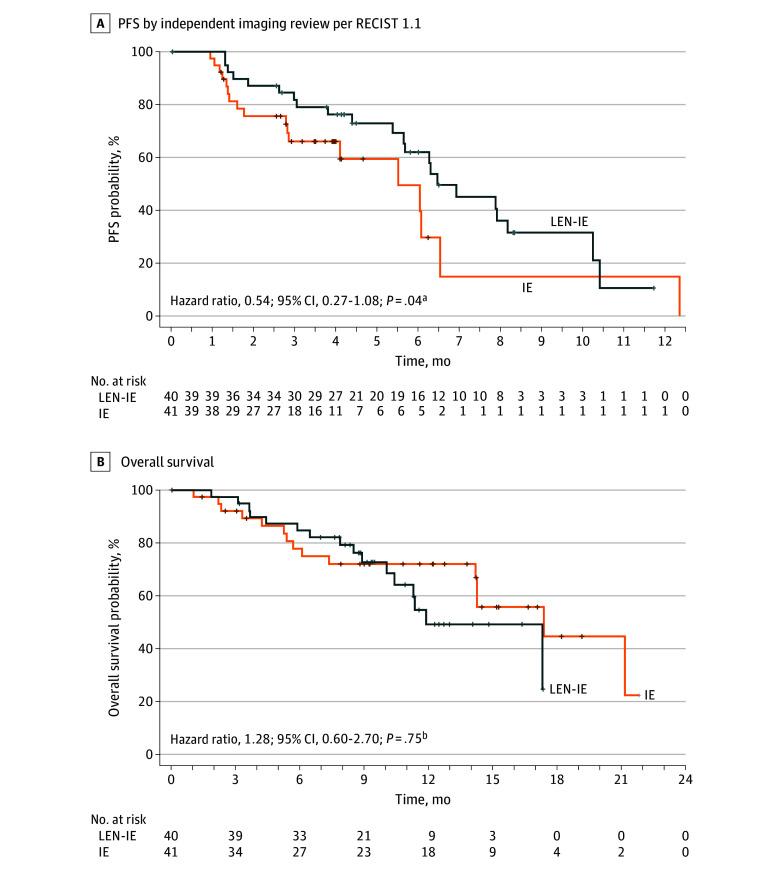
A total of 81 patients were enrolled (median [IQR] age, 15.0 [12.0-18.0] years; 46 males [56.8%]), with 40 in the LEN-IE arm and 41 in the IE arm. Median PFS was 6.5 months (95% CI, 5.7-8.2 months) for the LEN-IE arm and 5.5 months (95% CI, 2.9-6.5 months) for the IE arm (hazard ratio [HR], 0.54; 95% CI, 0.27-1.08; 1-sided P = .04). The rate of PFS at 4 months was 76.3% (95% CI, 59.3%-86.9%) in the LEN-IE arm and 66.0% (95% CI, 47.7%-79.2%) in the IE arm. Median overall survival was 11.9 months (95% CI, 10.1 months to not estimable) with LEN-IE and 17.4 months (95% CI, 14.2 months to not estimable) with IE (HR, 1.28; 95% CI, 0.60-2.70; 1-sided nominal P = .75). Grade 3 or higher treatment-related adverse events occurred in 35 of 39 patients (89.7%) in the LEN-IE arm and 31 of 39 patients (79.5%) in the IE arm.
CONCLUSIONS AND RELEVANCE
Although LEN-IE did not meet prespecified statistical significance for improved PFS vs IE, this study demonstrates the importance of international collaboration and randomized clinical trials in patients with relapsed or refractory osteosarcoma and may inform future trial design.
TRIAL REGISTRATION
ClinicalTrials.gov Identifier: NCT04154189.
重要性
异环磷酰胺与依托泊苷联合用药(IE)常用于治疗复发或难治性骨肉瘤;然而,不同指南对二线治疗的推荐有所不同。
目的
评估在IE方案基础上加用乐伐替尼(LEN-IE)是否能改善复发或难治性骨肉瘤儿童及青年患者的预后。
设计、地点和参与者:OLIE二期开放标签随机临床试验在欧洲、亚太地区和北美全球范围内开展。从2020年3月22日至2021年11月11日,该试验纳入了年龄在2至25岁之间、患有高级别骨肉瘤、根据实体瘤疗效评价标准1.1版(RECIST 1.1)可测量或可评估疾病且接受过1至2线全身治疗的患者。数据分析在2020年3月22日(首例患者入组)至2022年6月22日(主要分析的数据截止日期)以及2023年9月29日(研究结束最终数据库锁定)之间进行。
干预措施
OLIE试验评估了乐伐替尼(14mg/m²,每日口服一次)联合每周期第1至3天静脉注射异环磷酰胺(3000mg/m²)和依托泊苷(100mg/m²)共5个周期与单独使用相同剂量IE方案的疗效和安全性。随机分配至IE组的患者在疾病进展时经独立影像评估可交叉接受乐伐替尼治疗。
主要结局和测量指标
主要终点是根据RECIST 1.1经独立影像评估的无进展生存期(PFS)。采用Kaplan-Meier方法估计PFS分布,通过分层对数秩检验,预设单侧显著性阈值为0.025。次要终点包括4个月时的PFS率和总生存期。不良事件采用描述性统计进行总结。
结果
共纳入81例患者(中位[IQR]年龄,15.0[12.0 - 18.0]岁;46例男性[56.8%]),LEN-IE组40例,IE组41例。LEN-IE组的中位PFS为6.5个月(95%CI,5.7 - 8.2个月),IE组为5.5个月(95%CI,2.9 - 6.5个月)(风险比[HR],0.54;95%CI,0.27 - 1.08;单侧P = 0.04)。LEN-IE组4个月时的PFS率为76.3%(95%CI,59.3% - 86.9%),IE组为66.0%(95%CI,47.7% - 79.2%)。LEN-IE组的中位总生存期为11.9个月(95%CI,10.1个月至不可估计),IE组为17.4个月(95%CI,14.2个月至不可估计)(HR,1.28;95%CI,0.60 - 2.70;单侧名义P = 0.75)。LEN-IE组39例患者中有35例(89.7%)发生3级或更高等级的治疗相关不良事件,IE组39例患者中有31例(79.5%)发生。
结论和相关性
尽管与IE方案相比,LEN-IE方案在改善PFS方面未达到预设的统计学显著性,但本研究证明了国际合作及随机临床试验在复发或难治性骨肉瘤患者中的重要性,并可能为未来的试验设计提供参考。
试验注册
ClinicalTrials.gov标识符:NCT04154189

 Zotero 插件