
水果摄入量与非小细胞肺癌之间的关联:一项孟德尔随机化研究。
Association between fruit intake and non-small cell lung cancer: a Mendelian randomization study.
作者信息
Pan Chongde, Du Ying, Jiang Yu, Lin Yuechun, Zhao Yulin, Yu Huiwen, Liang Hengrui, Liao Wanzhe, Xu Xin, Huang Ying
机构信息
Department of Thoracic Oncology and Surgery, China State Key Laboratory of Respiratory Disease & National Clinical Research Center for Respiratory Disease, the First Affiliated Hospital of Guangzhou Medical University, Guangzhou, China.
Department of Clinical Medicine, The Nanshan College of Guangzhou Medical University, Guangzhou, China.
出版信息
Transl Lung Cancer Res. 2024 Sep 30;13(9):2388-2394. doi: 10.21037/tlcr-24-276. Epub 2024 Sep 27.
BACKGROUND
Several studies have explored the potential relationship between fruit consumption and non-small cell lung cancer (NSCLC). However, the impact of dried fruit on NSCLC risk remains unclear. Additionally, the presence of confounding variables in these observational investigations could not be avoided. Therefore, the aim of this article was to explore the potential relationship between fruits intake and NSCLC.
METHODS
We extracted fruit intake data from the UK Biobank and utilized a genome-wide association study (GWAS) encompassing 218,792 individuals for NSCLC data. We employed a two-sample Mendelian randomization (MR) analysis to investigate the potential causal associations between fruit intake and the risk of NSCLC. The major method of analysis was the inverse variance weighted (IVW). Furthermore, we conducted sensitivity analyses to corroborate the robustness of our findings.
RESULTS
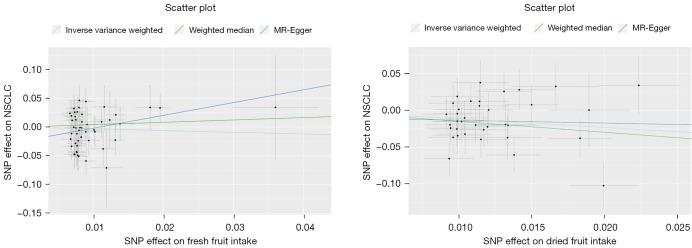
The result of our study showed convincing evidence suggesting that dried fruit intake is effective in reducing the risk of NSCLC. Specifically, the odds ratios (ORs) for NSCLC exhibited a noteworthy reduction at 0.32 [95% confidence interval (CI): 0.15, 0.67; P=0.003] with respect to dried fruit intake.
CONCLUSIONS
Our study underscores a significant correlation between dried fruit consumption and reduced NSCLC risk. In contrast, the association with fresh fruit intake did not reach statistical significance. To substantiate and validate these findings, further prospective randomized controlled trials (RCTs) are warranted in the future.
背景
多项研究探讨了水果摄入与非小细胞肺癌(NSCLC)之间的潜在关系。然而,果干对NSCLC风险的影响仍不明确。此外,这些观察性研究中混杂变量的存在无法避免。因此,本文旨在探讨水果摄入与NSCLC之间的潜在关系。
方法
我们从英国生物银行提取了水果摄入数据,并利用一项涵盖218,792人的全基因组关联研究(GWAS)获取NSCLC数据。我们采用两样本孟德尔随机化(MR)分析来研究水果摄入与NSCLC风险之间的潜在因果关联。主要分析方法是逆方差加权(IVW)。此外,我们进行了敏感性分析以证实研究结果的稳健性。
结果
我们的研究结果显示有令人信服的证据表明,摄入果干可有效降低NSCLC风险。具体而言,就果干摄入而言,NSCLC的优势比(OR)显著降低至0.32 [95%置信区间(CI):0.15, 0.67;P = 0.003]。
结论
我们的研究强调了食用果干与降低NSCLC风险之间的显著相关性。相比之下,与新鲜水果摄入的关联未达到统计学显著性。为了证实和验证这些发现,未来有必要进行进一步的前瞻性随机对照试验(RCT)。


 Zotero 插件