
奥密克戎毒株激增期间首次感染新冠病毒后的精子质量和性功能:中国西南部的一项观察性研究
Sperm quality and sexual function after the first COVID-19 infection during the omicron surge: an observational study in southwest China.
作者信息
Yang Tingting, Liu Bo, Luo Xiaohong, Shen Lingling, Xiao Xiao, Wang Yanyun, Li Shiliu, Zhang Lin, Zhou Bin, Li Fuping
机构信息
Department of Andrology/Human Sperm Bank of Sichuan Province, West China Second University Hospital, Sichuan University, Chengdu, China.
Key Laboratory of Birth Defects and Related Diseases of Women and Children (Sichuan University), Ministry of Education, Chengdu, China.
出版信息
Transl Androl Urol. 2024 Sep 30;13(9):1835-1846. doi: 10.21037/tau-24-173. Epub 2024 Sep 26.
BACKGROUND
As the Omicron variant became the dominant coronavirus disease 2019 (COVID-19) strain and the threat to human health decreased, the impact of COVID-19 on male reproductive health and semen quality may have changed. In this prospective observational study, we aimed to investigate the changes in semen quality and sexual function before and after the Omicron variant infection by self-controlled study and to explore the influence of Omicron variant infection on male reproductive health.
METHODS
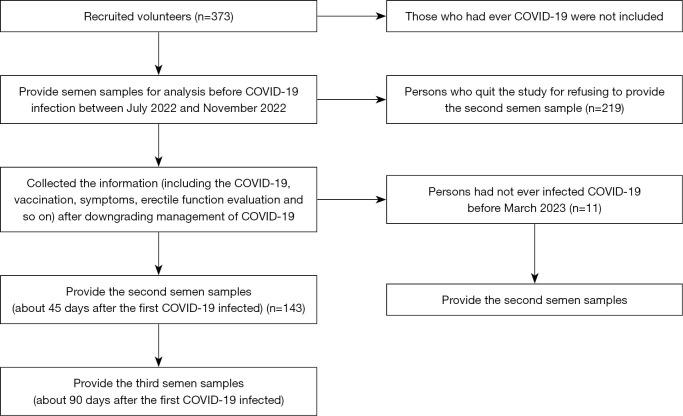
We recruited 373 participants who provided semen samples before their first COVID-19 infection. During the subsequent follow-up, only 154 participants provided the second semen samples, 11 of whom were not infected with COVID-19. Sperm quality was assessed approximately 45 and 90 days after COVID-19, as well as before infection.
RESULTS
Semen parameters, including total sperm count, total forward sperm, progressive motility, and sperm concentration, significantly declined 45 days after COVID-19 infection. At 90 days after infection, the total sperm count, total forward sperm, and sperm concentration gradually increased to pre-infection levels. Participants who experienced fever showed worse semen quality in terms of total forward sperm, sperm concentration, and sperm progressive rate. However, this phenomenon was not observed in the other group infected with COVID-19 without fever or not infected. In addition, 49 (34.3%) of 143 persons confirmed that the COVID-19 infection resulted in changes in sexual function, with an increase in premature ejaculation diagnostic tool (PEDT) scores.
CONCLUSIONS
The results of our self-controlled study indicate that COVID-19 is associated with impaired semen quality early after disease onset. After 1-2 spermatogenesis cycles, the semen quality gradually recovers from the infection. These findings are beneficial for better understanding the COVID-19-associated sequelae, which are fundamental for semen collection during assisted reproduction.
背景
随着奥密克戎变异株成为2019冠状病毒病(COVID-19)的主要毒株且对人类健康的威胁降低,COVID-19对男性生殖健康和精液质量的影响可能已发生变化。在这项前瞻性观察研究中,我们旨在通过自身对照研究调查奥密克戎变异株感染前后精液质量和性功能的变化,并探讨奥密克戎变异株感染对男性生殖健康的影响。
方法
我们招募了373名在首次感染COVID-19之前提供精液样本的参与者。在随后的随访中,只有154名参与者提供了第二次精液样本,其中11人未感染COVID-19。在COVID-19感染后约45天和90天以及感染前评估精子质量。
结果
COVID-19感染后45天,精液参数,包括精子总数、向前运动精子总数、进行性运动能力和精子浓度显著下降。感染后90天,精子总数、向前运动精子总数和精子浓度逐渐恢复到感染前水平。出现发热的参与者在向前运动精子总数、精子浓度和精子进行性速率方面精液质量较差。然而,在未发热的其他COVID-19感染组或未感染组中未观察到这种现象。此外,143人中的49人(34.3%)确认COVID-19感染导致性功能改变,早泄诊断工具(PEDT)评分增加。
结论
我们自身对照研究的结果表明,COVID-19在疾病发作早期与精液质量受损有关。经过1 - 2个生精周期后,精液质量从感染中逐渐恢复。这些发现有助于更好地理解与COVID-19相关的后遗症,这对于辅助生殖期间的精液采集至关重要。

 Zotero 插件