
多模态超声深度学习检测早期慢性肾脏病纤维化。
Multimodal ultrasound deep learning to detect fibrosis in early chronic kidney disease.
机构信息
Department of Ultrasound, Chengdu Second People's Hospital, Chengdu, Sichuan Province, China.
Department of Ultrasound, Nanchong Central Hospital, The Second Clinical Medical College, North Sichuan Medical College (University), Nanchong, Sichuan Province, China.
出版信息
Ren Fail. 2024 Dec;46(2):2417740. doi: 10.1080/0886022X.2024.2417740. Epub 2024 Oct 22.
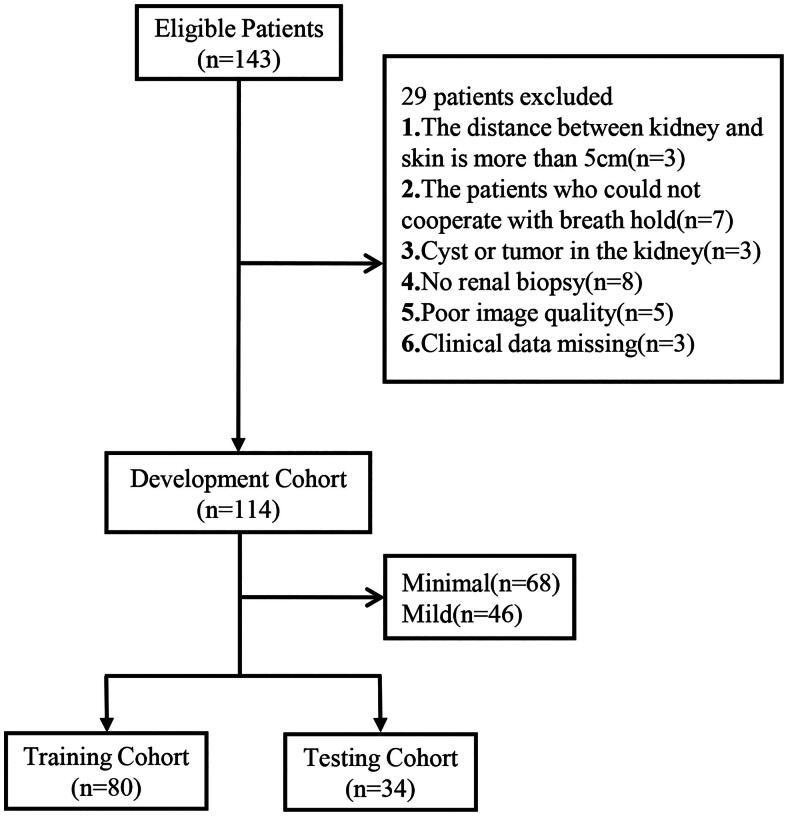
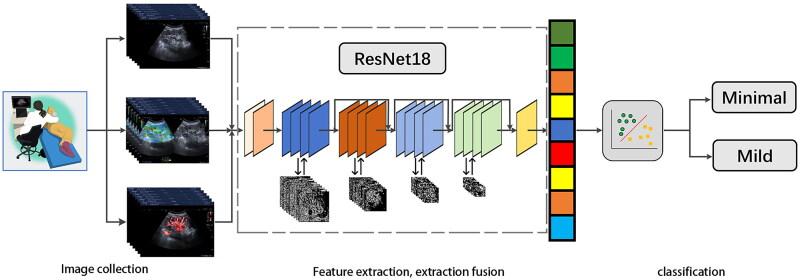
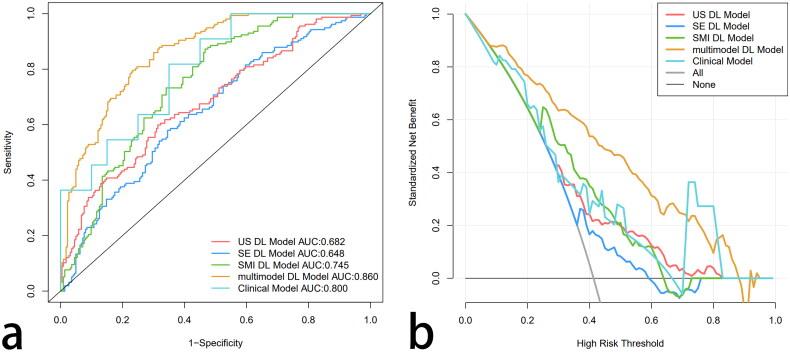
We developed a multimodal ultrasound (US) deep learning (DL) fusion model to automatically classify early fibrosis in patients with chronic kidney disease (CKD). This prospective study included patients with CKD who underwent continuous gray-scale US, superb microvascular imaging, and strain elastography from May to November 2022. According to the pathological tubular atrophy and interstitial fibrosis score, patients were divided into minimal and mild groups (affected area ≤10% and 11 - 25% of the total cortical volume, respectively). The dataset was divided into training (70%) and test (30%) sets. A DL model combining the features of the three US modes was developed to predict early fibrosis in patients with CKD. We compared these findings with the area under the receiver operating characteristic curve (AUC) of the clinical model by analyzing the receiver operating characteristic curve in the test set. The AUC of single-mode DL based on gray-scale US, superb microvascular imaging, and strain elastography was 0.682, 0.745, and 0.648, respectively, while that of the multimodal US DL model was 0.86. The accuracy, specificity, and sensitivity of the multimodal US DL model were 0.779, 0.767, and 0.796, respectively, and the negative and positive predictive values were 0.842 and 0.706, respectively. The AUC of the multimodal US DL model was significantly better than that of the single-mode DL and clinical models. The DL algorithm developed using multimodal US images can effectively predict early fibrosis in patients with CKD with significantly greater accuracy than single-mode DL or clinical models.
我们开发了一种多模态超声(US)深度学习(DL)融合模型,以自动对慢性肾脏病(CKD)患者的早期纤维化进行分类。这项前瞻性研究纳入了 2022 年 5 月至 11 月期间接受连续灰阶 US、超微血流成像和应变弹性成像的 CKD 患者。根据病理小管萎缩和间质纤维化评分,患者被分为最小和轻度组(分别为受累面积≤10%和 11-25%的总皮质体积)。数据集分为训练(70%)和测试(30%)集。开发了一种结合三种 US 模式特征的 DL 模型,以预测 CKD 患者的早期纤维化。我们通过分析测试集中的接收者操作特征曲线(ROC),比较了这些发现与临床模型的 ROC 曲线下面积(AUC)。基于灰阶 US、超微血流成像和应变弹性成像的单模态 DL 的 AUC 分别为 0.682、0.745 和 0.648,而多模态 US DL 模型的 AUC 为 0.86。多模态 US DL 模型的准确性、特异性和敏感性分别为 0.779、0.767 和 0.796,阴性和阳性预测值分别为 0.842 和 0.706。多模态 US DL 模型的 AUC 明显优于单模态 DL 和临床模型。使用多模态 US 图像开发的 DL 算法可以有效预测 CKD 患者的早期纤维化,其准确性明显高于单模态 DL 或临床模型。


 Zotero 插件