
多压力环境下的动物个性:应激套件反应个体间差异的进化生态学。
Animal personality in multiple stressor environments: the evolutionary ecology of among-individual differences in responses to stressor suites.
机构信息
Department of Biology, Indiana State University, Terre Haute, IN 47809, USA.
出版信息
Proc Biol Sci. 2024 Oct;291(2033):20241620. doi: 10.1098/rspb.2024.1620. Epub 2024 Oct 23.
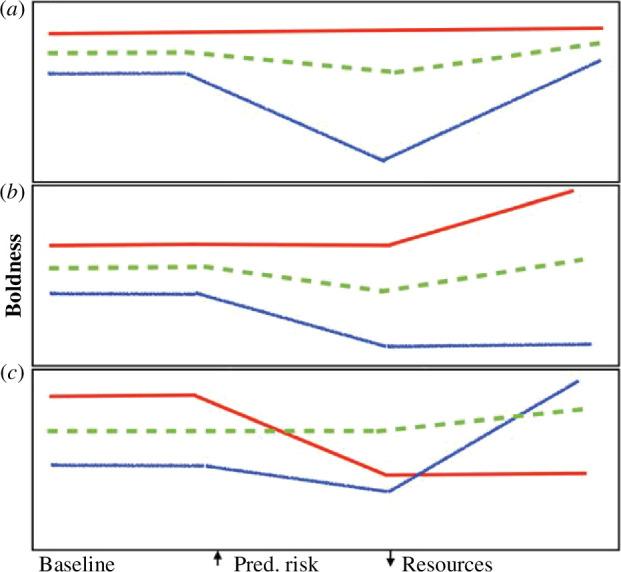
Animal personality differences may have evolved as alternative strategies for negotiating multiple stressor landscapes. Indeed, ecologists are increasingly recognizing that interactions among multiple stressors can transform selective landscapes and behavioural and physiological responses to stress regimes. Yet, evaluating this hypothesis poses challenges, as most studies involving relationships between personality variation and the environment consider single stressors. Here, we review the literature to explore the theory and evidence that multiple stressor environments may mediate personality variation. We consider effects on evolution of personality variation, as influenced by life-history, energetic and behavioural trade-offs, and effects on phenotypic expression of personality traits. We then explore how personality variation may modulate behavioural and physiological responses to multiple stressors, and how differential responses may be affected by personality-dependent movement ecology and cognitive strategies. Among-individual differences in responses to multiple stressors are critical to elucidate, as multi-stress interactions may transform animal behavioural and physiological responses relative to those predicted under single stressor scenarios, and because among-individual variation comprises the basis for evolutionary shifts in stress responsiveness and population resiliency to global environmental change.
动物的个性差异可能是作为应对多种压力景观的替代策略而进化的。事实上,生态学家越来越认识到,多种压力源的相互作用可以改变选择景观以及对压力环境的行为和生理反应。然而,评估这一假设存在挑战,因为大多数涉及个性差异与环境之间关系的研究都只考虑单一压力源。在这里,我们回顾文献,探讨多压力环境可能介导个性差异的理论和证据。我们考虑了个性变化对进化的影响,包括受生活史、能量和行为权衡影响的个性变化,以及个性特征表型表达的影响。然后,我们探讨了个性变化如何调节对多种压力源的行为和生理反应,以及个性依赖性的运动生态学和认知策略如何影响不同的反应。个体间对多种压力源的反应差异至关重要,因为多压力相互作用可能改变动物的行为和生理反应,而不是单一压力源情况下的预测反应,而且个体间的变异构成了对全球环境变化的应激反应和种群恢复力的进化转变的基础。

 Zotero 插件