
通过功能磁共振成像测量健康成年人全身利多卡因给药的神经相关性:一项单臂开放标签研究。
Neural correlates of systemic lidocaine administration in healthy adults measured by functional MRI: a single arm open label study.
作者信息
Vogt Keith M, Burlew Alex C, Simmons Marcus A, Reddy Sujatha N, Kozdron Courtney N, Ibinson James W
机构信息
Department of Anesthesiology and Perioperative Medicine, University of Pittsburgh, School of Medicine, Pittsburgh, PA, USA; Department of Bioengineering, Swanson School of Engineering, University of Pittsburgh, Pittsburgh, PA, USA; Center for the Neural Basis of Cognition, Pittsburgh, PA, USA; Clinical and Translational Science Institute, University of Pittsburgh, Pittsburgh, PA, USA.
Department of Anesthesiology and Perioperative Medicine, University of Pittsburgh, School of Medicine, Pittsburgh, PA, USA.
出版信息
Br J Anaesth. 2025 Feb;134(2):414-424. doi: 10.1016/j.bja.2024.07.039. Epub 2024 Oct 21.
INTRODUCTION
Intravenous lidocaine is increasingly used as a nonopioid analgesic, but how it acts in the brain is incompletely understood. We conducted a functional MRI study of pain response, resting connectivity, and cognitive task performance in volunteers to elucidate the effects of lidocaine at the brain-systems level.
METHODS
We enrolled 27 adults (age 22-55 yr) in this single-arm, open-label study. Pain response task and resting-state functional MRI scans at 3 T were obtained at baseline and then with a constant effect-site concentration of lidocaine. Electric nerve stimulation, titrated in advance to 7/10 intensity, was used for the pain task (five times every 10 s). Group-level differences in pain task-evoked responses (primary outcome, focused on the insula) and in resting connectivity were compared between baseline and lidocaine conditions, using adjusted P<0.05 to account for multiple comparisons. Pain ratings and performance on a brief battery of computer-based tasks were also recorded.
RESULTS
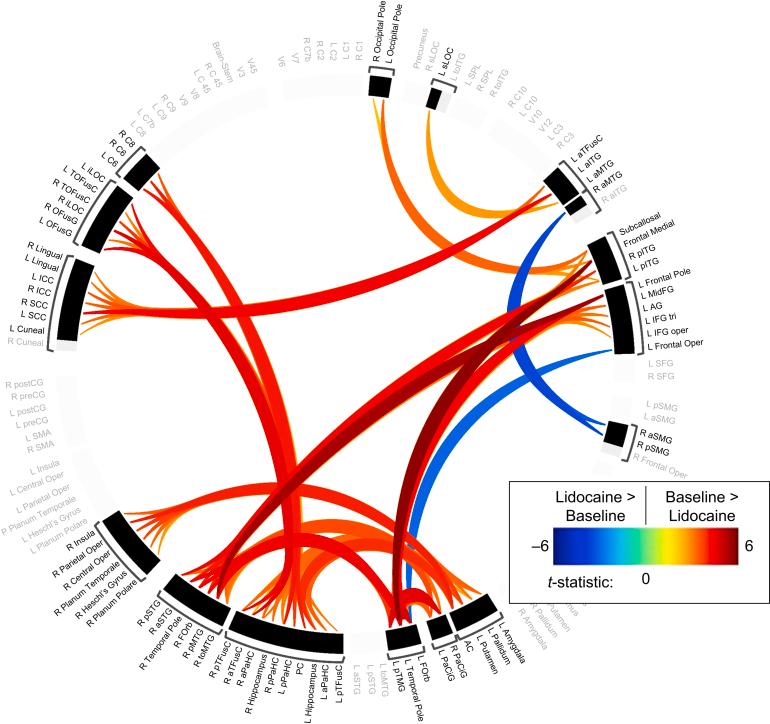
Lidocaine infusion was associated with decreased pain-evoked responses in the insula (left: Z=3.6, P<0.001, right: Z=3.6, P=0.004) and other brain areas including the cingulate gyrus, thalamus, and primary sensory cortex. Resting-state connectivity showed significant diffuse reductions in both region-to-region and global connectivity measures with lidocaine. Small decreases in pain intensity and unpleasantness and worse memory performance were also seen with lidocaine.
CONCLUSIONS
Lidocaine was associated with broad reductions in functional MRI response to acute pain and modulated whole-brain functional connectivity, predominantly decreasing long-range connectivity. This was accompanied by small but significant decreases in pain perception and memory performance.
CLINICAL TRIAL REGISTRATION
NCT05501600.
引言
静脉注射利多卡因作为一种非阿片类镇痛药的使用越来越广泛,但人们对其在大脑中的作用机制尚未完全了解。我们对志愿者进行了一项功能磁共振成像(fMRI)研究,以探讨疼痛反应、静息态连接性和认知任务表现,从而阐明利多卡因在脑系统水平上的作用。
方法
我们招募了27名成年人(年龄22 - 55岁)参与这项单臂、开放标签研究。在基线时以及在利多卡因达到恒定效应部位浓度后,采用3T进行疼痛反应任务和静息态功能磁共振成像扫描。预先将电神经刺激强度调整至7/10,用于疼痛任务(每10秒进行5次)。使用校正后的P<0.05来考虑多重比较,比较基线和利多卡因条件下疼痛任务诱发反应(主要结局,重点关注脑岛)和静息态连接性的组间差异。同时记录疼痛评分以及一系列简短计算机任务的表现。
结果
输注利多卡因与脑岛(左侧:Z = 3.6,P<0.001;右侧:Z = 3.6,P = 0.004)以及包括扣带回、丘脑和初级感觉皮层在内的其他脑区的疼痛诱发反应降低有关。静息态连接性显示,利多卡因使区域间和全脑连接性测量值均出现显著的弥漫性降低。利多卡因还导致疼痛强度和不愉快程度略有下降,以及记忆表现变差。
结论
利多卡因与急性疼痛的功能磁共振成像反应广泛降低以及全脑功能连接性的调节有关,主要是减少远程连接性。这伴随着疼痛感知和记忆表现的轻微但显著下降。
临床试验注册
NCT05501600。



 Zotero 插件