
共价抑制剂数据库2.0:用于基于结构和基于配体的共价抑制剂设计与筛选的更新综合数据库。
CovalentInDB 2.0: an updated comprehensive database for structure-based and ligand-based covalent inhibitor design and screening.
作者信息
Du Hongyan, Zhang Xujun, Wu Zhenxing, Zhang Odin, Gu Shukai, Wang Mingyang, Zhu Feng, Li Dan, Hou Tingjun, Pan Peichen
机构信息
College of Pharmaceutical Sciences, Zhejiang University, Hangzhou 310058, Zhejiang, China.
出版信息
Nucleic Acids Res. 2025 Jan 6;53(D1):D1322-D1327. doi: 10.1093/nar/gkae946.
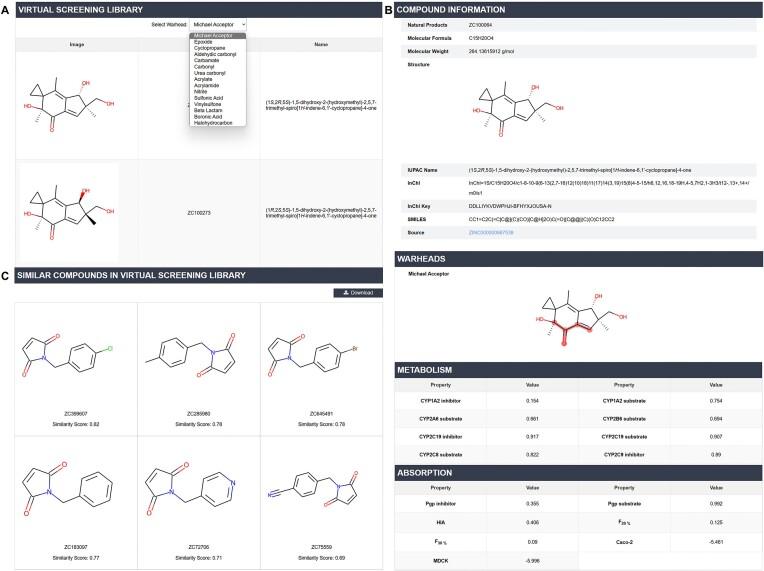
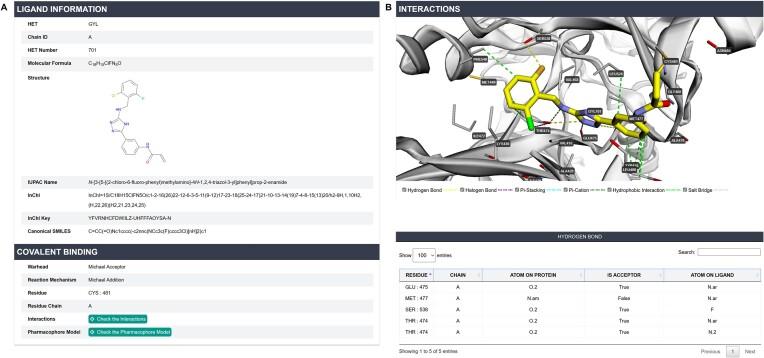
The rational design of targeted covalent inhibitors (TCIs) has emerged as a powerful strategy in drug discovery, known for its ability to achieve strong binding affinity and prolonged target engagement. However, the development of covalent drugs is often challenged by the need to optimize both covalent warhead and non-covalent interactions, alongside the limitations of existing compound libraries. To address these challenges, we present CovalentInDB 2.0, an updated online database designed to support covalent drug discovery. This updated version includes 8303 inhibitors and 368 targets, supplemented by 3445 newly added cocrystal structures, providing detailed analyses of non-covalent interactions. Furthermore, we have employed an AI-based model to profile the ligandability of 144 864 cysteines across the human proteome. CovalentInDB 2.0 also features the largest covalent virtual screening library with 2 030 192 commercially available compounds and a natural product library with 105 901 molecules, crucial for covalent drug screening and discovery. To enhance the utility of these compounds, we performed structural similarity analysis and drug-likeness predictions. Additionally, a new user data upload feature enables efficient data contribution and continuous updates. CovalentInDB 2.0 is freely accessible at http://cadd.zju.edu.cn/cidb/.
靶向共价抑制剂(TCIs)的合理设计已成为药物发现中的一种强大策略,以其实现强结合亲和力和延长靶点作用时间的能力而闻名。然而,共价药物的开发常常面临挑战,需要同时优化共价弹头和非共价相互作用,以及现有化合物库的局限性。为应对这些挑战,我们推出了CovalentInDB 2.0,这是一个经过更新的在线数据库,旨在支持共价药物发现。这个更新版本包含8303种抑制剂和368个靶点,并辅以3445个新添加的共晶结构,提供了对非共价相互作用的详细分析。此外,我们采用了基于人工智能的模型来分析人类蛋白质组中144864个半胱氨酸的成药潜力。CovalentInDB 2.0还拥有最大的共价虚拟筛选库,包含2030192种市售化合物,以及一个拥有105901个分子的天然产物库,这对共价药物筛选和发现至关重要。为提高这些化合物的实用性,我们进行了结构相似性分析和类药性预测。此外,新的用户数据上传功能可实现高效的数据贡献和持续更新。可通过http://cadd.zju.edu.cn/cidb/免费访问CovalentInDB 2.0。


 Zotero 插件