
二甲双胍可减轻三甲基锡诱导的认知障碍和海马神经退行性变。
Metformin Mitigates Trimethyltin-Induced Cognition Impairment and Hippocampal Neurodegeneration.
机构信息
Department of Biology, Faculty of Basic Sciences, Shahed University, Tehran, Iran.
Neurophysiology Research Center, Shahed University, Tehran, Iran.
出版信息
Cell Mol Neurobiol. 2024 Oct 23;44(1):70. doi: 10.1007/s10571-024-01502-4.
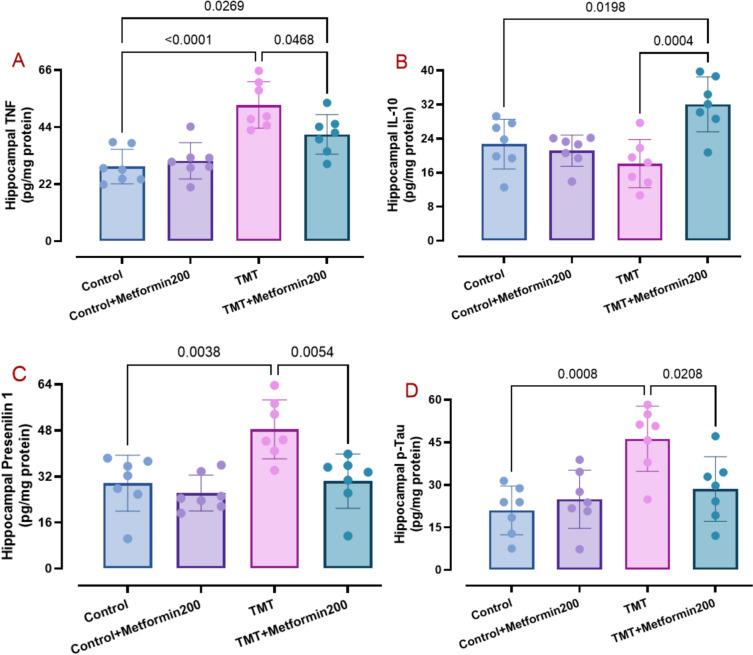
The neurotoxicant trimethyltin (TMT) triggers cognitive impairment and hippocampal neurodegeneration. TMT is a useful research tool for the study of Alzheimer's disease (AD) pathogenesis and treatment. Although the antidiabetic agent metformin has shown promising neuroprotective effects, however, its precise modes of action in neurodegenerative disorders need to be further elucidated. In this study, we investigated whether metformin can mitigate TMT cognition impairment and hippocampal neurodegeneration. To induce an AD-like phenotype, TMT was injected i.p. (8 mg/kg) and metformin was administered daily p.o. for 3 weeks at 200 mg/kg. Our results showed that metformin administration to the TMT group mitigated learning and memory impairment in Barnes maze, novel object recognition (NOR) task, and Y maze, attenuated hippocampal oxidative, inflammatory, and cell death/pyroptotic factors, and also reversed neurodegeneration-related proteins such as presenilin 1 and p-Tau. Hippocampal level of AMP-activated protein kinase (AMPK) as a key regulator of energy homeostasis was also improved following metformin treatment. Additionally, metformin reduced hippocampal acetylcholinesterase (AChE) activity, glial fibrillary acidic protein (GFAP)-positive reactivity, and prevented the loss of CA1 pyramidal neurons. This study showed that metformin mitigated TMT-induced neurodegeneration and this may pave the way to develop new therapeutics to combat against cognitive deficits under neurotoxic conditions.
神经毒素三甲基锡(TMT)可引发认知障碍和海马神经退行性病变。TMT 是研究阿尔茨海默病(AD)发病机制和治疗方法的有用研究工具。尽管抗糖尿病药物二甲双胍已显示出有希望的神经保护作用,但仍需进一步阐明其在神经退行性疾病中的确切作用机制。在这项研究中,我们研究了二甲双胍是否可以减轻 TMT 引起的认知障碍和海马神经退行性病变。为了诱导 AD 样表型,腹腔注射 TMT(8mg/kg),并每天灌胃给予二甲双胍 200mg/kg,共 3 周。我们的结果表明,二甲双胍给药可减轻 TMT 组在 Barnes 迷宫、新物体识别(NOR)任务和 Y 迷宫中的学习和记忆障碍,减弱海马氧化应激、炎症和细胞死亡/焦亡因子,并逆转与神经退行性变相关的蛋白,如早老素 1 和 p-Tau。海马 AMP 激活蛋白激酶(AMPK)水平作为能量稳态的关键调节剂也在二甲双胍治疗后得到改善。此外,二甲双胍降低了海马乙酰胆碱酯酶(AChE)活性、胶质纤维酸性蛋白(GFAP)阳性反应,并防止 CA1 锥体神经元的丢失。这项研究表明,二甲双胍可减轻 TMT 引起的神经退行性病变,这可能为开发新的治疗方法来对抗神经毒性条件下的认知障碍铺平道路。



 Zotero 插件