
交替氧化酶中的质子耦合电子转移动力学
Proton-coupled electron transfer dynamics in the alternative oxidase.
作者信息
Saura Patricia, Kim Hyunho, Beghiah Adel, Young Luke, Moore Anthony L, Kaila Ville R I
机构信息
Department of Biochemistry and Biophysics, Stockholm University Stockholm 10691 Sweden
Biochemistry and Biomedicine, School of Life Sciences, University of Sussex Falmer Brighton BN1 9QG UK.
出版信息
Chem Sci. 2024 Oct 11;15(44):18572-80. doi: 10.1039/d4sc05060f.
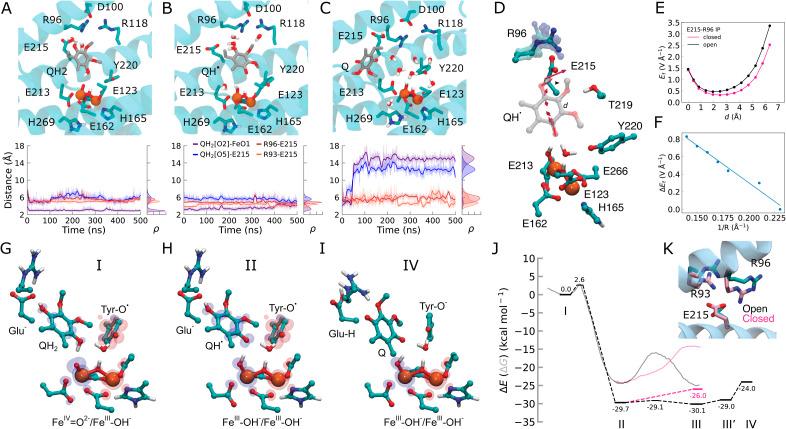
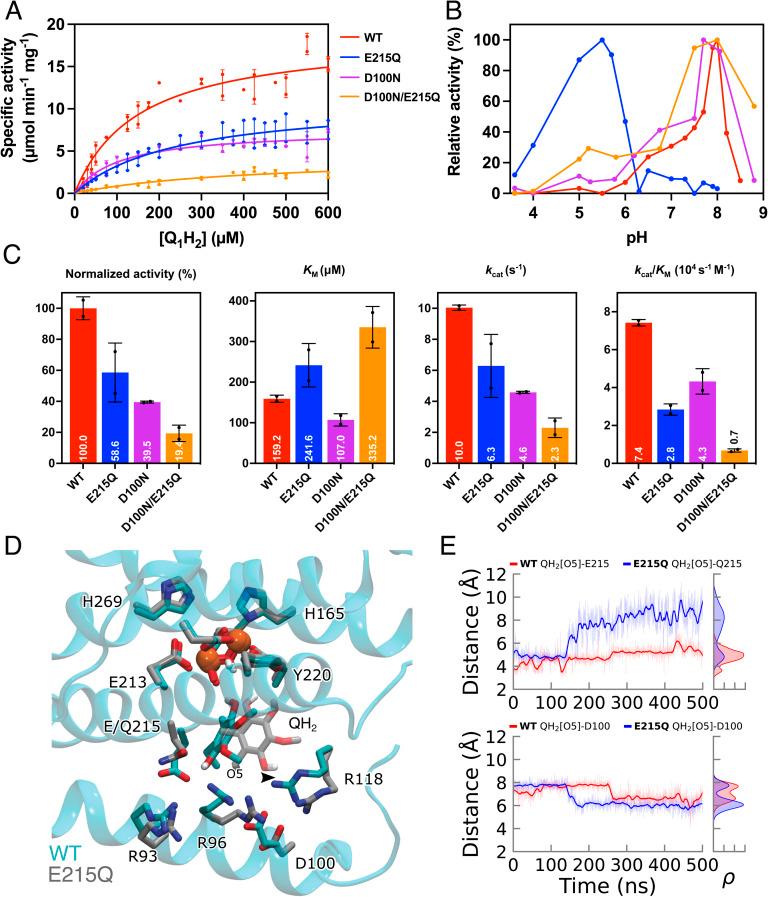
The alternative oxidase (AOX) is a membrane-bound di-iron enzyme that catalyzes O-driven quinol oxidation in the respiratory chains of plants, fungi, and several pathogenic protists of biomedical and industrial interest. Yet, despite significant biochemical and structural efforts over the last decades, the catalytic principles of AOX remain poorly understood. We develop here multi-scale quantum and classical molecular simulations in combination with biochemical experiments to address the proton-coupled electron transfer (PCET) reactions responsible for catalysis in AOX from , the causative agent of sleeping sickness. We show that AOX activates and splits dioxygen a water-mediated PCET reaction, resulting in a high-valent ferryl/ferric species and tyrosyl radical (Tyr220˙) that drives the oxidation of the quinol electric field effects. We identify conserved carboxylates (Glu215, Asp100) within a buried cluster of ion-pairs that act as a transient proton-loading site in the quinol oxidation process, and validate their function experimentally with point mutations that result in drastic activity reduction and p -shifts. Our findings provide a key mechanistic understanding of the catalytic machinery of AOX, as well as a molecular basis for rational drug design against energy transduction chains of parasites. On a general level, our findings illustrate how redox-triggered conformational changes in ion-paired networks control the catalysis electric field effects.
交替氧化酶(AOX)是一种膜结合二价铁酶,可催化植物、真菌以及一些具有生物医学和工业价值的致病性原生生物呼吸链中由氧驱动的醌醇氧化反应。然而,尽管在过去几十年里进行了大量的生物化学和结构研究,但AOX的催化原理仍知之甚少。我们在此结合生物化学实验开展多尺度量子和经典分子模拟,以研究导致昏睡病的布氏锥虫中AOX催化作用所涉及的质子耦合电子转移(PCET)反应。我们发现,AOX通过水介导的PCET反应激活并裂解双氧,生成高价铁酰/三价铁物种和酪氨酸自由基(Tyr220˙),该自由基在电场效应作用下驱动醌醇的氧化。我们在一个埋藏的离子对簇中鉴定出保守的羧酸盐(Glu215、Asp100),它们在醌醇氧化过程中作为一个瞬态质子加载位点,并通过点突变实验验证了它们的功能,这些点突变导致活性急剧降低和pKa位移。我们的研究结果为AOX催化机制提供了关键的机理认识,也为针对寄生虫能量转导链的合理药物设计提供了分子基础。从总体层面来看,我们的研究结果阐明了离子对网络中氧化还原触发的构象变化如何通过电场效应控制催化作用。


 Zotero 插件