
间充质干细胞治疗急性呼吸窘迫综合征的疗效与安全性——一项系统评价与荟萃分析
Efficacy and safety of mesenchymal stem cell therapy for acute respiratory distress syndrome-a systematic review and meta-analysis.
作者信息
Fang Lingyan, Hu Fangyuan, Li Han, Chang Wei, Liu Ling
机构信息
Department of Critical Care Medicine, Zhongda Hospital, School of Medicine, Southeast University, Nanjing, China.
Jiangsu Provincial Key Laboratory of Critical Care Medicine, Zhongda Hospital, School of Medicine, Southeast University, Nanjing, China.
出版信息
J Thorac Dis. 2024 Sep 30;16(9):5802-5814. doi: 10.21037/jtd-24-281. Epub 2024 Sep 26.
BACKGROUND
Mesenchymal stem cells (MSC) therapy for acute respiratory distress syndrome (ARDS) represents a burgeoning treatment approach, supported by numerous preclinical studies confirming its efficacy. Our study aims to provide a comprehensive evaluation of both the safety and effectiveness of MSC.
METHODS
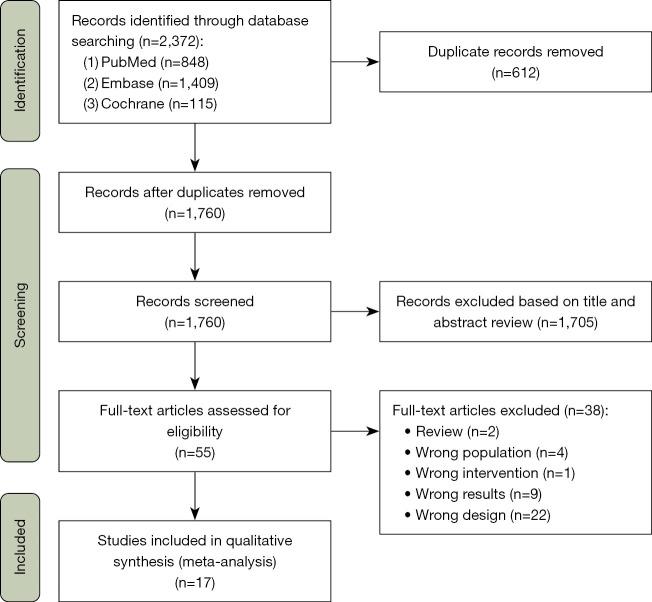
We conducted searches across three databases (PubMed, Embase, Cochrane) for randomized controlled studies up to June 23, 2024. A meta-analysis was performed on variables including adverse events, mortality, changes in the PaO/FiO ratio, intensive care unit (ICU), length of stay, ventilation-free days, and changes in pro-inflammatory and anti-inflammatory cytokines. Relative risk (RR) values were employed for dichotomous variables, while mean difference (MD) and standard mean difference (SMD) were used for continuous variables. Risk bias was assessed using risk of bias 2 (ROB2).
RESULTS
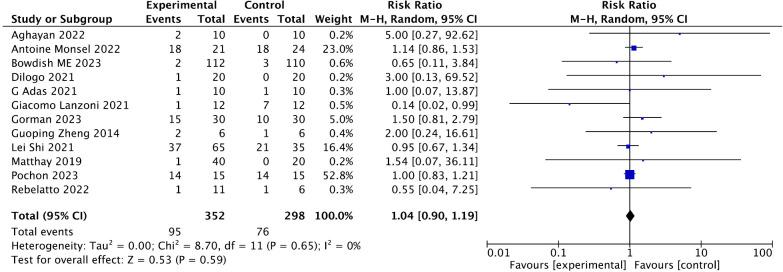
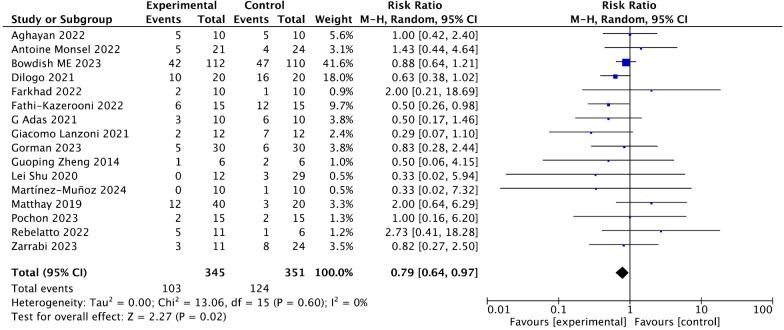
The meta-analysis encompassed 17 experiments involving 796 patients, with 410 undergoing MSC treatment and 386 in the control group. Primary outcomes indicated that MSC treatment did not escalate adverse events [RR =1.04; 95% confidence interval (CI): 0.90, 1.19; P=0.59; I=0%]. On the contrary, it significantly diminishes the mortality (RR =0.79; 95% CI: 0.64, 0.97; P=0.02; I=0%). Regarding secondary outcomes, MSCs led to a significant improvement in the PaO/FiO ratio for ARDS patients (SMD =0.53; 95% CI: 0.15, 0.92; P=0.007; I=0%). However, there were no significant differences in ICU length of stay (MD =-1.77; 95% CI: -6.97, 3.43; P=0.50; I=63%) and ventilation-free days (MD =-1.29; 95% CI: -4.09, 1.51; P=0.37; I=0%). MSCs significantly lowered C-reactive protein (CRP) (SMD =-0.65; 95% CI: -1.18, -0.13; P=0.01; I=56%) and interleukin-6 (IL-6) levels compared to the control group (SMD =-0.76; 95% CI: -1.34, -0.17; P=0.01; I=74%). However, changes in interleukin-10 (AIL-10) (SMD =-0.46; 95% CI: -1.51, 0.58; P=0.38; I=77%), and changes in tumor necrosis factor-alpha (ATNF-α) (SMD =-1.5; 95% CI: -3.39, 0.40; P=0.12; I=92%) levels showed no significant changes.
CONCLUSIONS
MSC therapy demonstrates reliable safety, with a significant impact on reducing mortality and improving certain clinical symptoms. Moreover, in certain aspects, it may alleviate the inflammatory response in ARDS. Nonetheless, these findings necessitate validation through additional high-quality randomized controlled trials.
背景
间充质干细胞(MSC)治疗急性呼吸窘迫综合征(ARDS)是一种新兴的治疗方法,众多临床前研究证实了其有效性。我们的研究旨在全面评估MSC的安全性和有效性。
方法
我们在三个数据库(PubMed、Embase、Cochrane)中检索截至2024年6月23日的随机对照研究。对不良事件、死亡率、动脉血氧分压/吸入氧浓度(PaO/FiO)比值变化、重症监护病房(ICU)住院时间、无通气天数以及促炎和抗炎细胞因子变化等变量进行荟萃分析。二分变量采用相对危险度(RR)值,连续变量采用均值差(MD)和标准化均值差(SMD)。使用偏倚风险2(ROB2)评估风险偏倚。
结果
荟萃分析纳入17项实验,涉及796例患者,其中410例接受MSC治疗,386例为对照组。主要结果表明,MSC治疗未增加不良事件[RR =1.04;95%置信区间(CI):0.90,1.19;P=0.59;I²=0%]。相反,它显著降低了死亡率(RR =0.79;95% CI:0.64,0.97;P=0.02;I²=0%)。关于次要结果,MSC使ARDS患者的PaO/FiO比值显著改善(SMD =0.53;95% CI:0.15,0.92;P=0.007;I²=0%)。然而,ICU住院时间(MD =-1.77;95% CI:-6.97,3.43;P=0.50;I²=63%)和无通气天数(MD =-1.29;95% CI:-4.09,1.51;P=0.37;I²=0%)无显著差异。与对照组相比,MSC显著降低了C反应蛋白(CRP)水平(SMD =-0.65;95% CI:-1.18,-0.13;P=0.01;I²=56%)和白细胞介素-6(IL-6)水平(SMD =-0.76;95% CI:-1.34,-0.17;P=0.01;I²=74%)。然而,白细胞介素-10(IL-10)变化(SMD =-0.46;95% CI:-1.51,0.58;P=0.38;I²=77%)和肿瘤坏死因子-α(TNF-α)变化(SMD =-1.5;95% CI:-3.39,0.40;P=0.12;I²=92%)水平无显著变化。
结论
MSC治疗显示出可靠的安全性,对降低死亡率和改善某些临床症状有显著影响。此外,在某些方面,它可能减轻ARDS中的炎症反应。尽管如此,这些发现需要通过更多高质量的随机对照试验进行验证。


 Zotero 插件