
全球、区域和国家归因于低温的心血管疾病死亡率和伤残调整生命年的时间趋势:2019 年全球疾病负担研究的年龄-时期-队列分析。
Global, regional, and national temporal trends in mortality and disability-adjusted life years for cardiovascular disease attributable to low temperature during 1990-2019: an age-period-cohort analysis of the global burden of disease 2019 study.
机构信息
Department of Cardiology, National Center for Cardiovascular Disease, Fuwai Hospital, Chinese Academy of Medical Sciences & Peking Union Medical College, Beijing, China.
Department of Cardiac Surgery, Peking University People's Hospital, Beijing, China.
出版信息
Front Public Health. 2024 Oct 10;12:1414979. doi: 10.3389/fpubh.2024.1414979. eCollection 2024.
BACKGROUND
Few studies have focused on the region-specific relationship between cardiovascular disease (CVD) and low temperature worldwide.
OBJECTIVE
We aimed to provide an overview of trends in mortality and disability-adjusted life years (DALYs) for CVD and its subtypes attributable to low temperature over the past 30 years in 204 countries and regions, along with the associations of these trends with age, period, and birth cohorts.
METHODS
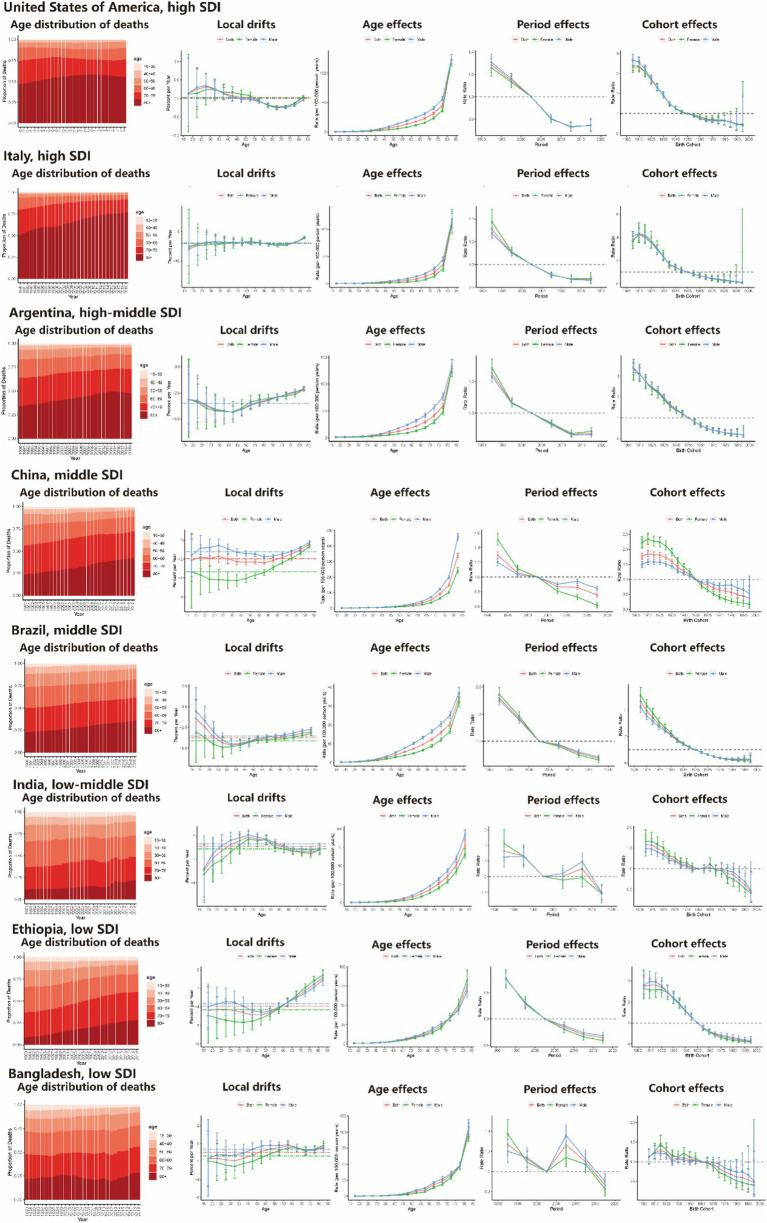
Data on the estimated burden of CVDs (including ischemic heart disease, hypertensive heart disease, and stroke) attributable to low temperature were obtained from the Global Burden of Disease Study 2019. We utilized an age-period-cohort model to estimate overall annual percentage changes in mortality (net drifts), annual percentage changes from 15 ~ 19 to 81 ~ 85 years (local drifts), and period and cohort relative risk (period/cohort effects) between 1990 and 2019.
RESULTS
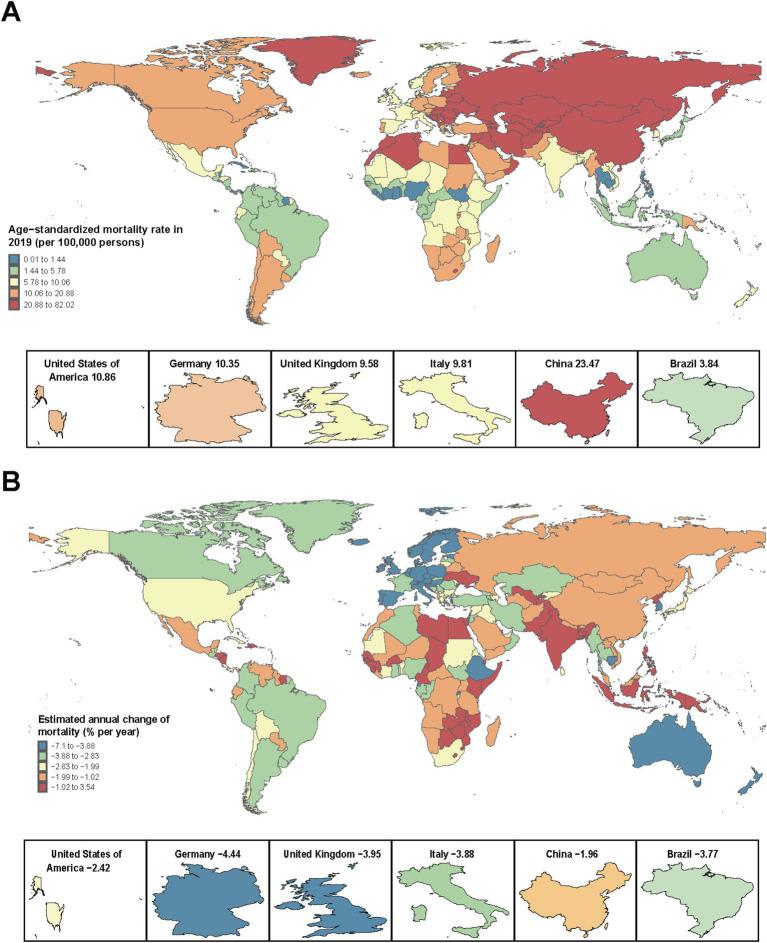
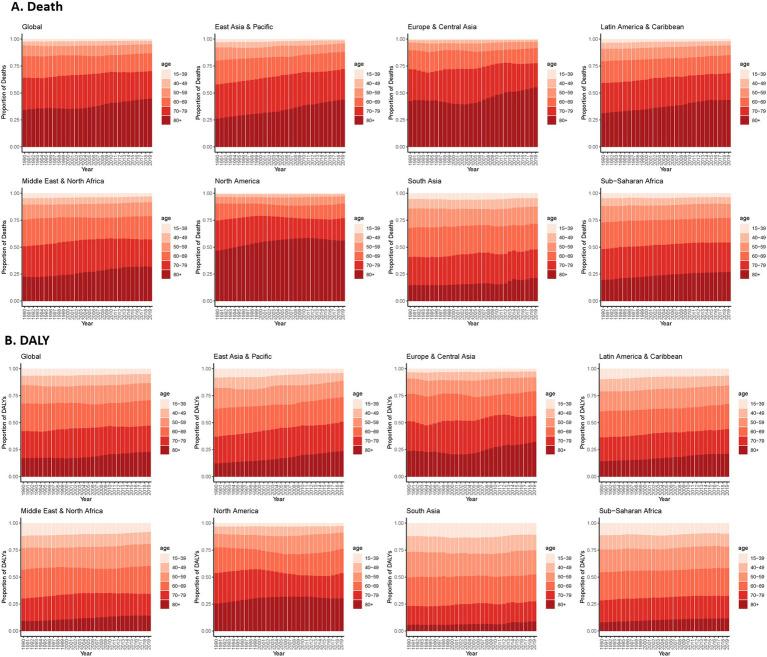
Among noncommunicable diseases, CVDs had the highest mortality rate and DALY loss attributable to low temperature worldwide and has increased from 65.7 to 67.3%, which is mainly attributed to the increase in East Asia and Pacific region. In terms of the level of economic and social development, an inverted U-shape was found in the age-standardized mortality rates (ASMR) due to low-temperature across different sociodemographic indices (SDI) regions. Both high CVD mortality (19.45, 95% CI [14.54, 24.17%]) and a decreasing mortality rate related to low temperature (from 1990 to 2019, net drift, -3.25% [-3.76, 2.73%] per year) was found in high SDI countries or territories, with opposite outcome found in low SDIs regions. The older adults (70+) and men share the highest rate of CVD ASMR and DALY attributed to low temperature across all regions, especially in North America and Europe and Central Asia.
CONCLUSION
Mortality and DALY loss from CVD attributable to low temperature showed an overall decreasing trend globally except for East Asia and Pacific region. SDI, sex, age and geographic location contributed to the diversity of the CVD disease burden associated with low temperature worldwide. More attention should be given to the older adults, men, and low SDI regions.
背景
很少有研究关注全球范围内心血管疾病(CVD)与低温之间的特定区域关系。
目的
我们旨在提供过去 30 年 204 个国家和地区与低温相关的 CVD 及其亚型死亡率和伤残调整生命年(DALY)趋势的概述,并探讨这些趋势与年龄、时期和出生队列的关联。
方法
从 2019 年全球疾病负担研究中获取与低温相关的 CVD (包括缺血性心脏病、高血压性心脏病和中风)估计负担数据。我们利用年龄-时期-队列模型来估计死亡率的总体年百分比变化(净漂移)、15 至 19 岁至 81 至 85 岁之间的年百分比变化(局部漂移)以及 1990 年至 2019 年期间和队列的相对风险(时期/队列效应)。
结果
在非传染性疾病中,CVD 是全球因低温导致死亡率和 DALY 损失最高的疾病,且呈上升趋势,从 65.7%增加到 67.3%,主要归因于东亚和太平洋地区的上升。在经济和社会发展水平方面,不同社会人口指数(SDI)地区因低温导致的年龄标准化死亡率(ASMR)呈倒 U 型。高 CVD 死亡率(19.45%,95%置信区间[14.54%,24.17%])和与低温相关的死亡率下降(从 1990 年到 2019 年,净漂移,每年减少 3.25%[-3.76%,2.73%])都存在于高 SDI 国家或地区,而低 SDI 地区则存在相反的结果。在所有地区,年龄较大的成年人(70 岁以上)和男性的 CVD ASMR 和 DALY 与低温有关的比例最高,尤其是在北美和欧洲及中亚。
结论
除东亚和太平洋地区外,全球范围内与低温相关的 CVD 死亡率和 DALY 损失呈总体下降趋势。SDI、性别、年龄和地理位置导致了全球范围内与低温相关的 CVD 疾病负担的多样性。应更加关注老年人、男性和低 SDI 地区。



 Zotero 插件