
用于脊髓损伤的带有功能性电刺激的步态运动康复机器人的自动辅助水平调节功能:来自临床试验的见解
Automatic Assist Level Adjustment Function of a Gait Exercise Rehabilitation Robot with Functional Electrical Stimulation for Spinal Cord Injury: Insights from Clinical Trials.
作者信息
Kimura Ryota, Sato Takahiro, Kasukawa Yuji, Kudo Daisuke, Iwami Takehiro, Miyakoshi Naohisa
机构信息
Department of Orthopedic Surgery, Akita University Graduate School of Medicine, Akita 010-8543, Japan.
Department of Rehabilitation, Akita University Hospital, Akita 010-8543, Japan.
出版信息
Biomimetics (Basel). 2024 Oct 13;9(10):621. doi: 10.3390/biomimetics9100621.
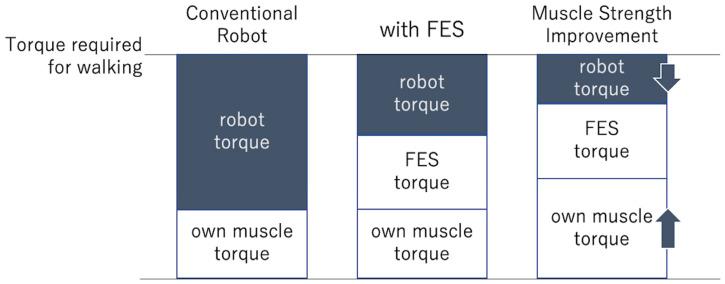
This study aimed to identify whether the combined use of functional electrical stimulation (FES) reduces the motor torque of a gait exercise rehabilitation robot in spinal cord injury (SCI) and to verify the effectiveness of the developed automatic assist level adjustment in people with paraplegia. Acute and chronic SCI patients (1 case each) performed 10 min of gait exercises with and without FES using a rehabilitation robot. Reinforcement learning was used to adjust the assist level automatically. The maximum torque values and assist levels for each of the ten walking cycles when walking became steady were averaged and compared with and without FES. The motor's output torque and the assist level were measured as outcomes. The assist level adjustment allowed both the motor torque and assist level to decrease gradually to a steady state. The motor torque and the assist levels were significantly lower with the FES than without the FES under steady conditions in both cases. No adverse events were reported. The combined use of FES attenuated the motor torque of a gait exercise rehabilitation robot for SCI. Automatic assistive level adjustment is also useful for spinal cord injuries.
本研究旨在确定功能性电刺激(FES)的联合使用是否会降低脊髓损伤(SCI)患者步态运动康复机器人的运动扭矩,并验证所开发的自动辅助水平调整对截瘫患者的有效性。急性和慢性SCI患者(各1例)使用康复机器人在有和没有FES的情况下进行了10分钟的步态训练。采用强化学习自动调整辅助水平。当步行稳定后,对十个步行周期中每个周期的最大扭矩值和辅助水平进行平均,并比较有和没有FES的情况。测量电机的输出扭矩和辅助水平作为结果。辅助水平调整使电机扭矩和辅助水平都逐渐降低至稳定状态。在两种情况下,稳定状态下有FES时的电机扭矩和辅助水平均显著低于没有FES时。未报告不良事件。FES的联合使用减弱了SCI患者步态运动康复机器人的运动扭矩。自动辅助水平调整对脊髓损伤也有用。

 Zotero 插件