
阿尔茨海默病神经炎症的新观点——关注肠道和口腔微生物群的作用。
Novelties on Neuroinflammation in Alzheimer's Disease-Focus on Gut and Oral Microbiota Involvement.
机构信息
Faculty of Medicine, University of Medicine and Pharmacy "Carol Davila", 020022 Bucharest, Romania.
Neuromuscular Rehabilitation Clinic Division, Clinical Emergency Hospital "Bagdasar-Arseni", 041915 Bucharest, Romania.
出版信息
Int J Mol Sci. 2024 Oct 19;25(20):11272. doi: 10.3390/ijms252011272.
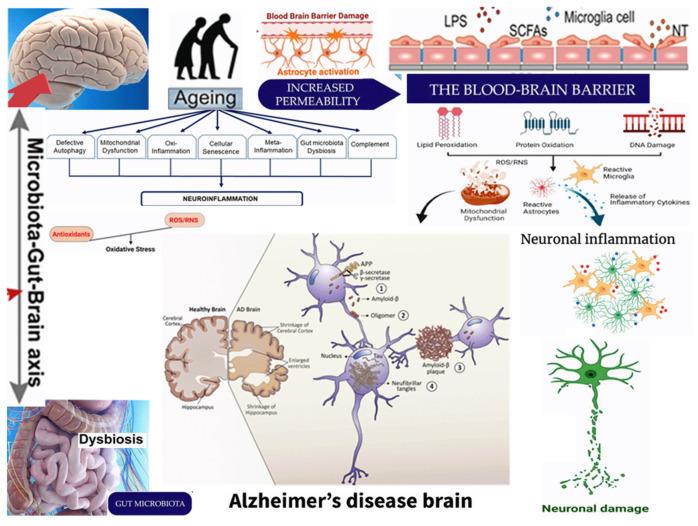
Recent studies underscore the role of gut and oral microbiota in influencing neuroinflammation through the microbiota-gut-brain axis, including in Alzheimer's disease (AD). This review aims to provide a comprehensive synthesis of recent findings on the involvement of gut and oral microbiota in the neuroinflammatory processes associated with AD, emphasizing novel insights and therapeutic implications. This review reveals that dysbiosis in AD patients' gut and oral microbiota is linked to heightened peripheral and central inflammatory responses. Specific bacterial taxa, such as Bacteroides and Firmicutes in the gut, as well as Porphyromonas gingivalis in the oral cavity, are notably altered in AD, leading to significant changes in microglial activation and cytokine production. Gut microbiota alterations are associated with increased intestinal permeability, facilitating the translocation of endotoxins like lipopolysaccharides (LPS) into the bloodstream and exacerbating neuroinflammation by activating the brain's toll-like receptor 4 (TLR4) pathways. Furthermore, microbiota-derived metabolites, including short-chain fatty acids (SCFAs) and amyloid peptides, can cross the blood-brain barrier and modulate neuroinflammatory responses. While microbial amyloids may contribute to amyloid-beta aggregation in the brain, certain SCFAs like butyrate exhibit anti-inflammatory properties, suggesting a potential therapeutic avenue to mitigate neuroinflammation. This review not only highlights the critical role of microbiota in AD pathology but also offers a ray of hope by suggesting that modulating gut and oral microbiota could represent a novel therapeutic strategy for reducing neuroinflammation and slowing disease progression.
最近的研究强调了肠道和口腔微生物群通过微生物群-肠-脑轴在影响神经炎症中的作用,包括在阿尔茨海默病(AD)中。本综述旨在综合最近关于肠道和口腔微生物群在与 AD 相关的神经炎症过程中的作用的研究结果,强调新的见解和治疗意义。本综述揭示了 AD 患者的肠道和口腔微生物群失调与外周和中枢炎症反应增强有关。特定的细菌分类群,如肠道中的拟杆菌和厚壁菌,以及口腔中的牙龈卟啉单胞菌,在 AD 中明显改变,导致小胶质细胞激活和细胞因子产生的显著变化。肠道微生物群的改变与肠道通透性增加有关,这使得内毒素(如脂多糖(LPS))更容易通过,通过激活大脑的 toll 样受体 4(TLR4)途径加剧神经炎症。此外,微生物衍生的代谢物,包括短链脂肪酸(SCFAs)和淀粉样肽,可以穿过血脑屏障并调节神经炎症反应。虽然微生物淀粉样蛋白可能有助于大脑中淀粉样蛋白-β的聚集,但某些 SCFAs,如丁酸盐,具有抗炎特性,这表明调节肠道和口腔微生物群可能是减轻神经炎症和减缓疾病进展的一种新的治疗策略。本综述不仅强调了微生物群在 AD 发病机制中的关键作用,还通过表明调节肠道和口腔微生物群可能代表一种减轻神经炎症和减缓疾病进展的新的治疗策略,为人们带来了一线希望。
 Zotero 插件