
与心力衰竭和冠状动脉疾病相关的肠道微生物群和代谢改变。
Gut Microbiota and Metabolic Alterations Associated with Heart Failure and Coronary Artery Disease.
机构信息
National Medical Research Center for Therapy and Preventive Medicine, Petroverigskyj Lane 10, Bld. 3, 101990 Moscow, Russia.
Federal State Budgetary Institution «Centre for Strategic Planning and Management of Biomedical Health Risks» of the Federal Medical and Biological Agency, Pogodinskaya Str., 10/1, 119121 Moscow, Russia.
出版信息
Int J Mol Sci. 2024 Oct 20;25(20):11295. doi: 10.3390/ijms252011295.
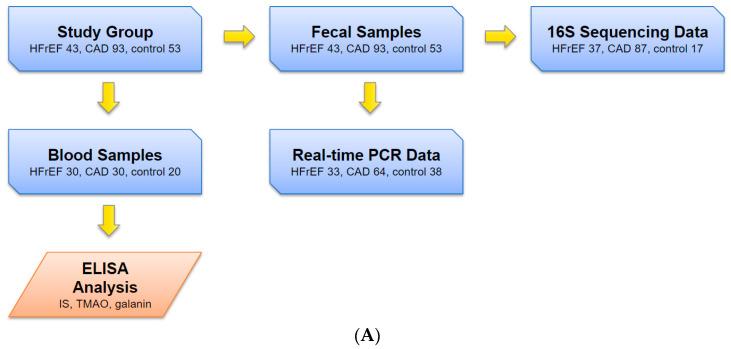
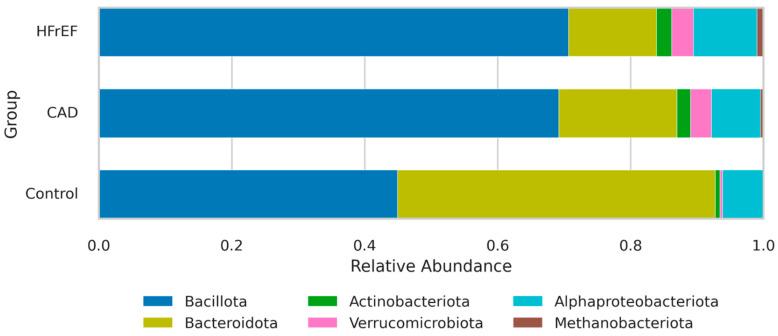
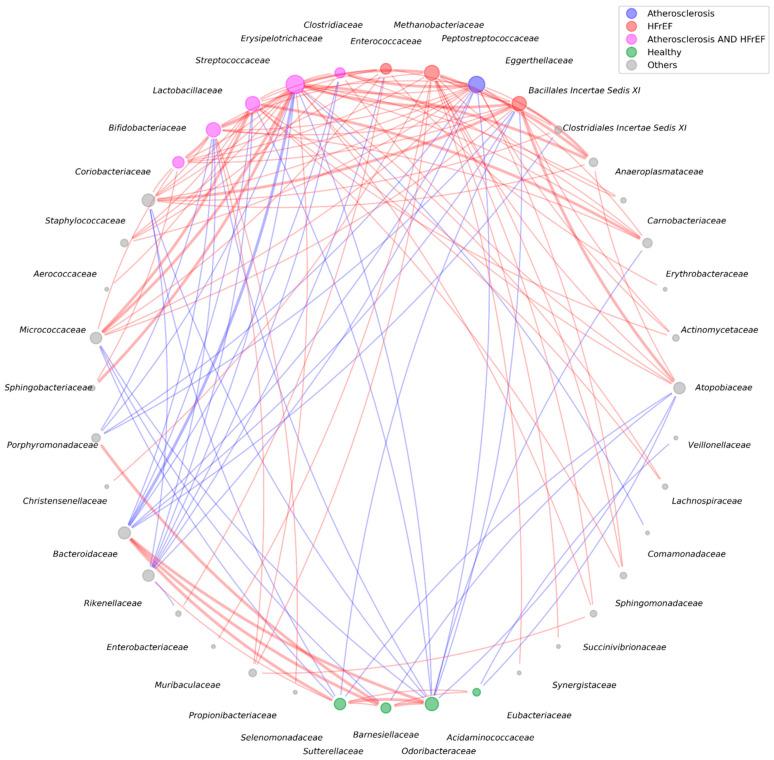
This study investigates the role of gut microbiota in cardiovascular diseases, with an additional focus on pro-atherogenic metabolites. We use advanced network analysis and machine learning techniques to identify key microbial features linked to coronary artery disease (CAD) and heart failure with reduced ejection fraction (HFrEF). This cross-sectional study included 189 participants divided into three groups: coronary artery disease ( = 93), heart failure with reduced ejection fraction ( = 43), and controls ( = 53). Assessments included physical exams, echocardiography, dietary surveys, blood analysis, and fecal analysis. Gut microbiota composition was analyzed using next-generation sequencing (NGS) and quantitative polymerase chain reaction (qPCR). Statistical analysis methods for testing hypotheses and correlations, alpha and beta-diversity analyses, co-occurrence networks, and machine learning were conducted using Python libraries or R packages with multiple comparisons corrected using the Benjamini-Hochberg procedure. Significant gut microbiota alterations were observed, with higher Bacillota/Bacteroidota ratios in CAD and HFrEF groups compared to controls ( < 0.001). Significant differences were observed in α-diversity indices (Pielou, Chao1, Faith) between disease groups and controls ( < 0.001). β-diversity analyses also revealed distinct microbial profiles ( = 0.0015). Interestingly, trimethylamine N-oxide (TMAO) levels were lower in CAD and HFrEF groups compared to controls ( < 0.05), while indoxyl sulfate (IS) levels were comparable between the study groups. Co-occurrence network analysis and machine learning identified key microbial features linked to these conditions, highlighting complex interactions within the gut microbiota associated with cardiovascular disease.
本研究探讨了肠道微生物群在心血管疾病中的作用,特别关注促动脉粥样硬化代谢物。我们使用先进的网络分析和机器学习技术来识别与冠状动脉疾病(CAD)和射血分数降低的心力衰竭(HFrEF)相关的关键微生物特征。这项横断面研究纳入了 189 名参与者,分为三组:冠状动脉疾病(n = 93)、射血分数降低的心力衰竭(n = 43)和对照组(n = 53)。评估包括体格检查、超声心动图、饮食调查、血液分析和粪便分析。使用下一代测序(NGS)和定量聚合酶链反应(qPCR)分析肠道微生物群组成。使用 Python 库或 R 包进行假设和相关性检验、α 和β多样性分析、共生网络和机器学习的统计分析方法,并使用 Benjamini-Hochberg 程序对多重比较进行校正。观察到显著的肠道微生物群改变,CAD 和 HFrEF 组的 Bacillota/Bacteroidota 比值高于对照组(<0.001)。疾病组和对照组之间的α多样性指数(Pielou、Chao1、Faith)存在显著差异(<0.001)。β多样性分析也揭示了不同的微生物谱(=0.0015)。有趣的是,CAD 和 HFrEF 组的三甲胺 N-氧化物(TMAO)水平低于对照组(<0.05),而吲哚硫酸酯(IS)水平在研究组之间相当。共生网络分析和机器学习确定了与这些疾病相关的关键微生物特征,突出了与心血管疾病相关的肠道微生物群内的复杂相互作用。



 Zotero 插件