
在胰腺癌患者的抽吸和液体活检中检测到的特定突变的预后作用。
Prognostic Role of Specific Mutations Detected in Aspiration and Liquid Biopsies from Patients with Pancreatic Cancer.
机构信息
Centre for Applied Genomics of Solid Tumors (CEGES), Genomac Research Institute, Drnovská 1112/60, 161 00 Prague, Czech Republic.
Department of Biochemistry, Faculty of Science, Charles University, Hlavova 8/2030, 128 00 Prague, Czech Republic.
出版信息
Genes (Basel). 2024 Oct 7;15(10):1302. doi: 10.3390/genes15101302.
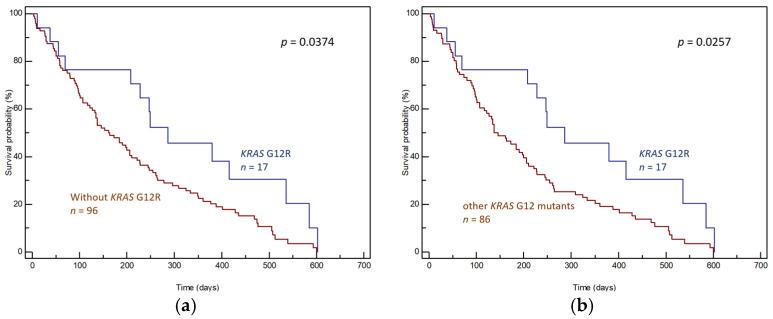
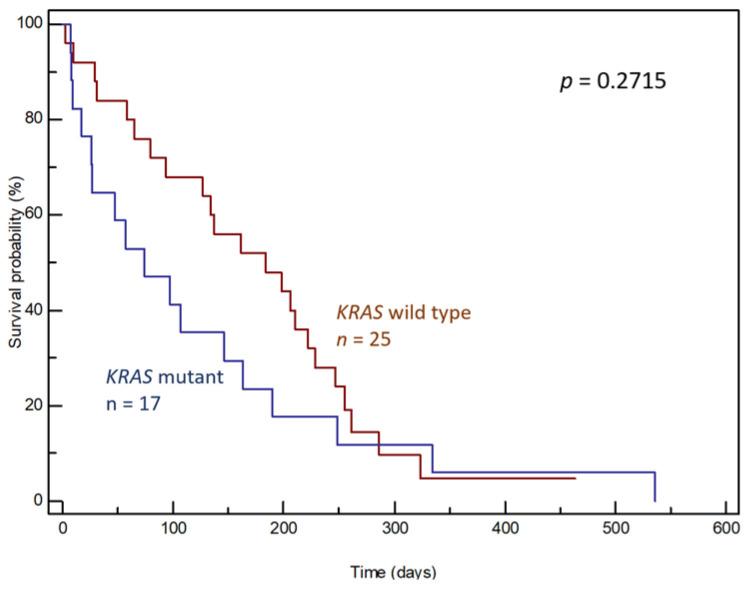
Although the overall survival prognosis of patients in advanced stages of pancreatic ductal adenocarcinoma (PDAC) is poor, typically ranging from days to months from diagnosis, there are rare cases of patients remaining in therapy for longer periods of time. Early estimations of survival prognosis would allow rational decisions on complex therapy interventions, including radical surgery and robust systemic therapy regimens. Understandably, there is great interest in finding prognostic markers that can be used for patient stratification. We determined the role of various mutations in the prognosis of PDAC patients using biopsy samples and circulating tumor DNA. A total of 118 patients with PDAC, clinically confirmed by endoscopic ultrasound-guided fine-needle aspiration biopsy (EUS-FNB), were included in the study. DNA was extracted from cytological slides following a standard cytology evaluation to ensure adequacy (viability and quantity) and to mark the tumor cell fraction. Circulating tumor DNA (ctDNA) was extracted from plasma samples of 45 patients in stage IV of the disease. mutations in exons 12 and 13 were detected by denaturing capillary electrophoresis (DCE), revealing a minute presence of mutation-specific heteroduplexes. Kaplan-Meier survival curves were calculated for individual mutation types. mutations were detected in 90% of tissue (106/118) and 44% of plasma (20/45) samples. All mutations were localized at exon 2, codon 12, with G12D (GGT > GAT) being the most frequent at 44% (47/106) and 65% (13/20), followed by other types including G12V (GGT > GTT) at 31% (33/106) and 10% (2/20), G12R (GGT > CGT) at 17% (18/106) and 10% (2/20), G12C (GGT/TGT) at 5% (5/106) and 0% (0/20) and G12S (GGT/AGT) at 1% (1/106) and 5% (1/20) in tissue and plasma samples, respectively. Two patients had two mutations simultaneously (G12V + G12S and G12D + G12S) in both types of samples (2%, 2/106 and 10%, 2/20 in tissue and plasma samples, respectively). The median survival of patients with the G12D mutation in tissues was less than half that of other patients (median survival 101 days, 95% CI: 80-600 vs. 228 days, 95% CI: 184-602), with a statistically significant overall difference in survival ( = 0.0080, log-rank test), and furthermore it was less than that of all combined patients with other mutation types (101 days, 95% CI: 80-600 vs. 210 days, 95% CI: 161-602, = 0.0166). For plasma samples, the survival of patients with this mutation was six times shorter than that of patients without the G12D mutation (27 days, 95% CI: 8-334 vs. 161 days, 95% CI: 107-536, = 0.0200). In contrast, patients with detected G12R in the tissue survived nearly twice as long as other patients in the aggregate (286 days, 95% CI: 70-602 vs. 162 days, 95% CI: 122-600, = 0.0374) or patients with other mutations (286 days, 95% CI: 70-602 vs. 137 days, 95% CI: 107-600, = 0.0257). Differentiation of specific mutations in EUS-FNB and ctDNA (above all, the crucial G12D and G12R) is feasible in routine management of PDAC patients and imperative for assessment of prognosis.
尽管晚期胰腺导管腺癌(PDAC)患者的总体生存预后较差,通常从诊断到死亡的时间为数天到数月,但仍有少数患者接受治疗的时间较长。早期预测生存预后可以为复杂的治疗干预提供合理的决策,包括根治性手术和强有力的系统治疗方案。可以理解的是,人们对寻找可以用于患者分层的预后标志物非常感兴趣。我们使用活检样本和循环肿瘤 DNA 来确定各种 突变在 PDAC 患者预后中的作用。
总共纳入了 118 例经内镜超声引导下细针穿刺活检(EUS-FNB)临床确诊的 PDAC 患者。对细胞学载玻片进行 DNA 提取,然后进行标准细胞学评估,以确保足够的(活力和数量)并标记肿瘤细胞分数。从 45 例疾病 IV 期的患者的血浆样本中提取循环肿瘤 DNA(ctDNA)。通过变性毛细管电泳(DCE)检测外显子 12 和 13 中的 突变,揭示了突变特异性异源双链体的微小存在。为每种 突变类型计算 Kaplan-Meier 生存曲线。在组织(106/118)和血浆(20/45)样本中均检测到 突变。所有突变均位于外显子 2,密码子 12,G12D(GGT > GAT)最常见,占 44%(47/106)和 65%(13/20),其次是其他类型,包括 G12V(GGT > GTT)占 31%(33/106)和 10%(2/20),G12R(GGT > CGT)占 17%(18/106)和 10%(2/20),G12C(GGT/TGT)占 5%(5/106)和 0%(0/20),G12S(GGT/AGT)占 1%(1/106)和 5%(1/20)。在组织和血浆样本中,各有 2 例患者同时存在两种突变(G12V + G12S 和 G12D + G12S),比例分别为 2%(2/106)和 10%(2/20)。组织中 G12D 突变患者的中位生存期短于其他患者(中位生存期 101 天,95%CI:80-600 vs. 228 天,95%CI:184-602),生存差异具有统计学意义(= 0.0080,对数秩检验),此外,它也短于所有其他突变类型的患者(101 天,95%CI:80-600 vs. 210 天,95%CI:161-602,= 0.0166)。对于血浆样本,该突变患者的生存时间是无 G12D 突变患者的六倍(27 天,95%CI:8-334 与 161 天,95%CI:107-536,= 0.0200)。相比之下,组织中检测到 G12R 的患者的生存时间几乎是其他患者总和的两倍(286 天,95%CI:70-602 与 162 天,95%CI:122-600,= 0.0374)或其他 突变患者(286 天,95%CI:70-602 与 137 天,95%CI:107-600,= 0.0257)。在 PDAC 患者的常规管理中,可以对 EUS-FNB 和 ctDNA 中的特定 突变(尤其是关键的 G12D 和 G12R)进行区分,这对于评估预后至关重要。


 Zotero 插件