
不同田径项目中运动诱导心脏重塑的见解
Insight on Exercise-Induced Heart Remodeling in Different Track and Field Disciplines.
作者信息
Di Gioia Giuseppe, Ferrera Armando, Vespasiano Francesca, Maestrini Viviana, Monosilio Sara, Lemme Erika, Serdoz Andrea, Mango Federica, Casciani Emanuele, Pelliccia Antonio, Squeo Maria Rosaria
机构信息
Institute of Sports Medicine and Science, National Italian Olympic Committee, Largo Piero Gabrielli, 1, 00197 Rome, Italy.
Department of Movement, Human and Health Sciences, University of Rome "Foro Italico", Piazza Lauro De Bosis, 15, 00135 Rome, Italy.
出版信息
J Clin Med. 2024 Oct 10;13(20):6027. doi: 10.3390/jcm13206027.
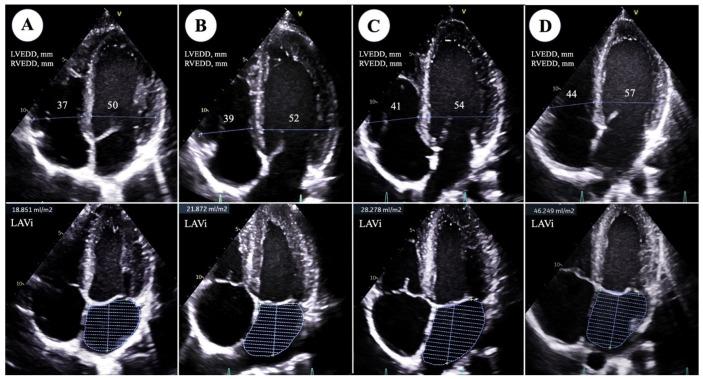
: The foot racing disciplines include sprints, middle distances, and long distances, which vary in terms of intensities, duration of training, and metabolic demands. The aim of our study was to evaluate the differences in morpho-functional parameters describing cardiac remodeling in a large cohort of Olympic athletes practicing the different track subspecialties. : We evaluated 140 track and field (52.1% males, mean age 26.3 ± 4.3 years) Olympic athletes divided into four groups according to the distance performed: Group A (46, 32.9%): 100 and 200 mt; Group B (34, 24.3%): 400 mt; Group C (25, 17.9%): 800, 1500, and 3000 mt; Group D (35, 24.9%): 5000, 10,000 mt, and marathon distance. The athletes underwent a pre-participation screening, which included transthoracic echocardiography and exercise stress testing. : In Group A and in Group B, most athletes presented normal cardiac geometry (41/46, 89.1% in Group A and 31/34, 91.2% in Group B, < 0.0001). Instead, in Groups C and D, more than half presented eccentric cardiac remodeling (13\25, 52% in Group C and 23\35, 65.7% in Group D). No significant differences were found between subspecialties in LVEF ( = 0.587), diastolic function ( = 0.431), and training hours/week ( = 0.078). : In conclusion, the presence and extent of cardiac remodeling vary according to the distance of the discipline practiced, with the largest dimensional increase in both left and right ventricles and atria in mid- and long-distance runners and the lowest in sprinters.
田径项目包括短跑、中距离跑和长距离跑,它们在强度、训练时长和代谢需求方面各不相同。我们研究的目的是评估一大批从事不同径赛专业的奥运运动员中心脏重塑的形态功能参数差异。我们评估了140名田径奥运运动员(52.1%为男性,平均年龄26.3±4.3岁),根据所跑距离分为四组:A组(46人,32.9%):100米和200米;B组(34人,24.3%):400米;C组(25人,17.9%):800米、1500米和3000米;D组(35人,24.9%):5000米、10000米和马拉松距离。这些运动员接受了赛前筛查,包括经胸超声心动图和运动负荷测试。在A组和B组中,大多数运动员心脏几何形态正常(A组41/46,89.1%;B组31/34,91.2%,P<0.0001)。相反,在C组和D组中,超过一半的运动员表现为离心性心脏重塑(C组13/25,52%;D组23/35,65.7%)。在左心室射血分数(P = 0.587)、舒张功能(P = 0.431)和每周训练时长(P = 0.078)方面,各专业之间未发现显著差异。总之,心脏重塑的存在和程度因所从事项目的距离而异,中长跑运动员左右心室及心房的尺寸增加最大,短跑运动员最小。

 Zotero 插件