
新型可变刚度髋关节外骨骼的设计与评估。
Design and Evaluation of a Novel Variable Stiffness Hip Joint Exoskeleton.
机构信息
School of Mechatronics Engineering, Harbin Institute of Technology, Harbin 150001, China.
School of Computer Science and Technology, Harbin Institute of Technology, Harbin 150001, China.
出版信息
Sensors (Basel). 2024 Oct 17;24(20):6693. doi: 10.3390/s24206693.
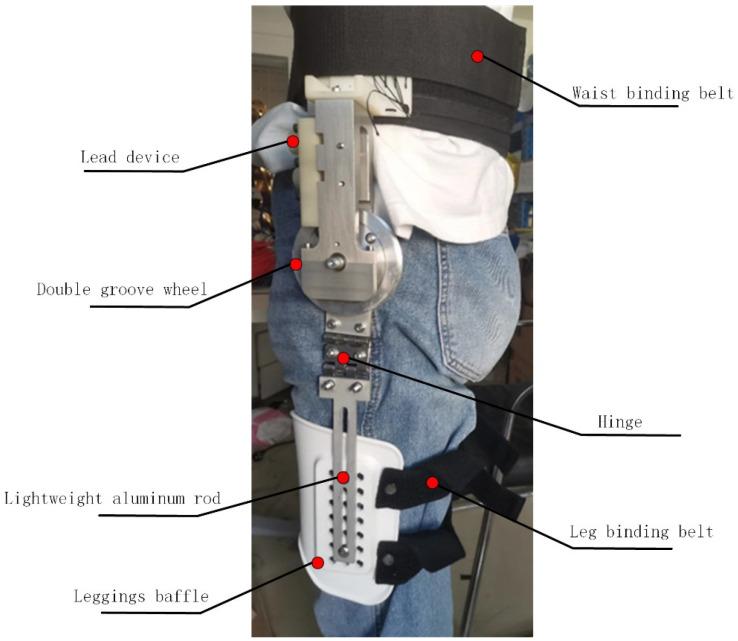
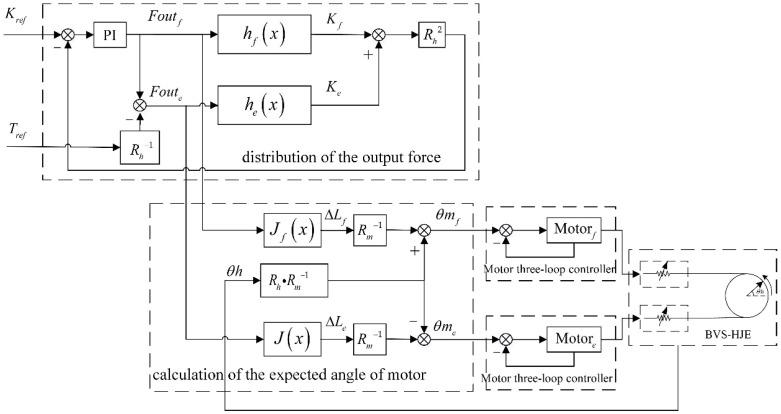
An exoskeleton is a wearable device with human-machine interaction characteristics. An ideal exoskeleton should have kinematic and kinetic characteristics similar to those of the wearer. Most traditional exoskeletons are driven by rigid actuators based on joint torque or position control algorithms. In order to achieve better human-robot interaction, flexible actuators have been introduced into exoskeletons. However, exoskeletons with fixed stiffness cannot adapt to changing stiffness requirements during assistance. In order to achieve collaborative control of stiffness and torque, a bionic variable stiffness hip joint exoskeleton (BVS-HJE) is designed in this article. The exoskeleton proposed in this article is inspired by the muscles that come in agonist-antagonist pairs, whose actuators are arranged in an antagonistic form on both sides of the hip joint. Compared with other exoskeletons, it has antagonistic actuators with variable stiffness mechanisms, which allow the stiffness control of the exoskeleton joint independent of force (or position) control. A BVS-HJE model was established to study its variable stiffness and static characteristics. Based on the characteristics of the BVS-HJE, a control strategy is proposed that can achieve independent adjustment of joint torque and joint stiffness. In addition, the variable stiffness mechanism can estimate the output force based on the established mathematical model through an encoder, thus eliminating the additional force sensors in the control process. Finally, the variable stiffness properties of the actuator and the controllability of joint stiffness and joint torque were verified through experiments.
外骨骼是一种具有人机交互特性的可穿戴设备。理想的外骨骼应具有与穿戴者相似的运动学和动力学特性。大多数传统外骨骼都是基于关节扭矩或位置控制算法由刚性致动器驱动的。为了实现更好的人机交互,已经将柔性致动器引入到外骨骼中。然而,具有固定刚度的外骨骼无法适应辅助过程中不断变化的刚度要求。为了实现刚度和扭矩的协同控制,本文设计了一种仿生可变刚度髋关节外骨骼(BVS-HJE)。本文提出的外骨骼受到协同作用的肌肉的启发,其致动器以髋关节两侧拮抗的形式布置。与其他外骨骼相比,它具有具有可变刚度机构的拮抗致动器,允许外骨骼关节的刚度控制独立于力(或位置)控制。建立了 BVS-HJE 模型来研究其变刚度和静态特性。基于 BVS-HJE 的特点,提出了一种控制策略,能够实现关节扭矩和关节刚度的独立调节。此外,可变刚度机构可以通过编码器根据建立的数学模型估计输出力,从而在控制过程中消除附加的力传感器。最后,通过实验验证了致动器的可变刚度特性以及关节刚度和关节扭矩的可控性。





 Zotero 插件