
亚单位重组新冠疫苗Betuvax-CoV-2单价和二价制剂对多种SARS-CoV-2毒株的中和能力比较分析
Comparative Analysis of the Neutralizing Capacity of Monovalent and Bivalent Formulations of Betuvax-CoV-2, a Subunit Recombinant COVID-19 Vaccine, Against Various Strains of SARS-CoV-2.
作者信息
Vakhrusheva Anna V, Romanovskaya-Romanko Ekaterina A, Stukova Marina A, Sukhova Maria M, Kuznetsova Ksenia S, Kudriavtsev Aleksandr V, Frolova Maria E, Ivanishin Taras V, Krasilnikov Igor V, Isaev Artur A
机构信息
Betuvax, 119571 Moscow, Russia.
Department of Vaccinology, Smorodintsev Research Institute of Influenza, Ministry of Health of the Russian Federation, 197376 Saint Petersburg, Russia.
出版信息
Vaccines (Basel). 2024 Oct 21;12(10):1200. doi: 10.3390/vaccines12101200.
UNLABELLED
SARS-CoV-2, the causal agent of the COVID-19 pandemic, is characterized by rapid evolution, which poses a significant public health challenge. Effective vaccines that provide robust protection, elicit strong immune responses, exhibit favorable safety profiles, and enable cost-effective large-scale production are crucial. The RBD-Fc-based Betuvax-CoV-2 vaccine has previously demonstrated a favorable safety profile and induced a significant anti-SARS-CoV-2 humoral immune response in clinical trials. Due to the rapid evolution and emergence of new SARS-CoV-2 strains, the relevance of bivalent vaccine formulations has increased.
METHODS
This study compared the neutralizing capacity of monovalent and bivalent vaccine formulations against different SARS-CoV-2 strains detected with a SARS-CoV-2 microneutralization assay (MNT).
FINDINGS
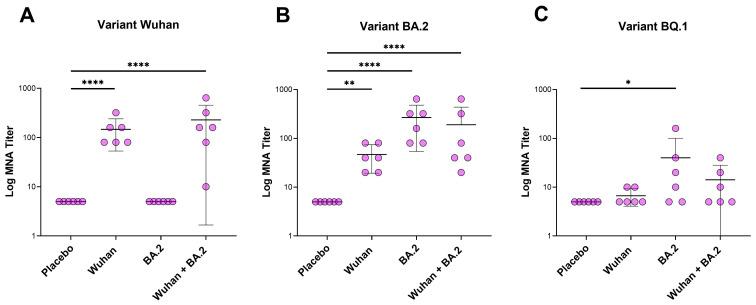
The monovalent Wuhan-based vaccine generated neutralizing antibodies against the Wuhan and Omicron BA.2 variants but not the distinct Omicron BQ.1 strain. Conversely, the monovalent BA.2-based vaccine induced neutralizing antibodies against both Omicron strains but not Wuhan. While the bivalent Wuhan and BA.2-based vaccine was effective against strains containing the same antigens, it was insufficient to neutralize the distinctive BQ.1 strain at a small dosage.
INTERPRETATION
These findings suggest that the vaccine composition should closely match the circulating SARS-CoV-2 strain to elicit the optimal neutralizing antibody response and include the appropriate dosage. Moreover, this study did not find additional advantages of using the bivalent form over the monovalent form for the vaccination against a single prevailing SARS-CoV-2 strain.
未标记
严重急性呼吸综合征冠状病毒2(SARS-CoV-2)是新冠疫情的病原体,其特点是快速进化,这对公共卫生构成了重大挑战。提供强大保护、引发强烈免疫反应、具有良好安全性且能实现具有成本效益的大规模生产的有效疫苗至关重要。基于受体结合域(RBD)-Fc的Betuvax-CoV-2疫苗此前在临床试验中已显示出良好的安全性,并诱导了显著的抗SARS-CoV-2体液免疫反应。由于SARS-CoV-2新毒株的快速进化和出现,二价疫苗配方的相关性增加。
方法
本研究使用SARS-CoV-2微量中和试验(MNT)比较了单价和二价疫苗配方对不同SARS-CoV-2毒株的中和能力。
结果
基于武汉毒株的单价疫苗产生了针对武汉和奥密克戎BA.2变体的中和抗体,但对不同的奥密克戎BQ.1毒株无效。相反,基于奥密克戎BA.2的单价疫苗诱导产生了针对两种奥密克戎毒株的中和抗体,但对武汉毒株无效。虽然基于武汉毒株和奥密克戎BA.2的二价疫苗对含有相同抗原的毒株有效,但小剂量时不足以中和独特的BQ.1毒株。
解读
这些发现表明,疫苗成分应与流行的SARS-CoV-2毒株紧密匹配,以引发最佳的中和抗体反应,并包括适当的剂量。此外,本研究未发现针对单一流行的SARS-CoV-2毒株接种时,二价形式比单价形式有额外优势。

 Zotero 插件