
日本新冠疫情期间严重心理困扰的现实世界预测因素:来自一项基于互联网的大规模队列研究的见解
Real-world predictors of severe psychological distress during the COVID-19 pandemic in Japan: Insights from a large-scale internet-based cohort study.
作者信息
Tokumitsu Keita, Sugawara Norio, Tabuchi Takahiro, Yasui-Furukori Norio
机构信息
Department of Neuropsychiatry, Towada City Hospital, Towada, Japan.
Department of Psychiatry, Dokkyo Medical University School of Medicine, Mibu, Japan.
出版信息
Neuropsychopharmacol Rep. 2024 Dec;44(4):798-808. doi: 10.1002/npr2.12495. Epub 2024 Oct 26.
AIM
The COVID-19 pandemic has had negative physical and psychological impacts worldwide. However, there has been a lack of real-world evidence concerning the predictors of severe psychological distress (SPD) among the general population in Japan during the COVID-19 pandemic. The aim of this study was to examine predictors of SPD during the COVID-19 pandemic.
METHODS
We investigated the predictors of new-onset SPD in the general Japanese population using data from a large-scale internet-based cohort study.
RESULTS
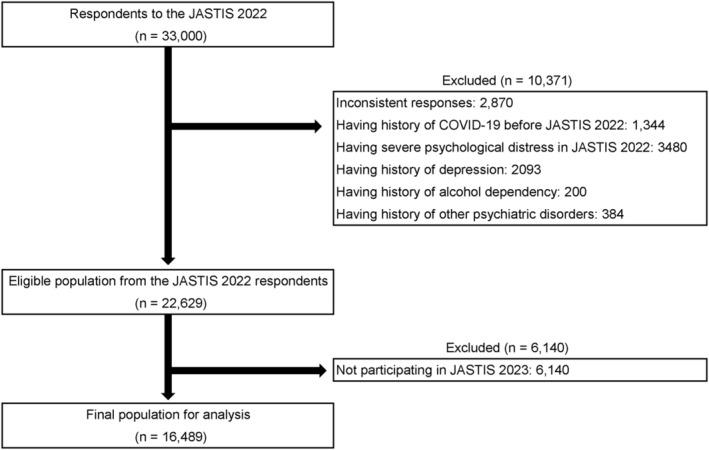
We included 16 489 study participants (age range = 16-81, mean age = 52.7, percentage of male = 50%) in the analysis. Over the course of 1 year from baseline, the estimated proportion of participants who experienced SPD was 5.2% with inverse probability weighting. The predictors of SPD included younger age, being never married, being unemployed, having a higher education background, scoring higher on the Fear of Coronavirus-19 Scale, experiencing more adverse childhood experiences, reporting poorer subjective health status, and COVID-19 with oxygen therapy. Our internet-based survey of the Japanese population may have selection bias, limiting the generalizability to other countries and cultures.
CONCLUSION
This study revealed that being afflicted with COVID-19 requiring oxygen therapy is the most significant predictor of SPD. In addition, we found that vulnerability to social isolation, such as never being unmarried, anxiety toward COVID-19, and susceptibility to stress, are predictors of the emergence of SPD. Therefore, the implementation of online support systems and ensuring access to accurate information may protect against SPD during the COVID-19 pandemic in Japan.
目的
新冠疫情在全球范围内对身体和心理产生了负面影响。然而,在新冠疫情期间,日本普通人群中严重心理困扰(SPD)的预测因素缺乏实际证据。本研究的目的是调查新冠疫情期间SPD的预测因素。
方法
我们使用来自一项大规模基于互联网的队列研究的数据,调查了日本普通人群中新发SPD的预测因素。
结果
我们纳入了16489名研究参与者(年龄范围=16 - 81岁,平均年龄=52.7岁,男性比例=50%)进行分析。从基线开始的1年时间里,采用逆概率加权法估计,经历SPD的参与者比例为5.2%。SPD的预测因素包括年龄较小、从未结婚、失业、具有较高的教育背景、在冠状病毒恐惧量表上得分较高、经历更多不良童年经历、主观健康状况较差以及因新冠接受氧疗。我们基于互联网对日本人群的调查可能存在选择偏差,限制了其对其他国家和文化的普遍性。
结论
本研究表明,因新冠需要氧疗是SPD最显著的预测因素。此外,我们发现易受社会隔离影响,如从未结婚、对新冠的焦虑以及对应激的易感性,是SPD出现的预测因素。因此,在日本新冠疫情期间,实施在线支持系统并确保获取准确信息可能预防SPD。
 Zotero 插件