
韧性之壁:肠道上皮如何预防肠道炎症侵袭
Wall of Resilience: How the Intestinal Epithelium Prevents Inflammatory Onslaught in the Gut.
作者信息
Liebing Eva, Krug Susanne M, Neurath Markus F, Siegmund Britta, Becker Christoph
机构信息
Department of Medicine 1, Universitätsklinikum Erlangen, Friedrich-Alexander-Universität Erlangen-Nürnberg, Erlangen, Germany; Deutsches Zentrum Immuntherapie, Erlangen, Germany.
Clinical Physiology/Nutritional Medicine, Charité-Universitätsmedizin Berlin corporate member of Freie Universität Berlin and Humboldt-Universität zu Berlin, Berlin, Germany.
出版信息
Cell Mol Gastroenterol Hepatol. 2025;19(2):101423. doi: 10.1016/j.jcmgh.2024.101423. Epub 2024 Oct 24.
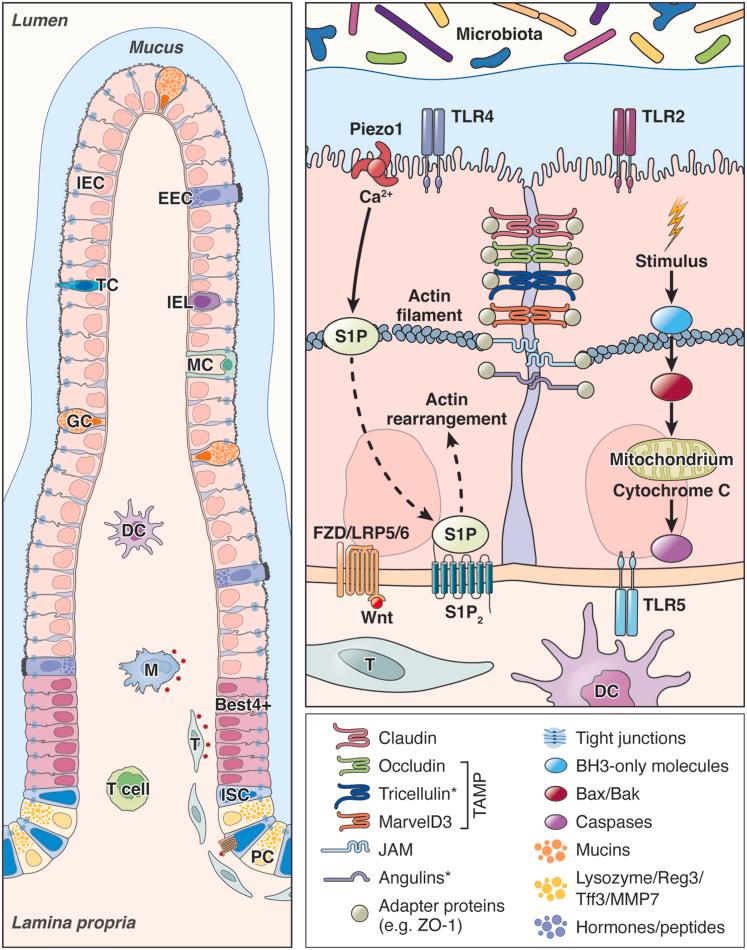
The intestinal epithelium forms the boundary between the intestinal immune system in the lamina propria and the outside world, the intestinal lumen, which contains a diverse array of microbial and environmental antigens. Composed of specialized cells, this epithelial monolayer has an exceptional turnover rate. Differentiated epithelial cells are released into the intestinal lumen within a few days, at the villus tip, a process that requires strict regulation. Dysfunction of the epithelial barrier increases the intestinal permeability and paves the way for luminal antigens to pass into the intestinal serosa. Stem cells at the bottom of Lieberkühn crypts provide a constant supply of mature epithelial cells. Differentiated intestinal epithelial cells exhibit a diverse array of mechanisms that enable communication with surrounding cells, fortification against microorganisms, and orchestration of nutrient absorption and hormonal balance. Furthermore, tight junctions regulate paracellular permeability properties, and their disruption can lead to an impairment of the intestinal barrier, allowing inflammation to develop or further progress. Intestinal epithelial cells provide a communication platform through which they maintain homeostasis with a spectrum of entities including immune cells, neuronal cells, and connective tissue cells. This homeostasis can be disrupted in disease, such as inflammatory bowel disease. Patients suffering from inflammatory bowel disease show an impaired gut barrier, dysregulated cellular communication, and aberrant proliferation and demise of cells. This review summarizes the individual cellular and molecular mechanisms pivotal for upholding the integrity of the intestinal epithelial barrier and shows how these can be disrupted in diseases, such as inflammatory bowel disease.
肠上皮构成了固有层中肠道免疫系统与外部世界(即肠腔)之间的边界,肠腔中含有各种各样的微生物和环境抗原。由特殊细胞组成的这一单层上皮具有极高的更新率。分化的上皮细胞在数天内于绒毛顶端被释放到肠腔中,这一过程需要严格调控。上皮屏障功能障碍会增加肠道通透性,为管腔抗原进入肠浆膜铺平道路。利伯kühn隐窝底部的干细胞持续供应成熟上皮细胞。分化的肠道上皮细胞展现出多种机制,能够与周围细胞进行通讯、抵御微生物以及协调营养吸收和激素平衡。此外,紧密连接调节细胞旁通透性特性,其破坏会导致肠道屏障受损,使炎症发展或进一步恶化。肠道上皮细胞提供了一个通讯平台,通过该平台它们与包括免疫细胞、神经细胞和结缔组织细胞在内的一系列细胞维持体内平衡。这种体内平衡在诸如炎症性肠病等疾病中可能会被破坏。患有炎症性肠病的患者表现出肠道屏障受损、细胞通讯失调以及细胞异常增殖和死亡。本综述总结了维持肠上皮屏障完整性的关键细胞和分子机制,并展示了这些机制在诸如炎症性肠病等疾病中是如何被破坏的。
 Zotero 插件