
靶向支气管扩张症中的中性粒细胞丝氨酸蛋白酶
Targeting neutrophil serine proteases in bronchiectasis.
作者信息
Chalmers James D, Mall Marcus A, Chotirmall Sanjay H, O'Donnell Anne E, Flume Patrick A, Hasegawa Naoki, Ringshausen Felix C, Watz Henrik, Xu Jin-Fu, Shteinberg Michal, McShane Pamela J
机构信息
Division of Respiratory Medicine and Gastroenterology, University of Dundee, Dundee, UK.
J.D. Chalmers and M.A. Mall are joint first authors.
出版信息
Eur Respir J. 2025 Jan 2;65(1). doi: 10.1183/13993003.01050-2024. Print 2025 Jan.
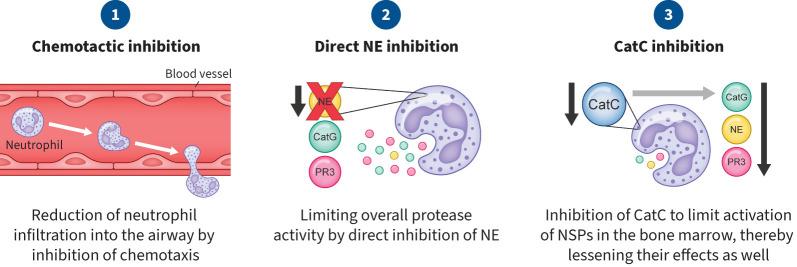
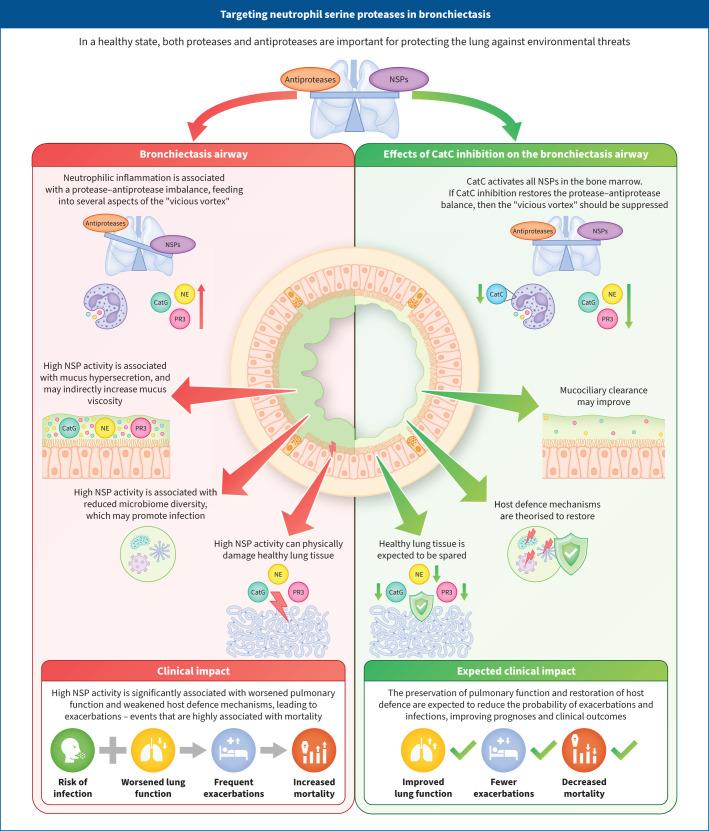
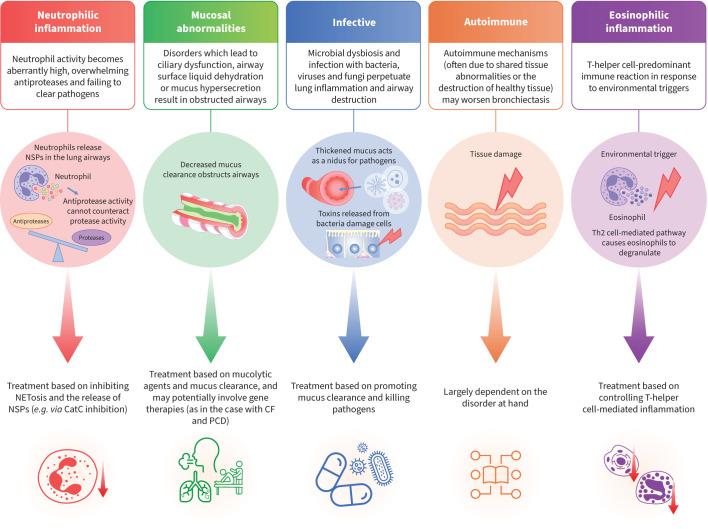
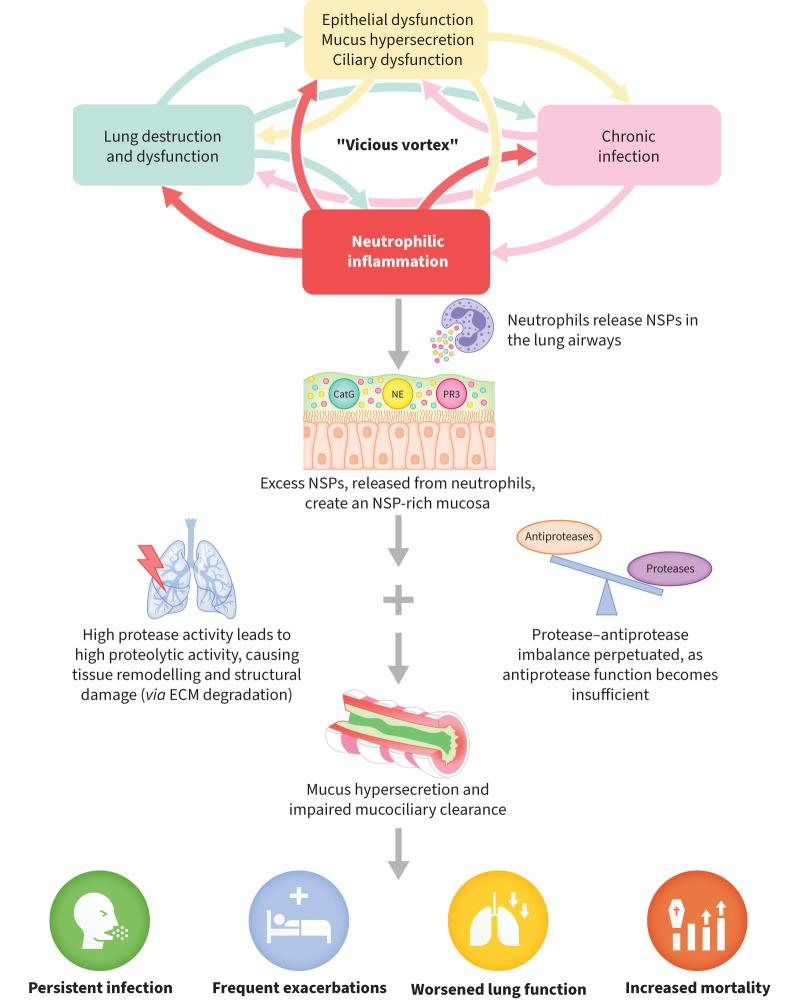
Persistent neutrophilic inflammation is a central feature in both the pathogenesis and progression of bronchiectasis. Neutrophils release neutrophil serine proteases (NSPs), such as neutrophil elastase (NE), cathepsin G and proteinase 3. When chronically high levels of free NSP activity exceed those of protective antiproteases, structural lung destruction, mucosal-related defects, further susceptibility to infection and worsening of clinical outcomes can occur. Despite the defined role of prolonged, high levels of NSPs in bronchiectasis, no drug that controls neutrophilic inflammation is licensed for the treatment of bronchiectasis. Previous methods of suppressing neutrophilic inflammation (such as direct inhibition of NE) have not been successful; however, an emerging therapy designed to address neutrophil-mediated pathology, inhibition of the cysteine protease cathepsin C (CatC, also known as dipeptidyl peptidase 1), is a promising approach to ameliorate neutrophilic inflammation, since this may reduce the activity of all NSPs implicated in bronchiectasis pathogenesis, and not just NE. Current data suggest that CatC inhibition may effectively restore the protease-antiprotease balance in bronchiectasis and improve disease outcomes as a result. Clinical trials for CatC inhibitors in bronchiectasis have reported positive phase III results. In this narrative review, we discuss the role of high NSP activity in bronchiectasis, and how this feature drives the associated morbidity and mortality seen in bronchiectasis. This review discusses therapeutic approaches aimed at treating neutrophilic inflammation in the bronchiectasis lung, summarising clinical trial outcomes and highlighting the need for more treatment strategies that effectively address chronic neutrophilic inflammation in bronchiectasis.
持续性中性粒细胞炎症是支气管扩张症发病机制和病情进展的核心特征。中性粒细胞会释放中性粒细胞丝氨酸蛋白酶(NSPs),如中性粒细胞弹性蛋白酶(NE)、组织蛋白酶G和蛋白酶3。当游离NSP活性长期处于高水平且超过保护性抗蛋白酶的活性时,就会导致肺结构破坏、黏膜相关缺陷、进一步易受感染以及临床预后恶化。尽管已明确高水平的NSPs在支气管扩张症中持续存在所起的作用,但尚无用于治疗支气管扩张症的控制中性粒细胞炎症的药物获得许可。以往抑制中性粒细胞炎症的方法(如直接抑制NE)均未成功;然而,一种旨在解决中性粒细胞介导的病理问题的新兴疗法——抑制半胱氨酸蛋白酶组织蛋白酶C(CatC,也称为二肽基肽酶1),是改善中性粒细胞炎症的一种有前景的方法,因为这可能降低与支气管扩张症发病机制相关的所有NSPs的活性,而不仅仅是NE。目前的数据表明,抑制CatC可能有效恢复支气管扩张症中的蛋白酶-抗蛋白酶平衡,并改善疾病预后。支气管扩张症中CatC抑制剂的临床试验已报告了积极的III期结果。在这篇叙述性综述中,我们讨论了高NSP活性在支气管扩张症中的作用,以及这一特征如何导致支气管扩张症中出现的相关发病率和死亡率。本综述讨论了旨在治疗支气管扩张症肺部中性粒细胞炎症的治疗方法,总结了临床试验结果,并强调需要更多有效解决支气管扩张症慢性中性粒细胞炎症的治疗策略。

 Zotero 插件