
COVID-19 死亡率中的性别和种族交叉问题以及马萨诸塞州疫苗接种不公平现象。
Intersectionality of sex and race in COVID-19 mortality and vaccination inequities in Massachusetts.
机构信息
Boston College Connell School of Nursing, Maloney Hall, 140 Commonwealth Ave, Chestnut Hill, MA, 02467, USA.
出版信息
BMC Public Health. 2024 Oct 29;24(1):2987. doi: 10.1186/s12889-024-20340-z.
BACKGROUND
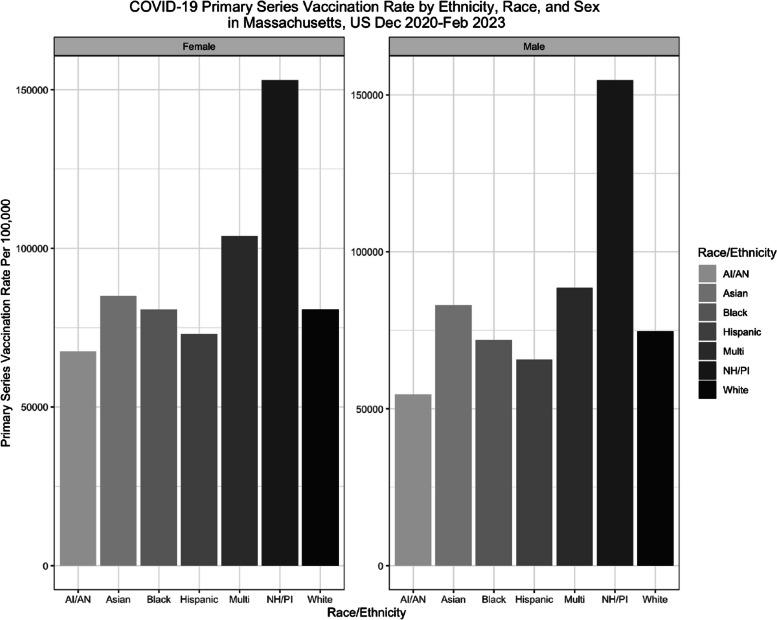
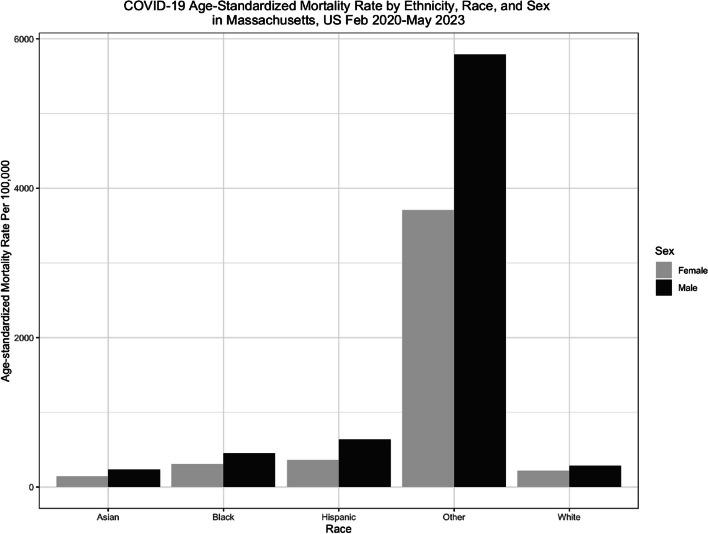
Inequities in COVID-19 incidence, morbidity, and mortality between racial and ethnic groups in the United States (U.S.) have been documented since the start of the pandemic in early 2020. Similarly, disparities by sex for COVID-19 morbidity and mortality have emerged, with men dying at a higher rate than women. Little research has been done to understand how the intersection of sex and race impacts COVID-19 inequities in Massachusetts (MA). This cross-sectional study examined how COVID-19 mortality rates (February 2020- May 2023) and vaccination rates (December 2020-February 2023) varied by sex across racial groups in MA.
METHODS
Using Massachusetts Department of Public Health data of all COVID-19 mortality cases and primary series vaccinations in MA from 2020 to 2023, we calculated both age-specific and age-adjusted COVID-19 mortality rates in order to account for differences in age distributions across sex-race groups.
RESULTS
Overall, men across all age-race groups consistently had a higher mortality rate compared to their female counterparts. The age-standardized mortality rate difference between White men and White women is the smallest, with the rate for White men being 1.3 times higher than White women. The age-standardized mortality rate between Hispanic men and Hispanic women varies the largest, with the rate for Hispanic men being 1.7 times higher than Hispanic women. Notably, Black women and White women have similar vaccination rates, yet the age-standardized mortality rate for Black women is 1.4 times the rate of White women.
CONCLUSIONS
Our findings show that there are disparities at the intersection of sex and race for COVID-19 mortality and vaccination in MA. This highlights the importance for targeted COVID-19 interventions at the intersection of sex and race and the need for detailed COVID-19 reporting by sex within race groups.
背景
自 2020 年初大流行开始以来,美国(U.S.)不同种族和族裔群体之间的 COVID-19 发病率、发病率和死亡率存在不平等现象。同样,COVID-19 发病率和死亡率也出现了性别差异,男性的死亡率高于女性。很少有研究致力于了解性和种族的交叉如何影响马萨诸塞州(MA)的 COVID-19 不平等现象。本横断面研究检查了 2020 年 2 月至 2023 年 5 月期间,COVID-19 死亡率(2020 年 2 月至 2023 年 5 月)和疫苗接种率(2020 年 12 月至 2023 年 2 月)如何因 MA 中不同种族群体的性别而异。
方法
使用马萨诸塞州公共卫生部 2020 年至 2023 年期间马萨诸塞州所有 COVID-19 死亡病例和初级系列疫苗接种的数据,我们计算了特定年龄和年龄调整后的 COVID-19 死亡率,以说明性别-种族群体之间年龄分布的差异。
结果
总体而言,所有年龄-种族群体中的男性死亡率始终高于女性。白人男性和白人女性之间的标准化死亡率差异最小,白人男性的死亡率是白人女性的 1.3 倍。西班牙裔男性和西班牙裔女性之间的标准化死亡率差异最大,西班牙裔男性的死亡率是西班牙裔女性的 1.7 倍。值得注意的是,黑人女性和白人女性的疫苗接种率相似,但黑人女性的标准化死亡率是白人女性的 1.4 倍。
结论
我们的研究结果表明,马萨诸塞州 COVID-19 死亡率和疫苗接种率在性别和种族的交叉点存在差异。这突显了在性别和种族的交叉点进行有针对性的 COVID-19 干预措施的重要性,以及按种族群体内的性别详细报告 COVID-19 的必要性。
 Zotero 插件