
三十年来,中东和北非(MENA)地区肝硬化和其他慢性肝病的负担。
The burden of cirrhosis and other chronic liver disease in the middle east and North Africa (MENA) region over three decades.
机构信息
Allegheny Health Network, Pittsburgh, PA, USA.
Cleveland Clinic Akron General, Akron, OH, USA.
出版信息
BMC Public Health. 2024 Oct 28;24(1):2979. doi: 10.1186/s12889-024-20445-5.
BACKGROUND
Cirrhosis comprises a significant health challenge in the Middle East and North African (MENA) region impacting healthcare systems and communities. This study sought to investigate trends in the burden of cirrhosis and other chronic liver disease, different etiologies, deaths, and the disability burden utilizing data from the Global Burden of Disease (GBD) database.
METHODS
Analyzing epidemiological trends from 1990 to 2021 across 21 MENA countries, this research utilized data on age-standardized incidence rates (ASIR), age-standardized death rates, and age-standardized disability-adjusted life years (DALYs) to evaluate the burden of cirrhosis and other chronic liver disease. The study also examined national variations and sociodemographic relationships.
RESULTS
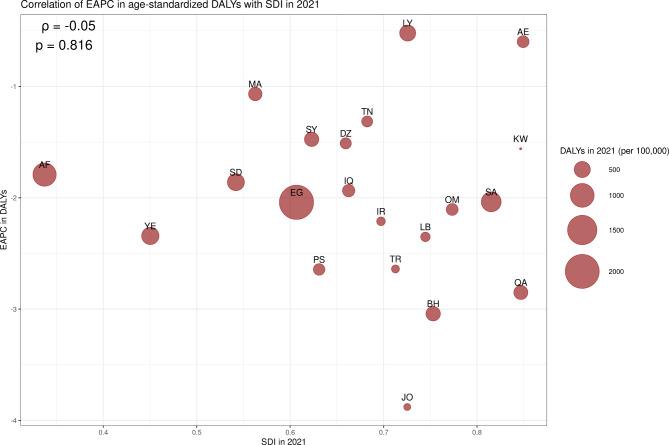
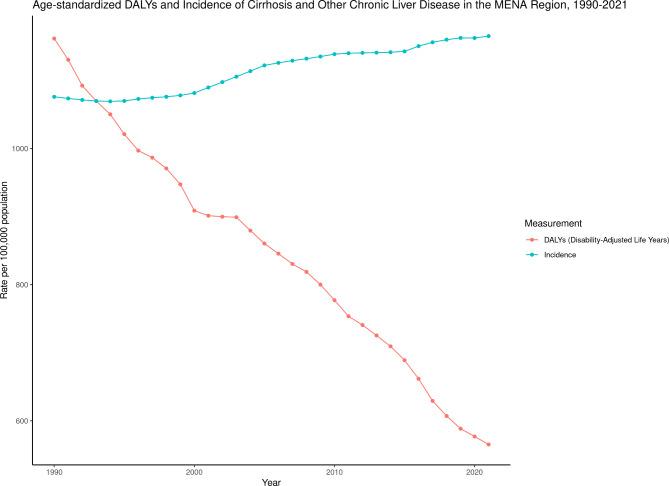
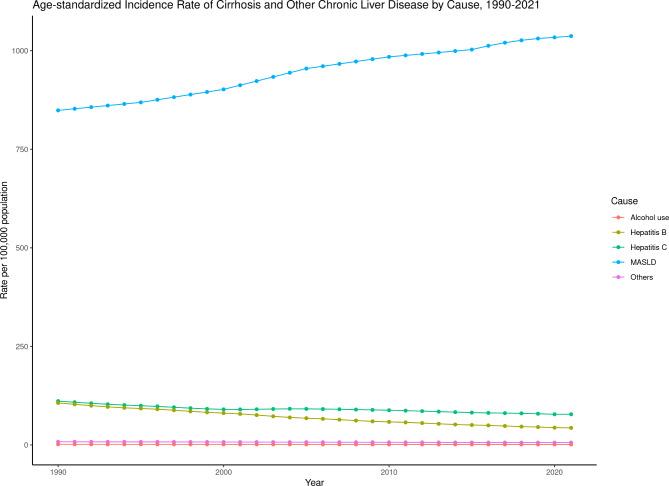
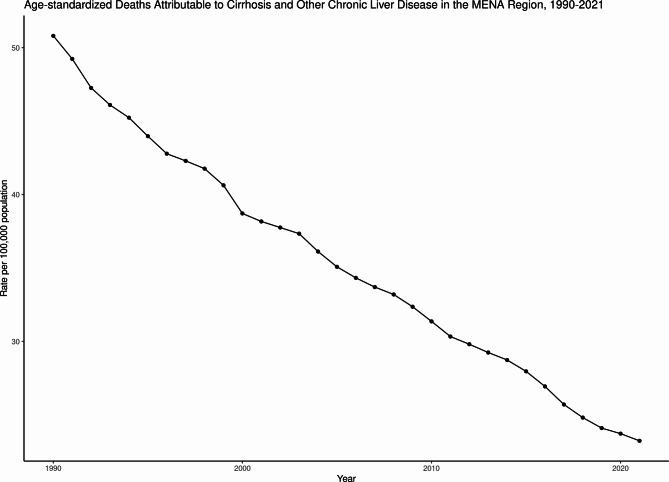
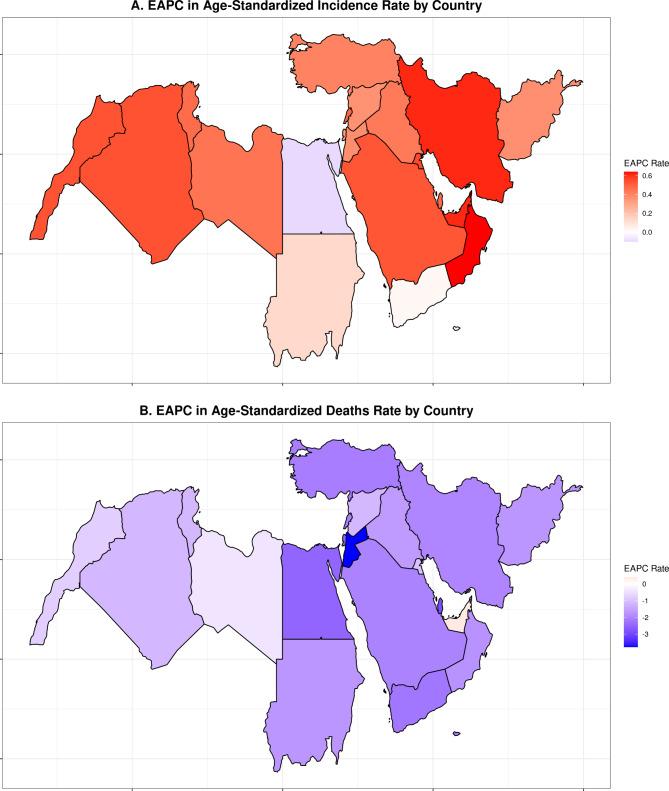
The study identified a 114.9% increase in cirrhosis and other chronic liver disease incidence within the MENA region between 1990 and 2021, with 7,344,030 incident cases reported in 2021. The ASIR showed a steeper rise in females (9.6%) compared to males (7.0%). Etiology-specific analysis revealed an increase in the ASIR for MASLD related cirrhosis and other chronic liver disease by 22.2%, while those due to alcohol as well as hepatitis B and C decreased by 28.1%, 59.3%, and 30%, respectively. Despite the rising incidence, overall age-standardized death rates across all etiologies decreased by 54.3%, with DALYs showing a 51.4% decrease during the same period. Country-specific trends varied significantly, with Oman recording the highest annual ASIR increase (0.64%), and Qatar observing the most substantial annual reduction in age-standardized death rates (-2.88%).
CONCLUSION
The study highlights evolving trends in cirrhosis and other chronic liver disease within the MENA region, emphasizing the necessity for comprehensive, etiology, and gender-specific interventions. Despite an increasing incidence, the observed improvements in mortality rates and age-standardized disability burden indicate progress in public health efforts to mitigate cirrhosis's impact. These findings point to the complex nature of cirrhosis outcomes and the urgent need for tailored strategies to manage its increasing burden effectively.
背景
肝硬化在中东和北非(MENA)地区是一个重大的健康挑战,影响着医疗保健系统和社区。本研究旨在利用全球疾病负担(GBD)数据库中的数据,调查肝硬化和其他慢性肝病的负担趋势、不同病因、死亡和残疾负担的变化。
方法
本研究分析了 1990 年至 2021 年 21 个 MENA 国家的流行病学趋势,利用年龄标准化发病率(ASIR)、年龄标准化死亡率和年龄标准化残疾调整生命年(DALY)的数据,评估肝硬化和其他慢性肝病的负担。该研究还检查了国家差异和社会人口统计学关系。
结果
研究发现,1990 年至 2021 年期间,MENA 地区肝硬化和其他慢性肝病的发病率增加了 114.9%,2021 年报告了 734.403 例新发病例。ASIR 显示女性(9.6%)的增长率高于男性(7.0%)。病因特异性分析显示,与 MASLD 相关的肝硬化和其他慢性肝病的 ASIR 增加了 22.2%,而由于酒精、乙型肝炎和丙型肝炎导致的肝硬化和其他慢性肝病的 ASIR 分别下降了 28.1%、59.3%和 30%。尽管发病率上升,但所有病因的年龄标准化死亡率总体下降了 54.3%,同期 DALY 下降了 51.4%。国家特定趋势差异显著,阿曼的年 ASIR 增长率最高(0.64%),卡塔尔的年龄标准化死亡率年降幅最大(-2.88%)。
结论
本研究强调了 MENA 地区肝硬化和其他慢性肝病的不断变化的趋势,强调了需要采取全面的、病因特异性和性别特异性干预措施。尽管发病率上升,但死亡率和年龄标准化残疾负担的改善表明,在减轻肝硬化影响的公共卫生努力方面取得了进展。这些发现表明了肝硬化结局的复杂性,迫切需要制定有针对性的策略来有效管理其日益增加的负担。

 Zotero 插件