
健康公平工程:为新一代医疗保健优化希望。
Health equity engineering: Optimizing hope for a new generation of healthcare.
作者信息
Enders Felicity T, Golembiewski Elizabeth H, Balls-Berry Joyce E, Brooks Tayla R, Carr Allison R, Cullen John P, DiazGranados Deborah, Gaba Ayorkor, Johnson Leigh, Menser Terri, Messinger Shari, Milam Adam J, Orellana Minerva A, Perkins Susan M, Pineda Tiffany D Chisholm, Thurston Sally W, Periyakoil Vyjeyanthi S, Hanlon Alexandra L
机构信息
Department of Quantitative Health Sciences, Mayo Clinic, Rochester, MN, USA.
Division of Endocrinology, Diabetes, Metabolism, and Nutrition, Mayo Clinic, Rochester, MN, USA.
出版信息
J Clin Transl Sci. 2024 May 23;8(1):e136. doi: 10.1017/cts.2024.549. eCollection 2024.
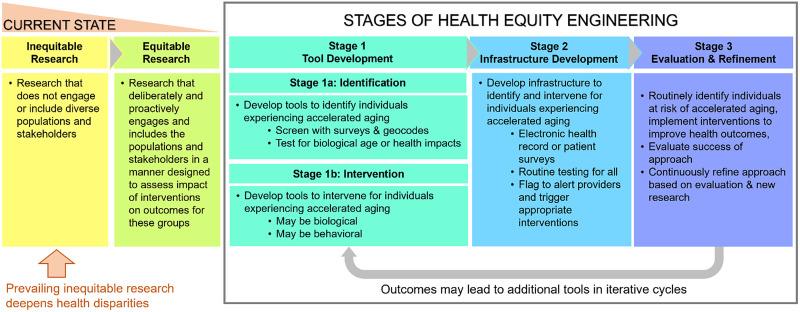
Medical researchers are increasingly prioritizing the inclusion of underserved communities in clinical studies. However, mere inclusion is not enough. People from underserved communities frequently experience chronic stress that may lead to accelerated biological aging and early morbidity and mortality. It is our hope and intent that the medical community come together to engineer improved health outcomes for vulnerable populations. Here, we introduce Health Equity Engineering (HEE), a comprehensive scientific framework to guide research on the development of tools to identify individuals at risk of poor health outcomes due to chronic stress, the integration of these tools within existing healthcare system infrastructures, and a robust assessment of their effectiveness and sustainability. HEE is anchored in the premise that strategic intervention at the individual level, tailored to the needs of the most at-risk people, can pave the way for achieving equitable health standards at a broader population level. HEE provides a scientific framework guiding health equity research to equip the medical community with a robust set of tools to enhance health equity for current and future generations.
医学研究人员越来越重视将服务不足的社区纳入临床研究。然而,仅仅纳入是不够的。来自服务不足社区的人们经常经历慢性压力,这可能导致生物衰老加速以及过早发病和死亡。我们希望并打算让医学界团结起来,为弱势群体设计出改善健康结果的方案。在此,我们引入健康公平工程(HEE),这是一个全面的科学框架,用于指导以下方面的研究:开发工具以识别因慢性压力而面临健康结果不佳风险的个体;将这些工具整合到现有的医疗系统基础设施中;以及对其有效性和可持续性进行有力评估。健康公平工程基于这样一个前提,即针对风险最高人群的需求在个体层面进行战略干预,可以为在更广泛的人群层面实现公平的健康标准铺平道路。健康公平工程提供了一个指导健康公平研究的科学框架,为医学界配备一套强大的工具,以增进当代人和后代人的健康公平。

 Zotero 插件