
通过整合RNA测序和单细胞RNA测序数据,鉴定 和 作为主动脉夹层中的两个枢纽基因并进行功能分析。 (你提供的原文中“Identifying and as two hub genes”这里有缺失信息,我按照完整的翻译逻辑进行了翻译,实际需根据完整准确的原文来确定具体所指基因)
Identifying and as two hub genes in aortic dissection and function analysis by integrating RNA sequencing and single-cell RNA sequencing data.
作者信息
Li Hai-Bing, Liu Chang, Mao Xiang-Di, Yuan Shu-Zheng, Li Li, Cong Xin
机构信息
Department of Physiology and Pathophysiology, State Key Laboratory of Vascular Homeostasis and Remodeling, Peking University School of Basic Medical Sciences, Beijing, China.
出版信息
Front Cardiovasc Med. 2024 Oct 16;11:1475991. doi: 10.3389/fcvm.2024.1475991. eCollection 2024.
OBJECTIVE
Aortic dissection (AD) is a severe aortic disease with high mortality, and its pathogenesis remains elusive. To explore the regulatory mechanisms of AD, we integrated public RNA sequencing (RNA-seq) and single-cell RNA sequencing (scRNA-seq) datasets to screen the hub genes of AD and further analyzed their functions, which may provide references to the diagnosis and treatment of AD.
METHODS
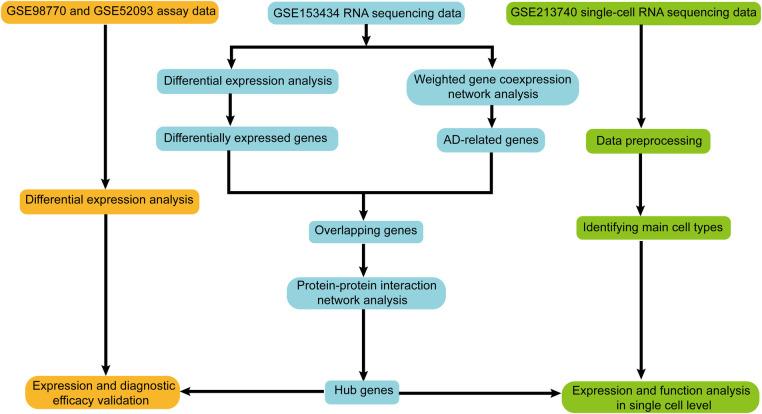
Four AD-related datasets were obtained from the Gene Expression Omnibus (GEO) database. Weighted gene co-expression network analysis and differential expression analysis were applied to identify overlapping genes in dataset GSE153434. Protein-protein interaction (PPI) network was constructed based on overlapping genes. Five methods (closeness, degree, EPC, MCC, and MNN) were used to pick hub genes. The receiver operating characteristic curve was used to evaluate the diagnostic efficiency of the hub genes in extra datasets GSE98770 and GSE52093. scRNA-seq dataset GSE213740 was used to explore the expression and function of the hub genes at the single-cell level. Quantitative real-time polymerase chain reaction was used to verify the expression of hub genes in beta-aminopropionitrile (BAPN)-induced mouse thoracic aortic aneurysm and dissection (TAAD) model.
RESULTS
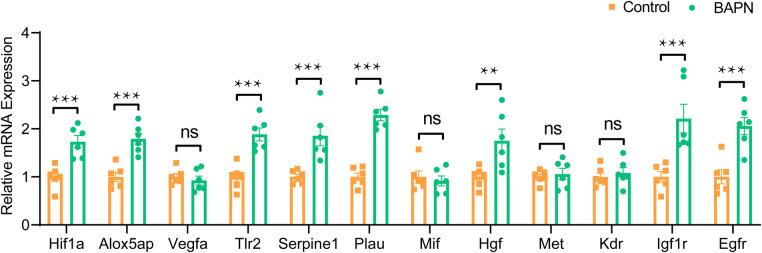
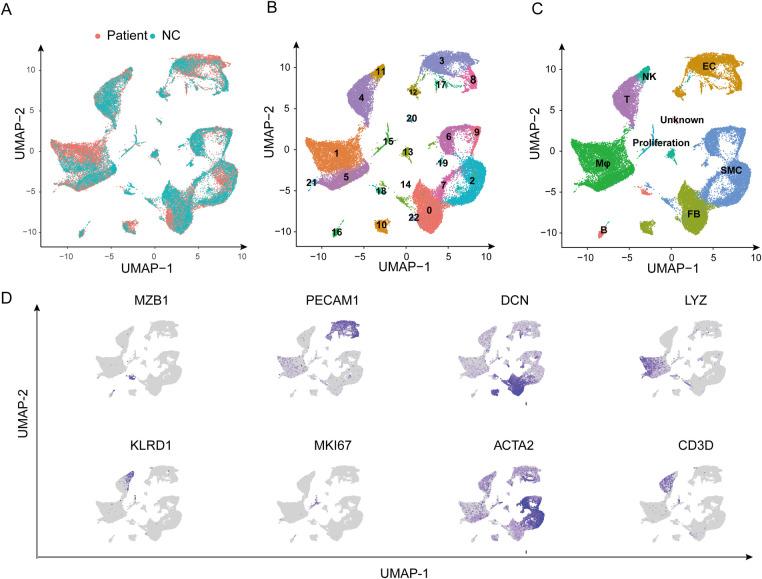
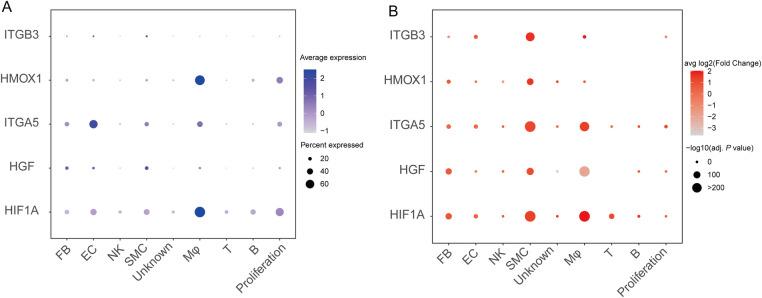
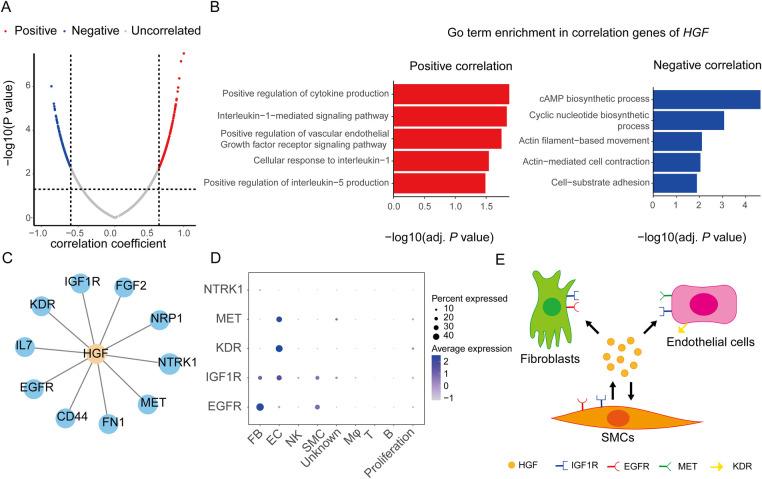
A total of 71 overlapping genes were screened by intersecting the significant genes in the pink module and the differentially expressed genes. A PPI network with 45 nodes and 74 edges was generated, and five top hub genes (, , , , and ) were identified. All the hub genes had area under the curve values above 0.55. scRNA-seq data analysis showed that was significantly upregulated in macrophages and was significantly upregulated in vascular smooth muscle cells (SMCs) of the ascending aortas in AD patients. HIF1A may transcriptionally regulate multiple downstream target genes involving inflammation (, , and ), glycolysis (, , and ), tissue remodeling (), and angiogenesis ( and ). HGF may participate in the signaling among SMCs, fibroblasts, and endothelial cells through binding to different receptors (MET, EGFR, IGF1R, and KDR). The mRNA expression of , , and their target genes, including , , , , , and , was significantly upregulated in aortic tissues of BAPN-treated mice.
CONCLUSION
By integrating RNA-seq and scRNA-seq data, we identified and as two hub genes with good diagnostic efficiency for AD. HIF1A in macrophages may promote AD formation by promoting inflammation, glycolysis, tissue remodeling, and angiogenesis, and HGF may mediate signaling among SMCs, fibroblasts, and endothelial cells in the development of AD.
目的
主动脉夹层(AD)是一种严重的主动脉疾病,死亡率高,其发病机制尚不清楚。为了探索AD的调控机制,我们整合了公共RNA测序(RNA-seq)和单细胞RNA测序(scRNA-seq)数据集,以筛选AD的关键基因,并进一步分析其功能,这可能为AD的诊断和治疗提供参考。
方法
从基因表达综合数据库(GEO)中获得四个与AD相关的数据集。应用加权基因共表达网络分析和差异表达分析,以识别数据集GSE153434中的重叠基因。基于重叠基因构建蛋白质-蛋白质相互作用(PPI)网络。使用五种方法(接近度、度、EPC、MCC和MNN)来挑选关键基因。受试者工作特征曲线用于评估关键基因在额外数据集GSE98770和GSE52093中的诊断效率。scRNA-seq数据集GSE213740用于在单细胞水平上探索关键基因的表达和功能。采用定量实时聚合酶链反应验证关键基因在β-氨基丙腈(BAPN)诱导的小鼠胸主动脉瘤和夹层(TAAD)模型中的表达。
结果
通过交叉粉色模块中的显著基因和差异表达基因,共筛选出71个重叠基因。生成了一个包含45个节点和74条边的PPI网络,并鉴定出五个顶级关键基因(、、、和)。所有关键基因的曲线下面积值均高于0.55。scRNA-seq数据分析表明,在巨噬细胞中显著上调,在AD患者升主动脉的血管平滑肌细胞(SMC)中显著上调。HIF1A可能转录调控多个下游靶基因,涉及炎症(、和)、糖酵解(、和)、组织重塑()和血管生成(和)。HGF可能通过与不同受体(MET、EGFR、IGF1R和KDR)结合,参与SMC、成纤维细胞和内皮细胞之间的信号传导。在BAPN处理的小鼠主动脉组织中,、及其靶基因(包括、、、、和)的mRNA表达显著上调。
结论
通过整合RNA-seq和scRNA-seq数据,我们鉴定出和是两个对AD具有良好诊断效率的关键基因。巨噬细胞中的HIF1A可能通过促进炎症、糖酵解、组织重塑和血管生成来促进AD的形成,而HGF可能在AD的发展中介导SMC、成纤维细胞和内皮细胞之间的信号传导。



 Zotero 插件