
智能扫描多囊卵巢综合征:一种使用机器学习和可解释人工智能对多囊卵巢综合征进行前沿预测的特征驱动方法。
SmartScanPCOS: A feature-driven approach to cutting-edge prediction of Polycystic Ovary Syndrome using Machine Learning and Explainable Artificial Intelligence.
作者信息
G Umaa Mahesswari, P Uma Maheswari
机构信息
Department of Computer Science and Engineering, College of Engineering Guindy, Anna University, Chennai, 600025, Tamil Nadu, India.
出版信息
Heliyon. 2024 Oct 11;10(20):e39205. doi: 10.1016/j.heliyon.2024.e39205. eCollection 2024 Oct 30.
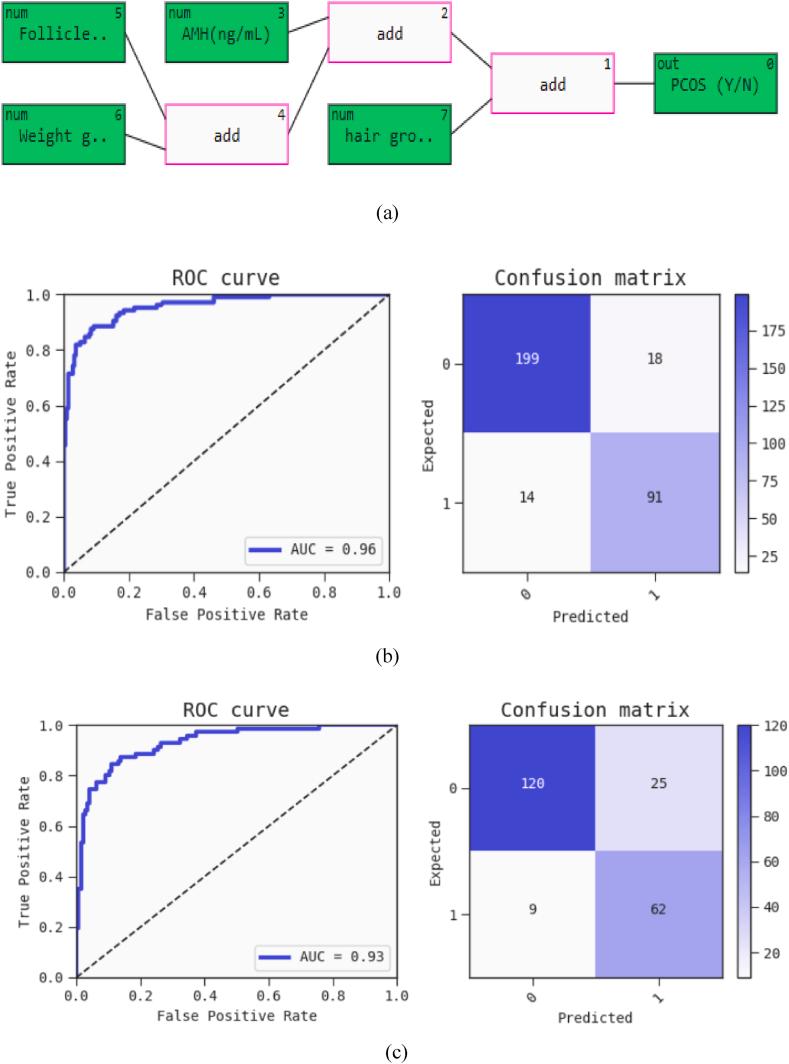
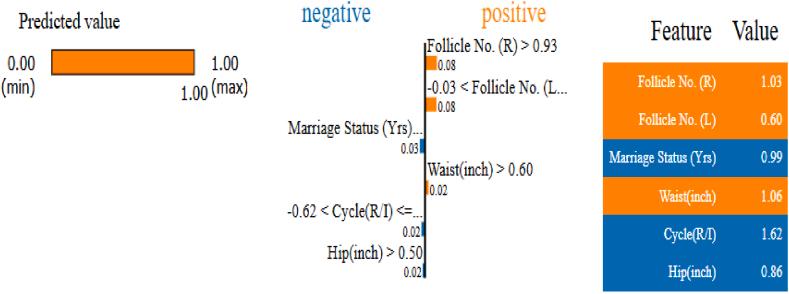
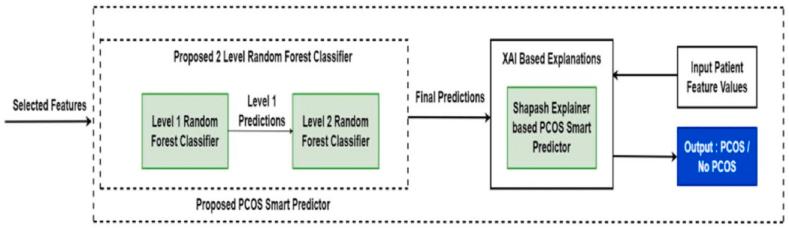
PolyCystic Ovarian Syndrome (PCOS) poses significant challenges to women's reproductive health due to its diagnostic complexity arising from a variety of symptoms, including hirsutism, anovulation, pain, obesity, hyperandrogenism, and oligomenorrhea, necessitating multiple clinical tests. Leveraging Artificial Intelligence (AI) in healthcare offers several benefits that can significantly impact patient care, streamline operations, and improve medical outcomes overall. This study presents an Explainable Artificial Intelligence (XAI)-driven PCOS smart predictor, structured as a hierarchical ensemble consisting of two tiers of Random Forest classifiers following extensive analysis of seven conventional classifiers and two additional stacking ensemble classifiers. An open-source data set comprising numerical parametric features linked to PCOS for classifier training was used. Moreover, to identify essential features for PCOS prediction three feature selection methods: Threshold-driven Optimized Principal Component Analysis (TOPCA), Optimized Salp Swarm (OSSM), and Threshold-driven Optimized Mutual Information Method (TOMIM) were fine-tuned through thresholding and improvisation to detect diverse attribute sets with varying numbers and combinations. Notably, the two-level Random Forest classifier model outperformed others with a remarkable 99.31 % accuracy by employing the top 17 features selected through the Threshold-driven Optimized Mutual Information Method (TOMIM) along with anoverallaccuracy of 99.32 % with 8 fold cross validation for 25 runs. The Smart predictor, constructed using Shapash - a Python library for Explainable Artificial Intelligence - was utilized to deploy the two-level Random Forest classifier model. Ensuring transparency and result reliability, visualizations from robust Explainable AI libraries were employed at different prediction stages for all considered classifiers in this study.
多囊卵巢综合征(PCOS)因其诊断复杂性给女性生殖健康带来重大挑战,其症状多样,包括多毛症、无排卵、疼痛、肥胖、高雄激素血症和月经过少,需要进行多项临床检查。在医疗保健中利用人工智能(AI)有诸多益处,可显著影响患者护理、简化操作并总体改善医疗结果。本研究提出了一种可解释人工智能(XAI)驱动的PCOS智能预测器,该预测器在对七个传统分类器和另外两个堆叠集成分类器进行广泛分析后,构建为一个由两层随机森林分类器组成的分层集成。使用了一个开源数据集,其中包含与PCOS相关的数值参数特征用于分类器训练。此外,为了确定PCOS预测的关键特征,通过阈值设定和改进对三种特征选择方法进行了微调:阈值驱动的优化主成分分析(TOPCA)、优化的鹈鹕群算法(OSSM)和阈值驱动的优化互信息方法(TOMIM),以检测具有不同数量和组合的不同属性集。值得注意的是,两级随机森林分类器模型表现优于其他模型,通过采用阈值驱动的优化互信息方法(TOMIM)选择的前17个特征,准确率达到了显著的99.31%,在25次运行的8折交叉验证中总体准确率为99.32%。使用Shapash(一个用于可解释人工智能的Python库)构建的智能预测器被用于部署两级随机森林分类器模型。为确保透明度和结果可靠性,在本研究中,针对所有考虑的分类器,在不同预测阶段采用了强大的可解释人工智能库的可视化方法。





 Zotero 插件